This manual is for HRM FPX 5120 Assessment 1, start to submission. The opening deliverable in Global Human Resource Practice usually asks you to put one management action against more than one legal system and report what changes, which means the paper is a comparison with a timeline attached rather than a tour of countries. The version our tutors see most often is a restructuring: the same number of roles removed from a site in each of two jurisdictions, with different notice, different payments, different people who have to be consulted first and a different amount of discretion left to the employer. The method, the structure and an annotated excerpt come next. Prefer somebody else drafted it? A premium original sample comes back in 24 to 48 hours, revised free until the criteria are met. Capella's catalog lists the course as HRM-FPX5120, and some courserooms print HRM5120; both point to this same Assessment 1.
One honesty note before the manual: Capella revises courses and scoring guides over time, so always write to the exact scoring guide attached to your assessment in the courseroom. The course identity above is verified on capella.edu; the method and structure below are our tutors' approach to it, not Capella's official rubric text.
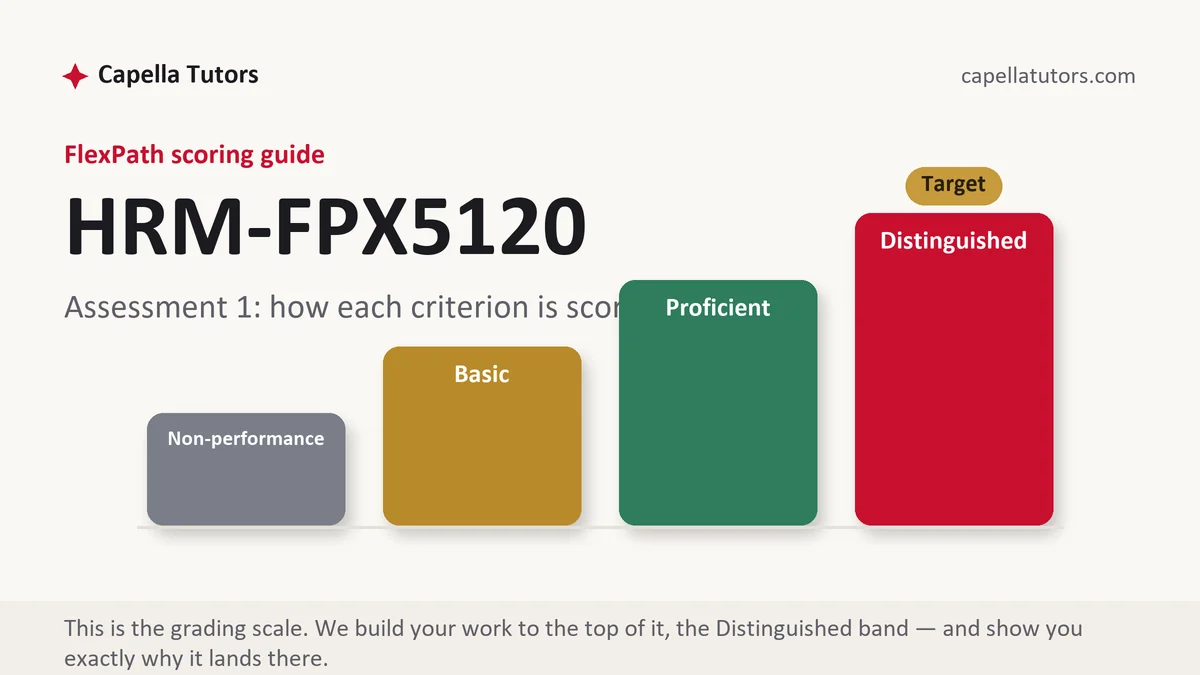
How HRM FPX 5120 Assessment 1 is scored
Every criterion resolves to one of four levels, and the top level sentence is the brief you are writing to:
| Level | What it means on a comparative jurisdictional deliverable |
|---|---|
| Distinguished | One action is held constant across the locations, each requirement is cited to the instrument that creates it and dated, the timeline shows consultation happening before the decision, and the cost and lead time are given as figures for each site. |
| Proficient | Both locations are described accurately and the differences are noted. Sound work that stops before the comparison does any analytical labor. |
| Basic | A country by country account with no shared action to compare, requirements characterized from secondary summaries, and culture offered where a statute belongs. |
| Non-performance | A required element is absent, most often the consultation obligation or the source and date for a notice or severance figure. |
Two jurisdictions analyzed to the instrument outscore six sketched in a paragraph each.
The HRM FPX 5120 Assessment 1 method, step by step
-
Choose the pair on sourcing and contrast
Pick one location whose labor ministry publishes guidance you can actually read and one that differs structurally rather than cosmetically. A shared services center with 62 roles in the United States and 48 roles at a site inside the European Union gives you a real comparison.
-
Hold the action constant
Define the single decision precisely: eliminate the roles, close the function, transfer the work to a third location, effective on one date. Then run that identical decision through each system.
-
Cite the instrument, not the article about the instrument
On the American side the notification duty comes from the Worker Adjustment and Retraining Notification Act of 1988, with its own coverage tests on employer size and the number affected at a single site, and several states impose their own additional requirements. On the European side the collective redundancy framework in Council Directive 98/59/EC and the information and consultation framework in Directive 2002/14/EC set the floor, while the national transposition is what actually binds the employer. Cite both layers and date them.
-
Build the two cost columns and print the arithmetic
At the American site, 62 roles at a 68,000 dollar average base carry no statutory severance, so the discretionary policy of two weeks per year of service across an average 6.4 years is 12.8 weeks, or 16,738 dollars a head and 1,037,756 in total, while failing to give the required notice would expose the employer to roughly 11,178 dollars a head in back pay across the notice period, another 693,036. At the European site, statutory notice averaging 3.2 months on a 61,000 dollar equivalent base is 16,267 a head and statutory severance at 3.55 months is 18,046, giving 34,313 a head and 1,647,024 across 48 roles. The two totals sit within six percent of each other, which is the finding nobody expects.
-
Put the difference where it actually is, in time and discretion
The American plan can be decided and then notified. The European plan cannot: the consultation obligation runs while the decision can still change, so a 45 day process precedes any individual notice and the announcement made before it completes creates a defect that later goodwill will not cure. Write both timelines as dated bars and the analytical point makes itself.
-
Self-score, then name what you could not verify
Mark each criterion yourself and rewrite anything below the top column. Then state which figures came from a national ministry publication, which came from a vendor benchmark, and which notice band you took from a translated summary rather than from the provision itself.
A structure that maps to the criteria
Planning targets for a graduate comparative analysis, not Capella rules; grow the section your guide weights hardest.
| Section | What it must do | Guide word target |
|---|---|---|
| Scope and the constant action | The locations, the population affected, and the single decision being tested in both places. | ~200 words |
| Jurisdiction A requirements | Notification, notice, payment and any state or provincial overlay, each cited and dated. | ~300 words |
| Jurisdiction B requirements | The directive floor, the national transposition, the representative body and what triggers it. | ~300 words |
| Cost comparison | Per head and total figures for each site with the inputs named and the assumptions printed. | ~250 words |
| Timeline and sequence | Dated steps for each location, with consultation placed before the decision rather than promised. | ~200 words |
| Recommendation and limits | What the employer should do, in what order, who owns each step, and what remains unverified. | ~250 words |
| References | Current APA, instruments cited with their dates, translations acknowledged where relied on. | as needed |
Annotated sample excerpt
An original paragraph from our team, showing what a comparison sounds like when it lands.
The two plans differ far less in what they cost than in when the employer stops being able to change its mind.1 At the American site the sequence is decide, notify at least 60 days ahead, then separate, and the whole path fits inside 11 weeks. At the European site consultation with the elected body has to run while the outcome is still open, which places a 45 day process ahead of any individual notice and pushes the same separation date out to week 21.2 The practical consequence for the transition plan is that the knowledge transfer window in the two locations cannot be scheduled symmetrically, and any communication that treats the European outcome as settled during those 45 days converts a procedural obligation into a defect that no later engagement repairs.3
- 1The comparison leads with the finding rather than with a summary of each country.
- 2Both sequences are given in weeks from the same starting point.
- 3The paragraph converts the legal point into an operational consequence for the project plan.
The full premium sample for your exact assessment, written fresh to your scoring guide and issue, is free to request. Study it, revise it into your own voice, and submit work you understand.
The five mistakes that cost Distinguished
- Two countries described rather than compared. Without one action held constant there is nothing for the reader to weigh, and the criterion that pays for analysis goes unpaid.
- A directive cited as though it bound the employer. The directive sets a floor and the national transposition binds.
- Notice and severance figures with no date. These tables are revised.
- Consultation scheduled after the announcement. The obligation exists so the outcome can still move, and a plan that consults afterwards has failed on sequence rather than on substance.
- Culture used to explain a statutory step. A required consultation is a legal duty, and attributing it to national temperament tells the reader you did not look it up.
Pre-submission checklist
- One action defined precisely and applied identically in both jurisdictions
- Each requirement cited to its instrument, with the national transposition named
- Every notice, severance and payment figure dated and sourced
- Per head and total costs shown for both sites with the assumptions printed
- Two dated timelines from a common start, consultation placed before the decision
- Unverified inputs and translations acknowledged, current APA verified both ways
Comparative deliverable due?
Send the criteria, the locations in scope and the population affected. Eight people work the file and the premium original sample returns in 24 to 48 hours with every jurisdictional claim traced to the instrument that creates it.