This manual is for HRM FPX 5118 Assessment 2, start to submission. The middle stretch of Human Resource Legal Challenges and Solutions usually moves from diagnosing a matter to reconciling entitlements that run at the same time, so the deliverable asks you to track each clock separately, say which one governs the next decision, and design the mechanism that stops an automated policy from doing something the employer is not permitted to do. The method, the criterion map and a worked excerpt follow. Want it taken off your desk? A premium original sample lands in 24 to 48 hours, with revisions free until the criteria are satisfied. Capella's catalog lists the course as HRM-FPX5118, and some courserooms print HRM5118; both point to this same Assessment 2.
One honesty note before the manual: Capella revises courses and scoring guides over time, so always write to the exact scoring guide attached to your assessment in the courseroom. The course identity above is verified on capella.edu; the method and structure below are our tutors' approach to it, not Capella's official rubric text.
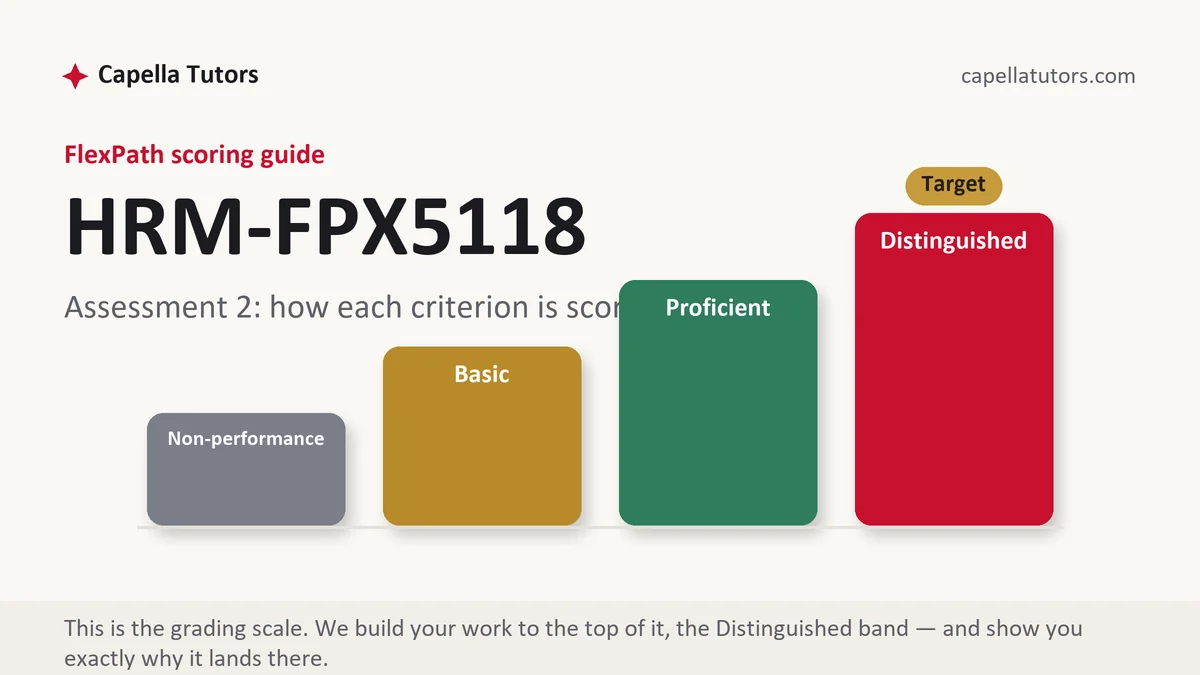
How HRM FPX 5118 Assessment 2 is scored
Nothing here is graded on a curve or against your classmates. Each criterion settles at one of four levels, and the top level wording is the specification you write to:
| Level | What it means on an entitlement and control deliverable |
|---|---|
| Distinguished | Every entitlement is tracked on its own measure with the arithmetic printed, the interaction between them is resolved rather than described, and the remedy is a system step that fires without anyone deciding to apply it. |
| Proficient | The entitlements are identified correctly and the recommendation is sound. Accurate work that still leaves the interaction implied. |
| Basic | Each statute is explained in its own paragraph, the balances are asserted rather than calculated, and the recommendation is a policy revision. |
| Non-performance | One of the engaged entitlements is simply absent, most commonly the accommodation analysis that begins where statutory leave ends. |
Where the guide uses the word evaluate, an evaluation needs a stated criterion and a verdict against it.
The HRM FPX 5118 Assessment 2 method, step by step
-
List the entitlements before you list the facts
Write down every entitlement the absence could touch and the trigger for each: the Family and Medical Leave Act of 1993, accommodation under the Americans with Disabilities Act of 1990 as amended in 2008, any state paid family and medical leave program, workers compensation, and the employer's own paid time off plan.
-
Fix the measurement basis in writing
Statutory family and medical leave is expressed in workweeks, so the hour balance depends on the schedule actually worked and on which permitted leave year method the employer has adopted and applied uniformly. Name the method in your second paragraph.
-
Do the arithmetic and show it
Take a mortgage servicing specialist at a regional bank working four ten hour days, which is a 40 hour week, and compare her with a colleague on a 32 hour schedule. Twelve workweeks for the second employee is 384 hours, not 480. She takes five hours a week for 18 weeks of treatment, which is 90 hours, then a continuous block of five weeks at 32 hours, another 160. That is 250 hours used and 134 remaining, which is 4.19 workweeks. The next scheduled block is six weeks, or 192 hours, so the entitlement runs 58 hours short.
-
Carry the analysis past exhaustion
Exhausting one entitlement ends that entitlement, not the employer's obligations. Additional leave can be a reasonable accommodation where the request is finite, the return date is reasonably definite and the cost of covering the role is bearable, and indefinite leave is where employers most often prevail. Work through the interactive process on those three facts and record the conversation, because an undocumented process is treated as one that did not happen.
-
Audit the automated policy that created the exposure
A no-fault attendance matrix assigns points without judgment, at scale, which is exactly why it assigns them to protected absence. Measure the failure rate rather than asserting it: if the center issued 214 point assessments last year and 19 were later reversed once protected status was confirmed, the control fails 8.9 percent of the time, and each reversal arrived after the employee had already been warned.
-
Cost the accommodation against the alternative
Fifty-eight unpaid hours cost the bank no salary and roughly 1,900 dollars in overtime coverage. Replacing the employee costs 4,100 dollars in recruiting, about 2,680 dollars in lost output across a six week ramp at sixty percent productivity on a 58,000 dollar salary, and 3,200 dollars in interim coverage, so near 9,980 dollars. Put both figures in the memo.
A structure that maps to the criteria
Planning aids for a graduate entitlement analysis, not Capella rules; lengthen the section your guide weights most.
| Section | What it must do | Guide word target |
|---|---|---|
| Situation and scope | Who the employee is, what the absence pattern looks like, and the decision the employer is facing next. | ~150 words |
| Entitlements engaged | Each statute or program named with its trigger, its coverage test and its measure, plus the leave year method in force. | ~300 words |
| The balance calculation | Hours converted from the actual schedule, usage itemized, remaining balance and the shortfall stated as a number. | ~300 words |
| Accommodation analysis | The interactive process, the duration and definiteness of the request, the cost of coverage, and the documented outcome. | ~300 words |
| Control design | Trigger, owner by role, the automatic system step, the exception path and the audit that proves it ran. | ~250 words |
| Cost, limits and review | The comparison in dollars, the retention obligation, and the sentence referring the legal call to counsel. | ~200 words |
| References | Current APA, provisions cited as they now read, and internal plan documents by title and effective date. | as needed |
Annotated sample excerpt
One model paragraph written by our team, in the register a graduate evaluator expects. Learn the moves and write your own version.
The control is a hard stop in the attendance module: when a point assessment would take an employee to six points, the system holds the assessment in a pending queue instead of issuing it, and routes the record to the leave administrator for a protected status check within two business days.1 The same queue fires a second alert when a family and medical leave balance falls below one scheduled workweek, opening a calendared accommodation conversation rather than a termination path.2 Performance is measured monthly on two figures the system already produces: the proportion of pending items cleared inside the two day window, and the count of point assessments reversed after issue, which stood at 19 of 214 in the year reviewed and should fall below five.3
- 1The remedy is a state change inside a system the employer already runs, with a named owner and a stated interval.
- 2The second trigger is placed exactly where the writer's own arithmetic found the failure, which is why it reads as a diagnosis rather than as a list of good ideas.
- 3Two measures, both drawn from existing reports, with a baseline and a target.
The full premium sample for your exact assessment, written fresh to your scoring guide and issue, is free to request. Study it, revise it into your own voice, and submit work you understand.
The five mistakes that cost Distinguished
- Twelve weeks converted to 480 hours by reflex. The conversion depends on the schedule the employee actually works, and a part-time balance calculated at full-time hours is wrong.
- The file closed at exhaustion. The end of one entitlement is the beginning of the accommodation question, and omitting that step leaves a criterion at the floor.
- An interactive process described but never documented. Where no note exists, a reviewer treats the conversation as having not occurred.
- The leave year method left unnamed. Different permitted methods yield different balances on the same date, so an unstated method makes every figure unverifiable.
- A recommendation with no price. An HR director who cannot compare the two costs will lose the argument to whoever can.
Pre-submission checklist
- Each engaged entitlement listed with its trigger, coverage test and measure
- Hours converted from the employee's real schedule, with the leave year method named
- Usage itemized and the remaining balance and shortfall shown as figures
- Accommodation analysis reaching a documented outcome, not a description of the duty
- Control written with trigger, owner by role, exception path and monthly measure
- Both cost figures present, scope sentence included, current APA verified both ways
Leave and accommodation memo due?
Send the criteria, the absence pattern and the attendance policy language you can share. Eight people work the file and the premium original sample comes back in 24 to 48 hours with every balance calculated and every figure traceable.