This manual is for HRM FPX 5118 Assessment 1, start to submission. The opening deliverable in Human Resource Legal Challenges and Solutions usually hands you a workplace complaint and asks what the employer should do about it, which means the document you submit behaves like a file rather than an essay: a dated chronology, an investigation plan written before anyone is interviewed, findings reasoned from the record, and a decision an outside reviewer could follow without your help. What follows is the method, the structure and an annotated excerpt. Rather hand it over? A premium original sample built to your scoring guide returns in 24 to 48 hours, revised free until every criterion clears. Capella's catalog lists the course as HRM-FPX5118, and some courserooms print HRM5118; both point to this same Assessment 1.
One honesty note before the manual: Capella revises courses and scoring guides over time, so always write to the exact scoring guide attached to your assessment in the courseroom. The course identity above is verified on capella.edu; the method and structure below are our tutors' approach to it, not Capella's official rubric text.
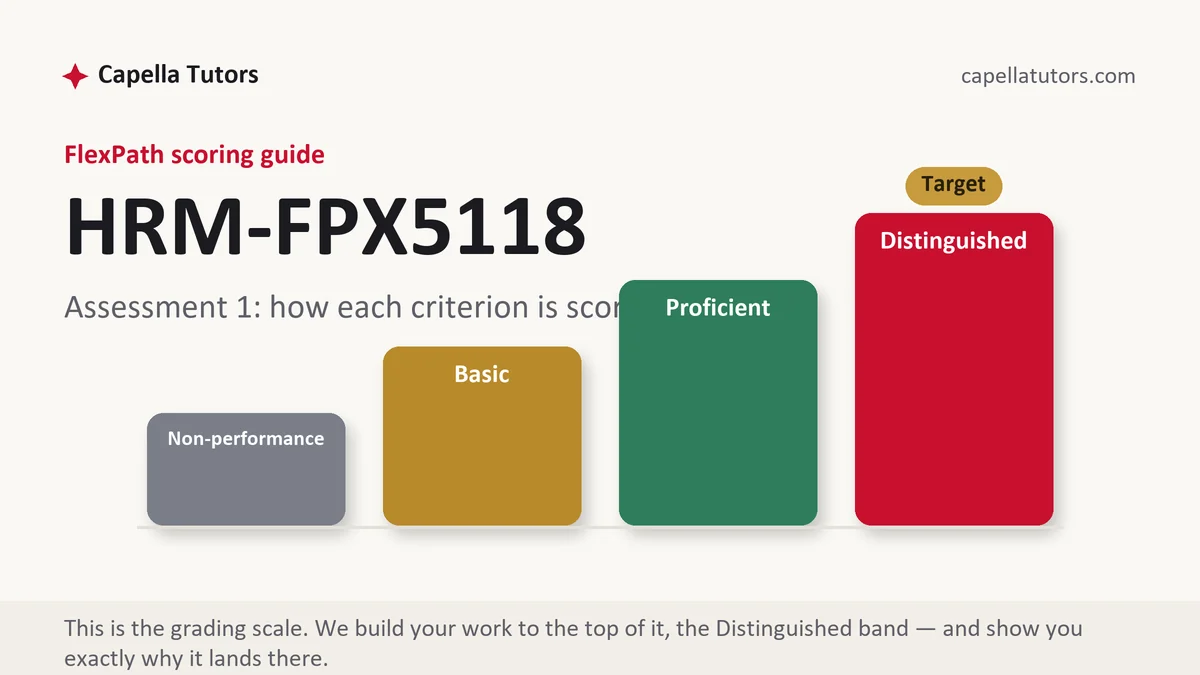
How HRM FPX 5118 Assessment 1 is scored
FlexPath awards no letter grade. Each criterion settles at one of four levels, and that level wording is your drafting brief:
| Level | What it means on an investigation and findings deliverable |
|---|---|
| Distinguished | The sequence is auditable, each finding names the evidence that produced it, the comparators are addressed by outcome, and the recommendation is a control with an owner rather than a policy sentence. |
| Proficient | The complaint is analyzed accurately and the obligations are correctly identified. Complete work, one degree short of the column above it. |
| Basic | The statute is described, the facts are summarized, and the conclusion arrives without visible reasoning. |
| Non-performance | A required element is missing rather than weak, most often the comparator analysis or the record retention obligation. Absence, not thinness, drops a criterion to the floor. |
Read the verbs in each criterion before you write. Analyze, evaluate and recommend are three different instructions, and a submission that summarizes where the guide said evaluate has failed a criterion it could read in advance.
The HRM FPX 5118 Assessment 1 method, step by step
-
Turn the guide into a file index
Copy each criterion into your outline as a heading and paste the top level description under it. Anything you write that does not sit beneath one of those headings is unpaid work.
-
Build the chronology, then mark what you cannot prove
Every line carries a date, an actor and the document it came from. In a scenario about a poultry processing plant where a sanitation crew alleges its shift supervisor rotates the worst assignments by race, the dispute is almost never about the rule; it is about what happened in which order.
-
Name the obligation by statute, then stop
Say that the allegation engages Title VII of the Civil Rights Act of 1964 and the state fair employment practices act, and that the plant's collective agreement gives the respondent the right to union representation at an investigatory interview under the National Labor Relations Act of 1935. Identify, describe the test, refer the prediction to counsel.
-
Run the comparator arithmetic before you write the finding
Pull the discipline records rather than the recollections. Over 24 months the sanitation department issued written warnings to 9 of the 14 employees on the complainant's crew, which is 64.3 percent, and to 6 of the 19 employees on the alternating crew, which is 31.6 percent. The impact ratio is 31.6 divided by 64.3, or 0.49, well under the 0.80 threshold the Uniform Guidelines on Employee Selection Procedures use as a rule of thumb. Then say what the number is not. Four-fifths is a screening heuristic rather than a legal test.
-
Price the exposure in a sentence finance would accept
A director defends a control with arithmetic. If the plant discharges the complainant on this record and the discharge is later reversed, back pay at 24.60 dollars an hour for 40 hours across 22 weeks is 21,648 dollars before benefits, fees or the cost of the replacement hire.
-
Self-score, then state the boundary of the analysis
Mark yourself against each criterion at D, P, B or N and rewrite anything below the top. Close with one sentence saying this is a management analysis, and that the legal call belongs with counsel before anyone acts.
A structure that maps to the criteria
Planning targets for a graduate legal analysis, not Capella rules; expand any section your guide weights heavily.
| Section | What it must do | Guide word target |
|---|---|---|
| The matter and the scope | What was alleged, by whom, when it reached the employer, and what question you set out to answer. | ~150 words |
| Chronology | Dated events with actor and source document, and a separate list of what remains unverified. | ~250 words |
| Obligations engaged | Each statute named with its section, the representation right if the workplace is organized, and the policy provisions in force on the relevant dates. | ~300 words |
| Findings and credibility | Facts found, facts rejected, and the corroboration or documentary basis for each determination. | ~350 words |
| Comparators and decision | The discipline arithmetic, who else was treated how, and the fact that explains any difference. | ~300 words |
| Controls, retention and limits | Trigger, owner by role, the automatic step, the audit measure, the litigation hold, and the scope of your analysis. | ~250 words |
| References | Current APA, statutes cited as they now read, and internal documents by title, version and date. | as needed |
Annotated sample excerpt
An original model paragraph from our team, pitched where the top column of the guide sits.
The assignment rotation logs for the 24 months preceding the complaint show that the four Spanish-speaking employees on B crew were assigned to the offal line on 61 of 88 available shifts, against a crew average of 34.1 The supervisor's explanation, that those employees requested the assignment because it carries a shift premium, is not corroborated by any written request, any premium payment on the payroll register, or any note in the shift handover book.2 I therefore find the pattern established and the offered justification unsupported, while noting that no witness places the supervisor's stated reason on any specific date, so the intent question remains open and is referred with this file to counsel.3
- 1The finding opens on a count drawn from a named record rather than on an impression.
- 2The respondent's account is tested against three independent documents by name.
- 3The finding states what it does not settle and refers the legal question rather than predicting it, which is the correct scope for a management analysis.
The full premium sample for your exact assessment, written fresh to your scoring guide and issue, is free to request. Study it, revise it into your own voice, and submit work you understand.
The five mistakes that cost Distinguished
- The statute essay. Three pages explaining Title VII and half a page on the facts inverts the weighting the guide actually uses.
- Credibility settled on demeanour. A witness who seemed nervous is not evidence, and a finding resting on that observation collapses under any external review.
- No comparator arithmetic. Inconsistent discipline is visible in records the employer already holds, and skipping the count wastes the strongest evidence.
- A training recommendation as the remedy. The evidence that a single anti-harassment session changes behavior is weak, and the criterion is asking for a control that operates whether anyone remembers it.
- Retention treated as an afterthought. Once a claim is foreseeable, ordinary deletion schedules become a separate problem, and a file that never mentions the hold has left a criterion unanswered.
Pre-submission checklist
- Each criterion in your guide carries a section of its own, labeled as such
- Chronology dated and attributed, with unverified items kept in a separate list
- Each statute named with its section and cited as it currently reads
- Comparator counts shown with the arithmetic and the limits of the ratio stated
- Each recommended control carries a trigger, an owner by role and an audit measure
- Scope sentence referring the legal question to counsel, and current APA throughout
Investigation deliverable due this week?
Send the prompt, the scoring guide and whatever fact pattern or policy language you are permitted to share. A team of eight returns a premium original sample argued to the Distinguished column in 24 to 48 hours, with the chronology built and every provision cited as it now reads.