This manual is for HRM FPX 5070 Assessment 3, start to submission. The closing deliverable in a workplace learning course is where the money argument lives, so the assessment usually asks how the behavior will survive the return to work, which evaluation levels you will run and with what instruments, and whether the program is worth what it costs once participant time is counted. Below is the method our tutors use for that argument, a section map that satisfies the criteria, and an annotated sample excerpt built around a member complaint program at a regional credit union. Rather hand it off? A single premium original sample, written straight to your own scoring guide, arrives in 24 to 48 hours and is reworked without charge until the descriptors are met. Capella's catalog lists the course as HRM-FPX5070, and some courserooms print HRM5070; both point to this same Assessment 3.
One honesty note before the manual: Capella revises courses and scoring guides over time, so always write to the exact scoring guide attached to your assessment in the courseroom. The course identity above is verified on capella.edu; the method and structure below are our tutors' approach to it, not Capella's official rubric text.
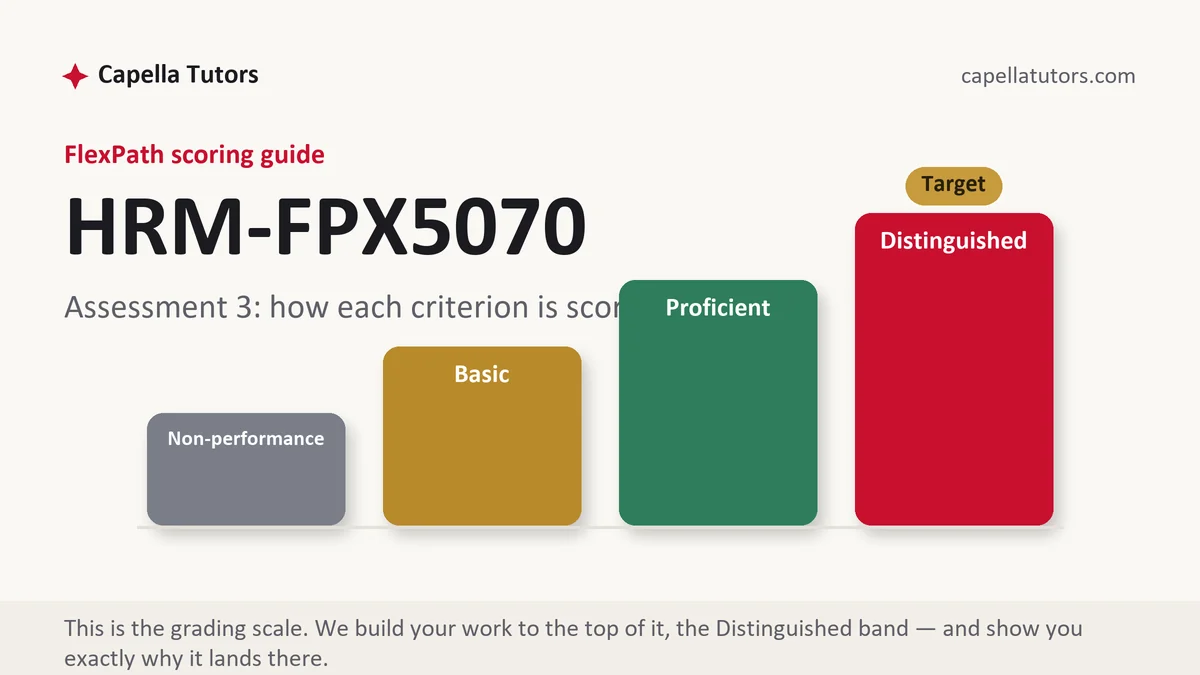
How HRM FPX 5070 Assessment 3 is scored
FlexPath criteria are pass or improve, four levels deep, and the descriptors tell you exactly what an evaluator is hunting for in an evaluation plan:
| Level | What it means on a transfer and evaluation plan |
|---|---|
| Distinguished | A behavior measure with a baseline captured before delivery, a named supervisor role at a stated interval, a cost model containing participant time, and a benefit figure whose weakest assumption the writer identifies without being asked. |
| Proficient | The levels are chosen and justified, the transfer plan exists, and the numbers add up. What is absent is the writer arguing against their own figure. |
| Basic | A satisfaction survey described as evaluation and a paragraph hoping managers will reinforce the learning. Common, and one criterion below where you want to be. |
| Non-performance | No measurement plan, or a plan whose data could never be collected because the baseline it needs no longer exists. |
The reason baselines dominate this deliverable is that they cannot be recovered. A learning measure can be added late and a reaction survey can be run whenever you like, but a behavior comparison needs a before figure, and the before is gone the moment the first session starts.
The HRM FPX 5070 Assessment 3 method, step by step
-
Choose your evaluation levels before you write anything else
Donald Kirkpatrick's four levels run reaction, learning, behavior and results, with Jack Phillips adding return on investment above them. Pick two you can genuinely deliver and say why the others are not worth their price here. A plan promising all four and resourcing none reads worse than a plan that runs two properly.
-
Take the baseline from a report the organization already produces
First contact resolution sits in the case management system, absence sits in the timekeeping system, and error rates usually sit in a quality queue somebody already reviews. Using an existing report means the measure survives your departure, and it also means nobody has to be persuaded to start collecting something new.
-
Give the supervisor a job, not an encouragement
Baldwin and Ford's transfer framing holds that learner characteristics, program design and the work environment jointly decide whether anything survives contact with Monday, and the work environment is the piece an HR designer can actually specify. Write the brief the supervisor receives, the conversation they hold in week one, and the two behaviors they observe. Then name who checks that they did it.
-
Remove the obstacle that makes the old behavior faster
People revert because reverting is quicker, not because they forgot. If resolving a case in one contact requires an approval the representative does not hold, raise the authority limit and say so in the plan. A transfer section with no obstacle removed is a section that only asks people to try harder.
-
Put cost and benefit in the same units and show the arithmetic
For 132 representatives, development at 5,580 dollars, facilitation at 3,060 dollars, materials at 1,452 dollars and four hours of participant time each at a 34 dollar loaded rate, which is 17,952 dollars, the program costs 28,044 dollars. Against that, lifting first contact resolution from 61 to 68 percent of 9,400 annual cases avoids 658 escalations at roughly 26 dollars of specialist handling each, or 17,108 dollars, plus about 14 retained memberships at 310 dollars of annual contribution, or 4,340 dollars.
-
Report the answer even when the answer is no, then self-score
That benefit totals 21,448 dollars against 28,044 dollars of cost, a first year ratio of 0.76, and the program only clears in year two when development and participant time do not repeat. Write that sentence yourself. A candidate who shows a negative first year and explains when it turns is trusted; one who reports a 300 percent return is not. Then mark every criterion D, P, B or N and rework anything short of D.
A structure that maps to the criteria
Treat the counts below as our tutors' planning shape for an evaluation deliverable, not as Capella instructions, and expand wherever your own guide gives a section its own criterion.
| Section | What it must do | Guide word target |
|---|---|---|
| Scope and recap | Name the program, the population and the behavior it was built to change, in enough lines that the plan stands alone. | ~150 words |
| Transfer plan | Supervisor brief, reinforcement points at stated intervals, the obstacle removed, and the person accountable for each. | ~275 words |
| Evaluation design | The levels chosen, the instrument for each, the levels declined, and the reason each decision was made. | ~250 words |
| Baseline and data source | The existing report, the definition of the measure, the window, and when the before figure is captured. | ~200 words |
| Cost and benefit | Development, delivery, materials and participant time, set against a benefit calculated line by line. | ~300 words |
| Limits, review and references | The softest assumption, what could confound the result, the review date, and current APA matched both ways. | ~225 words |
Annotated sample excerpt
Here is a short original passage from our team, written at the level of concreteness the top descriptor is asking for. Copy the structure of the thinking, not the numbers.
Behavior is measured as first contact resolution, defined as a member case closed without a second inbound touch within 14 days, drawn from the existing case management report that branch operations already circulates each Monday.1 The baseline covers the 13 weeks ending three days before the first session and stands at 61.4 percent across 2,281 cases, and it is captured in that window precisely because a figure gathered after the announcement would already contain the effect of the announcement.2 Two conditions would confound the comparison, a scheduled change to the case closure rules in the fourth quarter and the seasonal complaint volume that follows the annual fee statement, so the post measure is taken from the equivalent 13 weeks a year later rather than from the quarter immediately after delivery.3
- 1Defines the measure operationally and sources it to a report that already exists. A measure nobody has to build is a measure that will still be running next year.
- 2Fixes the baseline window before the intervention and explains the timing. Naming the contamination risk is what separates a plan from a wish.
- 3Identifies two confounds and adjusts the design around them. Evaluators read this as measurement literacy rather than as hedging.
The full premium sample for your exact assessment, written fresh to your scoring guide and issue, is free to request. Study it, revise it into your own voice, and submit work you understand.
The five mistakes that cost Distinguished
- Reaction scores presented as impact. Satisfaction sheets measure the room and the facilitator, and reaction predicts very little about whether behavior changed.
- A behavior measure with no before. Deciding to evaluate at level three after delivery has begun means the comparison can never be made.
- Participant salary omitted from the cost. Leave the largest line out and the ratio is fiction, which a finance reader will detect in about a minute.
- A benefit figure with no assumption attached. Every avoided cost rests on a rate somebody estimated, and the estimate belongs in the sentence beside the number.
- Transfer written as manager encouragement. Support them where you can is not a plan; a brief, a date, an observation and an accountable name is a plan.
Pre-submission checklist
- Each criterion on the guide is answered under its own heading
- Evaluation levels chosen and declined, each with a stated reason
- A baseline defined, sourced to an existing report, and dated before delivery
- Supervisor actions written as tasks with intervals and an accountable owner
- Cost includes participant time, and the benefit arithmetic is shown line by line
- The weakest assumption named, a review date set, current APA matched, and every criterion self-scored D
Want this assessment done with backup?
Send the scoring guide, the program you designed and whatever operational report you can point at. A team of eight, including a research analyst and two QA reviewers, returns a premium original sample written to the Distinguished column in 24 to 48 hours, with revisions until it gets there. The cost model is built line by line, and if the first year does not clear, the draft says so.