This manual is for HRM FPX 5070 Assessment 2, start to submission. Where the earlier work in this course argues that a gap exists, the middle deliverable builds the response, so the assessment usually asks for measurable objectives, a delivery method you can defend, a content sequence, and practice that matches what each objective claims a learner will be able to do. What follows is the method our tutors use to design against criteria, the section map we build from, and an annotated sample excerpt taken from a selection interview program for production supervisors. Want it handled? Send the prompt and a premium original deliverable comes back within two working days, revised at no charge until every criterion is satisfied. Capella's catalog lists the course as HRM-FPX5070, and some courserooms print HRM5070; both point to this same Assessment 2.
One honesty note before the manual: Capella revises courses and scoring guides over time, so always write to the exact scoring guide attached to your assessment in the courseroom. The course identity above is verified on capella.edu; the method and structure below are our tutors' approach to it, not Capella's official rubric text.
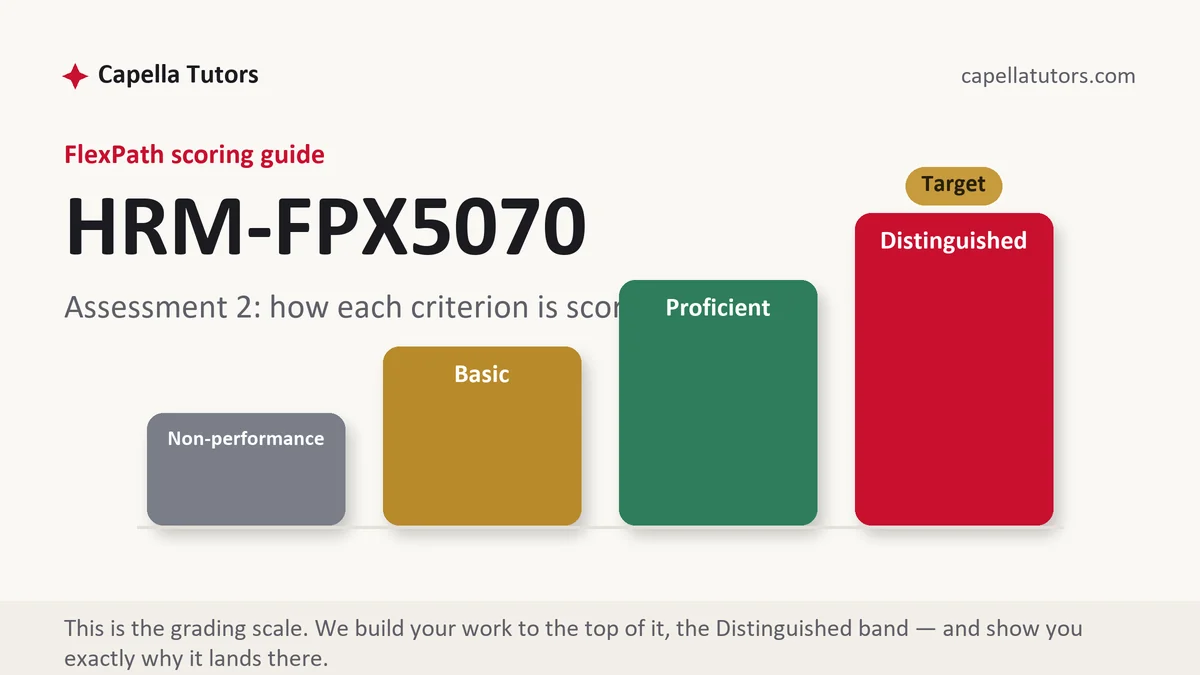
How HRM FPX 5070 Assessment 2 is scored
There is no percentage and no curve. Each criterion returns at one of four levels, and the language of those levels is the specification you were meant to write against:
| Level | What it means on a program design |
|---|---|
| Distinguished | Objectives carry a condition, an observable behavior and a standard; the delivery method is justified against the objective and the audience; and the practice would genuinely produce the behavior the objective names. |
| Proficient | A complete and coherent design with sound objectives. What is missing is the defense of why this method rather than another one. |
| Basic | An agenda. Topics with times beside them, objectives written as understand or be aware of, and a delivery choice made because it is the one everybody uses. |
| Non-performance | A required design element never appears, and the practice or assessment component is the usual casualty. The criterion floors on absence, not on quality. |
Design criteria are unusually mechanical, which is good news. An objective either states a measurable standard or it does not, and an evaluator can check that in a single reading, so most of the available points here are won by discipline rather than by insight.
The HRM FPX 5070 Assessment 2 method, step by step
-
Anchor the design to the analysis rather than restating it
Open with three or four sentences that carry the gap, the population and the cause forward, then stop. Faculty reading a design deliverable want to see the diagnosis honored, not repeated, and a design whose objectives cannot be traced back to a named cause reads as a program looking for a problem.
-
Write objectives in three parts, one sentence each
Condition, behavior, standard. Given a completed application and the requisition's minimum qualifications, the supervisor will draft four job related questions with none that inquire into disability, age or family status is an objective; supervisors will improve their interviewing is a wish. Three to five objectives is right for a program of a few hours, and each one should make its own assessment method obvious.
-
Defend the delivery method against the objective
Say what you chose, then say what you rejected and why. A behavior that has to be performed under mild social pressure needs live practice with an observer, so a self-paced module cannot carry it whatever the scheduling advantages are. Where the constraint decided the choice, name the constraint instead of dressing it as pedagogy.
-
Build practice and assessment backward from each objective
The verb in the objective dictates the activity. Draft means the learner drafts something and somebody reviews it against a key. Identify means a sorting task with right and wrong answers. If you cannot describe how you would check an objective, the objective is not finished, and adults will not rehearse something they cannot see the point of, which is Malcolm Knowles's argument and worth citing to him.
-
Sequence for spacing, not for the calendar
Two 90 minute sessions two weeks apart with a short retrieval task between them beats a single three hour block, because material distributed across sessions and recalled effortfully is retained substantially better than the same material delivered comfortably in one sitting. Organizations prefer the block for scheduling reasons, so state the trade and let the reader see you made it deliberately.
-
Cost the design honestly, then self-score
For 96 production supervisors at three hours each on a loaded rate of 46 dollars, participant time alone is 13,248 dollars. Add 60 development hours at 58 dollars for 3,480 dollars, and materials at 14 dollars a head for 1,344 dollars, and the program costs 18,072 dollars, or 188 dollars per supervisor. Then mark each criterion D, P, B or N yourself and fix everything below D before submitting.
A structure that maps to the criteria
The targets below are how our tutors plan a design deliverable of this size, not rules from Capella; widen any section your scoring guide treats as a criterion of its own.
| Section | What it must do | Guide word target |
|---|---|---|
| Purpose and audience | Carry the gap and the population forward in a few lines, with the cause the design is aimed at named explicitly. | ~150 words |
| Learning objectives | Three to five objectives, each with condition, observable behavior and standard, and each traceable to the cause above. | ~200 words |
| Instructional strategy | The delivery method chosen, the alternatives rejected, and the reason grounded in the objective and the audience rather than in convenience. | ~275 words |
| Content and sequence | What is covered in what order, with session boundaries, spacing intervals and the retrieval work that sits between them. | ~250 words |
| Practice and assessment | The activity that produces each objective's behavior and the check that confirms it, matched one to one. | ~250 words |
| Resources, cost and references | Facilitator time, materials, participant time priced at a loaded rate, and current APA matched both ways. | ~200 words |
Annotated sample excerpt
What follows is a passage our team wrote to demonstrate the level of specificity the top column asks for. Take the technique, then rebuild it around your own program.
On completing the program, and given a requisition, a completed application and the site's structured question bank, the supervisor will select five job related questions and reject any question that inquires into disability, age, national origin or family responsibilities, with no impermissible question retained.1 This objective is assessed in session two by a sorting task in which each supervisor sorts 20 candidate questions into permissible and impermissible piles against a key derived from Title VII of the Civil Rights Act of 1964 and the pre-employment inquiry limits at 42 U.S.C. section 12112(d), with 18 of 20 correct treated as mastery.2 The sorting task rather than a discussion was chosen because the behavior under pressure is a rapid judgment made while a candidate is waiting, and a graded sort reproduces that condition where an open conversation does not.3
- 1All three parts of the objective in one sentence, with the standard expressed as an absolute rather than as a percentage improvement nobody could verify.
- 2The assessment is named, the key is sourced to statute, and mastery is a number. Graduate register means the law arrives by citation, not by allusion.
- 3Justifies the method against the working condition and names what was rejected. This sentence is usually the difference between Proficient and Distinguished.
The full premium sample for your exact assessment, written fresh to your scoring guide and issue, is free to request. Study it, revise it into your own voice, and submit work you understand.
The five mistakes that cost Distinguished
- Objectives written as topics. Understand, appreciate and be familiar with cannot be observed, so they cannot be assessed, and an unassessable objective drags the assessment criterion down with it.
- An agenda submitted as a design. Times beside topics say when things happen and nothing about what a learner will be able to do afterwards.
- Delivery chosen and never defended. The criterion asks why this method, and silence on that question is the most common reason a complete design stalls at Proficient.
- Practice that does not rehearse the behavior. A lecture followed by a quiz teaches recall, and no objective containing the word draft or conduct is satisfied by recall.
- A resource plan with no participant time in it. Salary for people sitting in the room is the largest line in most training budgets, and leaving it out makes the whole model look naive.
Pre-submission checklist
- Each scoring-guide criterion has its own labeled section in the document
- Every objective contains a condition, an observable verb and a standard somebody could check
- Each objective has one named assessment activity attached to it
- The delivery method is defended, with at least one rejected alternative named
- Sequence shows session boundaries and any spacing interval you chose deliberately
- Cost includes participant time at a loaded rate, references in current APA, and every criterion self-scored D
Want this assessment done with backup?
Send the scoring guide, the analysis you already submitted and what the organization can genuinely spend. A team of eight, including a research analyst and two QA reviewers, returns a premium original sample written to the Distinguished column in 24 to 48 hours, with revisions until it gets there. Objectives arrive gradeable and the cost model arrives with participant time already in it.