This manual is for HRM FPX 5070 Assessment 1, start to submission. The opening deliverable in a workplace learning course is the analysis rather than the design, so the assessment usually asks you to establish that a performance gap is real, size it in numbers a finance reader would accept, and demonstrate that instruction is the right instrument before anything gets built. Below is the method our tutors use for that argument, a structure that maps to the criteria, and an annotated sample excerpt drawn from a leave administration case. Would you rather not draft it? One premium original sample built around your own prompt returns inside 24 to 48 hours, with free revision until the criteria clear. Capella's catalog lists the course as HRM-FPX5070, and some courserooms print HRM5070; both point to this same Assessment 1.
One honesty note before the manual: Capella revises courses and scoring guides over time, so always write to the exact scoring guide attached to your assessment in the courseroom. The course identity above is verified on capella.edu; the method and structure below are our tutors' approach to it, not Capella's official rubric text.
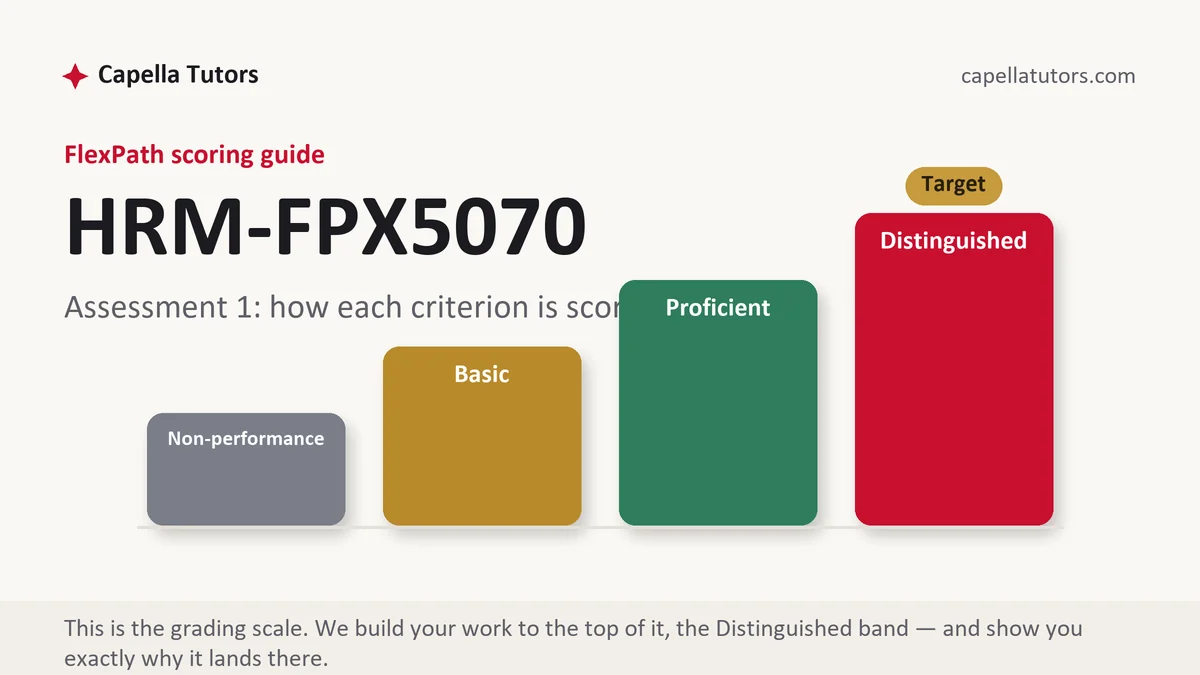
How HRM FPX 5070 Assessment 1 is scored
FlexPath awards no letter grades. Every criterion on your scoring guide comes back at one of four levels, and the wording of those levels is the brief you should have been writing to:
| Level | What it means on a needs analysis |
|---|---|
| Distinguished | The gap is quantified, the population holding it is named, and at least two non-training causes are tested and rejected on evidence. The analysis is allowed to conclude that instruction is only part of the answer. |
| Proficient | Organizational, task and person analysis are all present and correct, and the conclusion follows from them. Complete work that has not yet ruled anything out. |
| Basic | A description of a workplace problem with a training solution attached to the front of it. This is where most first attempts in 5070 land. |
| Non-performance | One of the three analysis levels never appears, most often the task analysis. An absent element floors the criterion no matter how good the surrounding prose is. |
The reason the analysis criteria carry so much weight is commercial. An organization that funds instruction for a problem instruction cannot fix has spent real money and changed nothing, and the graduate register of this course expects you to say that out loud rather than write an enthusiastic proposal.
The HRM FPX 5070 Assessment 1 method, step by step
-
Turn the scoring guide into headings before you write a sentence
Copy each criterion into your document as a heading and paste its Distinguished wording underneath while you draft. Nothing that fails to sit under one of those headings earns anything, and the outline you produce this way is the assignment. Delete the pasted wording in your final pass.
-
State the gap as two numbers and a window
Current performance, required performance, and the period both were measured over. Late leave designations across 38 supervisors is a complaint; 61 of 214 leave events in the twelve months to June carried a designation notice issued beyond the five business day window in 29 C.F.R. section 825.300, or 28.5 percent, is a gap. The second version tells your reader what success would look like.
-
Run the three levels in order and refuse to skip one
Organizational analysis asks whether the goal is supported by strategy, budget and the people who sign timesheets. Task analysis breaks the work into the steps somebody actually performs, which for a leave file means intake, eligibility, designation, medical certification and return to work. Person analysis says who holds the gap, by name or by role, and the count matters.
-
Test the causes instruction cannot repair
Four candidates deserve a sentence each: an undocumented standard, absent or delayed feedback, missing tools or access, and a reward system pointing elsewhere. Where a supervisor is measured on shift coverage and overtime and nothing on their scorecard registers a compliance step, no amount of well designed instruction will move the behavior, and saying so is the move the top of the guide is describing.
-
Price the gap before you price any solution
Give the reader the cost of doing nothing in arithmetic they can check. Reconciling each late file consumed roughly 40 minutes of generalist time, so 61 files came to 40.7 hours at a loaded rate of 38 dollars, or 1,547 dollars in rework, sitting alongside the statutory exposure that a designation notice issued late creates under the Family and Medical Leave Act. Then note which figure you are least sure of.
-
Self-score every criterion, then submit early in the week
Read the draft one criterion at a time and mark yourself D, P, B or N without generosity. Anything short of D gets another pass. Faculty have up to two business days with a submitted attempt, so a Wednesday submission usually returns inside the same week and a Friday one may not.
A structure that maps to the criteria
These word counts are the planning targets our tutors use for an analysis deliverable of this kind, not Capella requirements; stretch any section your own guide asks more of.
| Section | What it must do | Guide word target |
|---|---|---|
| The gap, stated | Open on the performance shortfall with current and required figures, the measurement window, and the business consequence in one sentence. | ~175 words |
| Organizational analysis | Strategy alignment, resource reality and management support, drawn from documents you can name rather than assumptions about culture. | ~225 words |
| Task analysis | The work broken into observable steps, with the step where performance actually fails identified and evidenced. | ~250 words |
| Person analysis | Who holds the gap, how many of them, and how you established that rather than inferred it. | ~200 words |
| Non-training causes tested | Standard, feedback, tools and incentives each examined and either ruled out or admitted as a contributing cause. | ~275 words |
| Conclusion, cost and references | What instruction can and cannot fix here, the cost of the gap, and current APA matched both ways. | ~225 words |
Annotated sample excerpt
Below is an original passage written by our team at the register the top of the guide rewards. Read it for the moves, not the content, then build your own version from your own file.
Three explanations other than capability were tested before instruction was recommended. The designation notice template is current and sits in the HRIS document library, where access logs confirm every supervisor opened it during onboarding, so the tools are present.1 Of the 61 late files, 54 came from leave requests that reached a supervisor by text message or hallway conversation rather than through the absence workflow, which places the failure at intake and not at the notice itself.2 Supervisors are measured on shift coverage and overtime variance, and no compliance step appears anywhere on that scorecard, so the reward system is pointing away from the behavior the organization wants.3 Capability remains a genuine component, since 22 of 38 supervisors could not state the five business day window when asked directly, and the recommendation that follows therefore pairs instruction with a workflow change rather than offering instruction alone.
- 1Names the tool and shows it was available, with a record behind the claim. A cause tested and rejected is worth far more to the criterion than a cause asserted.
- 2Converts an impression into a count with a denominator. 54 of 61 is evidence; most of them is an opinion an evaluator has no reason to accept.
- 3Reads the reward system, the cause students omit most often and the first one an operating leader will raise in the room.
The full premium sample for your exact assessment, written fresh to your scoring guide and issue, is free to request. Study it, revise it into your own voice, and submit work you understand.
The five mistakes that cost Distinguished
- The solution arrives before the diagnosis. A paper that opens by describing a workshop has conceded the analysis criterion in its first paragraph.
- A gap with no numbers. Adjectives about frequent errors cannot be compared to a target, and a gap you cannot measure is one you cannot close.
- Task analysis skipped. Writers who understand the job well tend to assume the reader does too, and that assumption reads as a missing element rather than as efficiency.
- Every cause blamed on knowledge. Standard, feedback, tools and incentives exist as categories precisely because most workplace failures live in one of them.
- Law referred to loosely. At the graduate level a compliance gap needs the statute or regulation named, and the Family and Medical Leave Act deserves better than a general mention of federal rules.
Pre-submission checklist
- Every criterion on the guide has its own labeled section in the document
- The gap appears as a current figure, a required figure and a measurement window
- Organizational, task and person analysis are all present, in that order
- At least two non-training causes tested, with the evidence that ruled them out
- The cost of the gap shown as arithmetic, with the softest input identified
- Current APA matched both ways, and self-scored D on every criterion before you submit
Want this assessment done with backup?
Send the scoring guide, the performance problem and whatever data you hold on it. A team of eight, including a research analyst and two QA reviewers, returns a premium original sample written to the Distinguished column in 24 to 48 hours, with revisions until it gets there. The analysis is done properly, which means the draft may tell you instruction is not the whole answer.