This manual is for HRM FPX 5060 Assessment 2, start to submission. Job Analysis and Competency Model asks you to analyze a role, often one in the courseroom scenario, and produce a comprehensive job description and competency model: the position overview, key responsibilities, required knowledge, skills and abilities, the competencies that distinguish strong performance, the work environment and accommodations, and equal employment opportunity language. The grade turns on a description grounded in analysis. Responsibilities and competencies derived from what the job requires score above a generic template. Below is the method our tutors use, a structure that maps to the criteria, and an annotated sample excerpt. Prefer to hand it off? A premium original sample for this exact assessment comes back in 24 to 48 hours, revised free until it meets the guide. Capella's catalog lists the course as HRM-FPX5060, and some courserooms print HRM5060; both point to this same Assessment 2. In current courserooms this assessment typically appears as "Job Analysis and Competency Model".
One honesty note before the manual: Capella revises courses and scoring guides over time, so always write to the exact scoring guide attached to your assessment in the courseroom. The course identity above is verified on capella.edu; the method and structure below are our tutors' approach to it, not Capella's official rubric text.
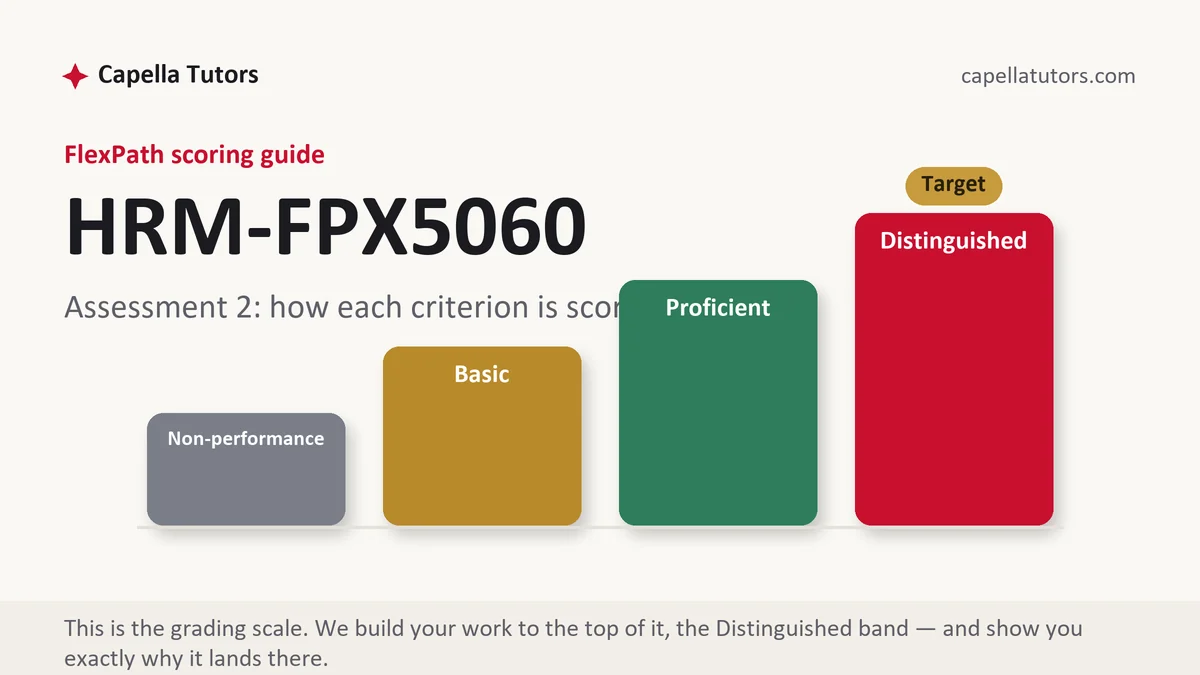
How HRM FPX 5060 Assessment 2 is scored
FlexPath does not use letter grades. Each criterion in the scoring guide lands on one of four levels, and the level descriptions are the real writing brief:
| Level | What it means on a job analysis and competency model |
|---|---|
| Distinguished | The job analysis and competency model is specific to the organization or case, applies course concepts accurately with credible sources, and ends in justified conclusions or recommendations. |
| Proficient | The job analysis and competency model is accurate, but the application or recommendations are general. |
| Basic | The job analysis and competency model describes concepts with little application. |
| Non-performance | A required part of the job analysis and competency model is missing. |
Use the role your courseroom specifies and sources such as O*NET.
The HRM FPX 5060 Assessment 2 method, step by step
-
Gather job information
Interviews, O*NET and existing documents.
-
Write the overview
Purpose and reporting line.
-
List responsibilities
Specific duties with weight.
-
Set requirements
Education, licensure, experience.
-
Define competencies
Behaviors that mark strong performance.
-
Add environment and EEO language
Physical demands, accommodations, equal opportunity statement.
A structure that maps to the criteria
Word counts are planning targets our tutors use, not Capella rules; follow the length and format your scoring guide states.
| Section | What it must do | Guide |
|---|---|---|
| Overview of the position | Purpose. | ~100 words |
| Key responsibilities | Duties. | ~150 words |
| Position requirements and competencies | KSAs and competencies. | ~200 words |
| Work environment, accommodations and EEO | Conditions and statements. | ~100 words |
| References | Sources. | as needed |
Annotated sample excerpt
An original model excerpt from our team, written to show the register that reaches the top of the guide. Learn the moves, then write your own version.
Clinical judgment: makes timely, evidence-based decisions about injured workers' care and return-to-work status, documenting the reasoning so employers and insurers can follow it.1 Communication: explains work restrictions in plain language to patients, supervisors and case managers, which reduces disputes and delays in returning to work.2 These competencies were drawn from interviews with the occupational medicine director and the O*NET profile for physician assistants, so they reflect what distinguishes strong performance in this setting.3
- 1Defines a competency as observable behavior.
- 2Links another competency to outcomes.
- 3States where the competencies came from.
The full premium sample for your exact assessment, written fresh to your scoring guide and topic, is free to request. Study it, revise it into your own voice, and submit work you understand.
The five mistakes that cost Distinguished
- Definitions without application. Apply each concept to the organization or case.
- No sources. Cite credible business sources.
- Vague recommendations. Make them specific and justified.
- Generic templates. Derive content from the job.
Pre-submission checklist
- Job information gathered
- Overview
- Responsibilities
- Requirements
- Competencies
- Environment, EEO and references
Want the job analysis and competency model written?
Send the scoring guide and any materials from your courseroom. Our team returns a premium original job analysis and competency model in 24 to 48 hours, revised free until it meets the guide.