This manual is for HRM FPX 5055 Assessment 3, start to submission. Assessment 3 of HRM FPX 5055, Comprehensive Reward Systems, widens the frame from pay to everything the employer spends on the employment relationship. The assessment usually asks you to design or evaluate a total rewards mix for a described workforce and defend the balance between cash, benefits and everything that is not money. Below is the method our tutors use, a structure that maps to the criteria, and an annotated sample excerpt. Prefer to hand it off? A premium original sample for this exact assessment comes back in 24 to 48 hours, revised free until it meets the guide. Capella's catalog lists the course as HRM-FPX5055, and some courserooms print HRM5055; both point to this same Assessment 3.
One honesty note before the manual: Capella revises courses and scoring guides over time, so always write to the exact scoring guide attached to your assessment in the courseroom. The course identity above is verified on capella.edu; the method and structure below are our tutors' approach to it, not Capella's official rubric text.
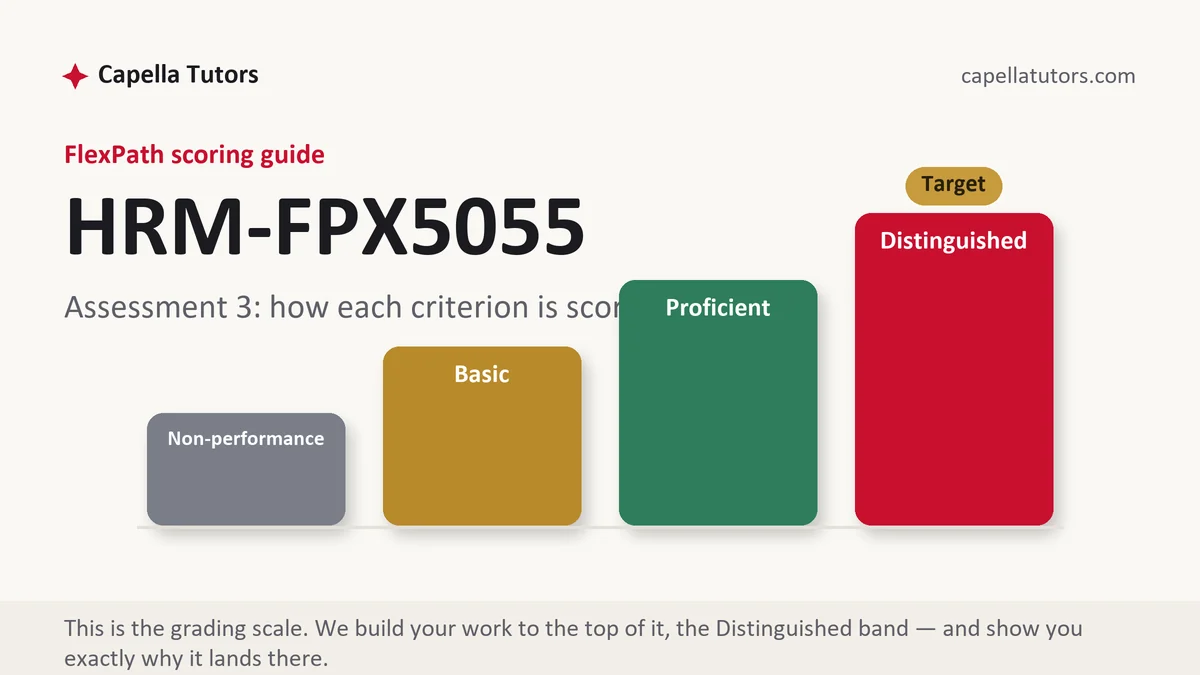
How HRM FPX 5055 Assessment 3 is scored
There are no letter grades to chase. Each criterion lands at one of four levels, and the level language is the brief:
| Level | What it means on a total rewards mix |
|---|---|
| Distinguished | Every element carries a dollar cost with its arithmetic, two elements of equal cost are compared on what each is worth to the employee, and the writer says which parts of the mix the workforce described will not value. |
| Proficient | A complete mix, priced, with a coherent rationale. Correct work that never sets two equally expensive options against each other. |
| Basic | A list of benefits with no dollar values attached. Total rewards means priced, and an unpriced mix cannot be traded off against anything. |
| Non-performance | A required element of the mix is missing, or the cost of the design is never established, which leaves the recommendation unfundable. |
The comparison worth building the whole paper around is cost against perceived value. Two elements can carry identical price tags and land completely differently on the same workforce, and a criterion at the top of the column is looking for the writer who noticed and said which one they would buy.
The HRM FPX 5055 Assessment 3 method, step by step
-
Describe the workforce before designing anything for it
Age distribution, tenure, income level, household situation where you can reasonably infer it, and whether people are paid enough to defer income at all. A mix that suits well-paid mid-career professionals can be close to worthless to a young low-paid workforce, and the criterion is asking whether you noticed which one you were designing for.
-
Price every element and total the load
Employer premium share, retirement contribution, payroll taxes, and anything else the employer writes a cheque for. Express the total as a percentage of base payroll and as a figure per employee per year. Both forms are useful, because the percentage travels to benchmarks and the per-employee figure travels to a budget meeting.
-
Separate the additive costs from the ones already inside salary
Paid time off is expensive and is mostly already sitting in the salary line, so adding it to the load as though it were new money double counts. Say which elements are additive and which are time-based. Getting this right is a small technical point that signals to a knowledgeable reader that the rest of your arithmetic can be trusted.
-
Compare two options of equal cost
Take a headline change and cost it two ways. A three percent increase to base and a three-point rise in a retirement match look alike in a memo, cost differently once payroll taxes are counted, and are received differently by somebody who cannot afford to defer. Run the numbers and choose, on the record.
-
Bring evidence for what rewards actually do
Peer-reviewed work on pay, benefits and motivation supports any sentence claiming a reward changes behaviour, and the honest reading is that it depends heavily on the work and the population. Read each study for its design, its sample and its outcome measure before you let it carry a claim, and quote coefficients with their source and their year.
-
Communicate the mix, then self-score
A total rewards statement that shows an employee the full employer cost of their employment is often the cheapest intervention in the paper, and it belongs in the recommendation. Then mark each criterion D, P, B or N, give the numbers a separate pass, and submit early enough to absorb two business days of evaluation.
A structure that maps to the criteria
Section lengths our tutors aim at on a total rewards deliverable, and nothing Capella requires. Expand wherever your scoring guide carries more weight.
| Section | What it must do | Guide |
|---|---|---|
| The workforce | Composition, income level, tenure and anything that changes what an element is worth to them. | ~200 words |
| The current mix priced | Every element with its employer cost, totalled as a percentage of payroll and per employee. | ~300 words |
| Cost against value | Which elements the workforce described will value, which they will not, and the evidence. | ~250 words |
| The trade-off tested | Two options of equal headline size, costed fully, with a choice made and defended. | ~250 words |
| Recommendation | The proposed mix, its total cost, what it replaces, and how the change is communicated. | ~250 words |
| Constraints and references | Statutory obligations touching the elements chosen, and current APA in text and list. | ~200 words |
Annotated sample excerpt
An original model excerpt from our team, showing the register that scores at the top of the guide. It is study material: learn the moves, then write your own version.
Thirty-two salaried staff at an average $58,000 give a base payroll of $1,856,000, on which the employer already carries $294,400 of health premium share, a four percent retirement match worth $74,240, and $141,984 in payroll taxes, an additive load of $510,624 or 27.5 percent of payroll.1 A three percent increase to base costs $55,680 and $59,940 once payroll taxes follow it, while raising the match from four to seven percent moves the same three percent of pay for $55,680 and attracts no payroll tax, a difference of $4,260 for an identical headline.2 The recommendation still takes the base increase, because a match is worth nothing to an employee at $41,000 who cannot afford to defer, and this workforce has eleven of them.3
- 1Builds the load from named components and reports it in both forms, as a percentage that travels to a benchmark and a total the organization can recognize on its own ledger.
- 2Sets two equal-sounding options against each other and finds the $4,260 the headline concealed. This is the comparison the top column exists to reward.
- 3Then rejects the cheaper option for a reason drawn from the workforce described earlier, with a count. Choosing the costlier design on evidence is a stronger paper than choosing the cheaper one on arithmetic.
The full premium sample for your exact assessment, written fresh to your scoring guide and issue, is free to request. Study it, revise it into your own voice, and submit work you understand.
The five mistakes that cost Distinguished
- Benefits listed and never costed. An element with no dollar figure beside it cannot be traded against anything, which is the entire purpose of the exercise.
- Paid time off added to the load as new money. Most of it already sits inside salary, and double counting it inflates the total a reader will check.
- Payroll taxes forgotten. They are the reason two equal-sounding options are not equal, and omitting them removes the sharpest comparison available.
- A mix designed for a workforce other than the one described. Deferral, tuition support and elective benefits assume disposable income the population may not have.
- Perceived value asserted rather than sourced. What employees value is an empirical question, and a criterion asking for evidence will not accept intuition.
Pre-submission checklist
- The workforce described in terms that change what each element is worth
- Every element priced, with the load shown as a percentage of payroll and per employee
- Additive costs separated from costs already carried inside salary
- Two options of equal headline size costed fully, including payroll taxes, with a choice defended
- At least one claim about what rewards do carried by peer-reviewed evidence read for its design
- Totals re-added by hand and current APA verified in both directions
Total rewards deliverable due?
Send the scoring guide, the workforce and whatever benefit costs you can reach, even partial ones. A research analyst opens the file and two QA reviewers close it, eight people in all, and the premium original sample is with you inside 24 to 48 hours with every element priced, the trade-off tested in the open, and revisions free until the criteria are met.