This manual is for HRM FPX 5055 Assessment 2, start to submission. Assessment 2 of HRM FPX 5055, Comprehensive Reward Systems, is where the structure has to be administered rather than designed. The assessment usually asks you to spend a fixed increase budget across a described population, decide who gets what and why, and defend the result against internal equity and the statutes governing pay. Below is the method our tutors use, a structure that maps to the criteria, and an annotated sample excerpt. Prefer to hand it off? A premium original sample for this exact assessment comes back in 24 to 48 hours, revised free until it meets the guide. Capella's catalog lists the course as HRM-FPX5055, and some courserooms print HRM5055; both point to this same Assessment 2.
One honesty note before the manual: Capella revises courses and scoring guides over time, so always write to the exact scoring guide attached to your assessment in the courseroom. The course identity above is verified on capella.edu; the method and structure below are our tutors' approach to it, not Capella's official rubric text.
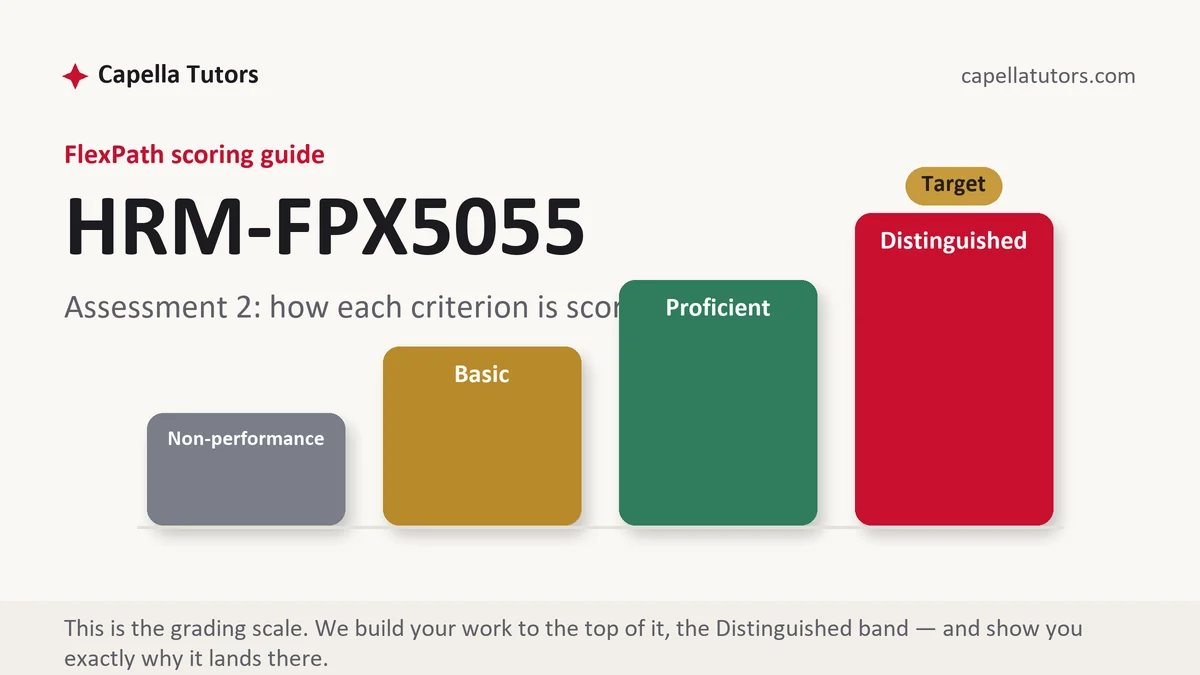
How HRM FPX 5055 Assessment 2 is scored
Nothing here is graded as a letter. Every criterion is placed at one of four levels, and the level wording is the instruction set for the deliverable:
| Level | What it means on a pay administration plan |
|---|---|
| Distinguished | The budget balances to the dollar, allocation is driven by both performance and position in range, any compression is measured before it is corrected, and the correction is funded from a source the writer names. |
| Proficient | A defensible allocation inside budget with the logic stated. Complete, and silent about where the money for the structural corrections came from. |
| Basic | Percentages assigned by performance rating alone, with compa-ratio absent, so a well-paid strong performer receives the same treatment as an underpaid one. |
| Non-performance | The allocation is never totalled, or exceeds the stated budget, which turns a design exercise into a fiscal error. |
The discipline this deliverable teaches is scarcity. An increase budget is a fixed pot, every dollar spent correcting a structural problem is a dollar not available for merit, and a plan that pretends otherwise is the one a finance director rejects on the first page.
The HRM FPX 5055 Assessment 2 method, step by step
-
Total the budget before you allocate a cent of it
Take the eligible payroll, apply the increase percentage, and write the dollar figure at the top of the section. Everything after that is division. Students who allocate first and total afterwards almost always overspend, and an allocation that exceeds its budget cannot be rescued by good prose.
-
Measure compression instead of asserting it
Compare median pay for short-service employees against median pay for long-service employees in the same grade and job family. If the gap is thin or inverted, you have compression and a number to prove it. If it is healthy, say so and stop, because correcting a problem the data does not show is worse than missing one.
-
Build the matrix on two axes, not one
Performance rating decides how much the person earned; position in range decides how much room the grade has to give. A strong performer low in the range should receive more than an equally strong performer already paid above the midpoint, because the second is being paid above the market rate the organization itself chose. Write the matrix out as a grid the reader can audit.
-
Price the structural corrections separately from merit
Adjustments for compression, for employees below the minimum, and for equity findings are not merit and should not be paid from the merit pool without saying so. Show both totals. A plan that spends thirty percent of the pool on corrections before rewarding anyone has told the reader something true and useful about the organization.
-
Apply the statutes where the money moves, not in a preamble
The Equal Pay Act of 1963 covers substantially equal work inside a single establishment, and the only defences it recognises are seniority, merit, a measure of production quantity or quality, and a factor other than sex. Broader pay discrimination claims run under Title VII of the Civil Rights Act of 1964. The Lilly Ledbetter Fair Pay Act of 2009 then resets the filing clock on every affected paycheck, which is why an unexplained differential never simply ages out of reach. Put each of them beside the number it governs.
-
Add the allocation up twice, then self-score
Sum the increase column, compare it to the budget figure at the top, and reconcile any difference before you write the conclusion. Then mark each criterion D, P, B or N and revise anything under D. Faculty are permitted two business days to evaluate, so build that into the date you actually need the grade.
A structure that maps to the criteria
Planning targets our tutors use for an administration deliverable at this level, not Capella rules. Reweight to match the emphasis in your own scoring guide.
| Section | What it must do | Guide |
|---|---|---|
| The population and the budget | Eligible headcount, eligible payroll, the increase percentage, and the resulting dollar pool. | ~200 words |
| Diagnosis | Compa-ratios by group, compression measured, and anyone sitting outside their range. | ~300 words |
| The increase matrix | The grid itself, both axes defined, and the reasoning behind each cell value. | ~300 words |
| Allocation and reconciliation | What each group receives, the total, and how it reconciles to the budget. | ~250 words |
| Structural corrections | Compression and minimum adjustments, priced, with the funding source named. | ~200 words |
| Legal and references | Pay statutes applied to the differentials in this plan, plus current APA both ways. | ~200 words |
Annotated sample excerpt
An original model excerpt from our team, showing the register that scores at the top of the guide. It is study material: learn the moves, then write your own version.
The engineering ladder carries 52 people against a $6.8 million eligible payroll, so a 3.2 percent merit budget is $217,600 and not a dollar more.1 Median pay for engineers with under two years of service is $121,400 against $124,900 for those past five years, a gap of $3,500, or 2.9 percent, which values five additional years of experience at roughly one year of market movement.2 Correcting the fourteen long-service engineers to a defensible position takes an average adjustment of $4,600, or $64,400, which is 30 percent of the merit budget spent before a single merit increase is awarded; the recommendation therefore asks for the correction as a separate one-time request rather than quietly thinning the pool.3
- 1Puts the budget ceiling on the page in dollars before any allocation is discussed, which is the sentence that keeps the rest of the section honest.
- 2Proves compression with two medians and a subtraction rather than describing it as a concern. The interpretive clause afterwards is what turns a figure into a finding.
- 3Costs the correction, expresses it as a share of the pool, then names the funding decision. Naming who pays is the move that lifts a compensation paper out of the Proficient column.
The full premium sample for your exact assessment, written fresh to your scoring guide and issue, is free to request. Study it, revise it into your own voice, and submit work you understand.
The five mistakes that cost Distinguished
- An allocation that overspends the pool. A plan totalling more than its budget is a fiscal error rather than a design choice, and no criterion forgives it.
- Increases assigned on performance alone. Ignoring position in range hands the largest raises to people already paid above the rate the organization chose.
- Compression asserted with no medians behind it. A complaint from a senior engineer is evidence that somebody is unhappy, not evidence of a pay problem.
- Corrections buried inside the merit pool. Mixing equity money with reward money hides the trade-off the criterion most wants to see.
- Statutes parked in a background paragraph. The Equal Pay Act belongs beside the differential it governs, not in a preamble nobody rereads.
Pre-submission checklist
- Eligible payroll, increase percentage and the resulting dollar pool stated before any allocation
- Compression tested with medians by service length inside the same grade
- The matrix uses both performance rating and position in range, with every cell explained
- Allocation totalled and reconciled against the budget to the dollar
- Structural corrections priced separately, with a named funding source
- Pay statutes cited at the point the differential appears, and current APA verified both ways
Merit plan to build?
Send the scoring guide, the population and the budget you have been given. One premium original sample comes back inside 24 to 48 hours, eight people behind it, and an arithmetic pass devoted to nothing except confirming that the allocation reconciles to the budget.