This manual is for HRM FPX 5055 Assessment 1, start to submission. Assessment 1 of HRM FPX 5055, Comprehensive Reward Systems, is the deliverable where pay stops being a policy statement and becomes a set of numbers. The assessment usually asks you to settle a pay philosophy, evaluate a group of jobs, price them against survey data and build a grade with a minimum, a midpoint and a maximum in it. Below is the method our tutors use, a structure that maps to the criteria, and an annotated sample excerpt. Prefer to hand it off? A premium original sample for this exact assessment comes back in 24 to 48 hours, revised free until it meets the guide. Capella's catalog lists the course as HRM-FPX5055, and some courserooms print HRM5055; both point to this same Assessment 1.
One honesty note before the manual: Capella revises courses and scoring guides over time, so always write to the exact scoring guide attached to your assessment in the courseroom. The course identity above is verified on capella.edu; the method and structure below are our tutors' approach to it, not Capella's official rubric text.
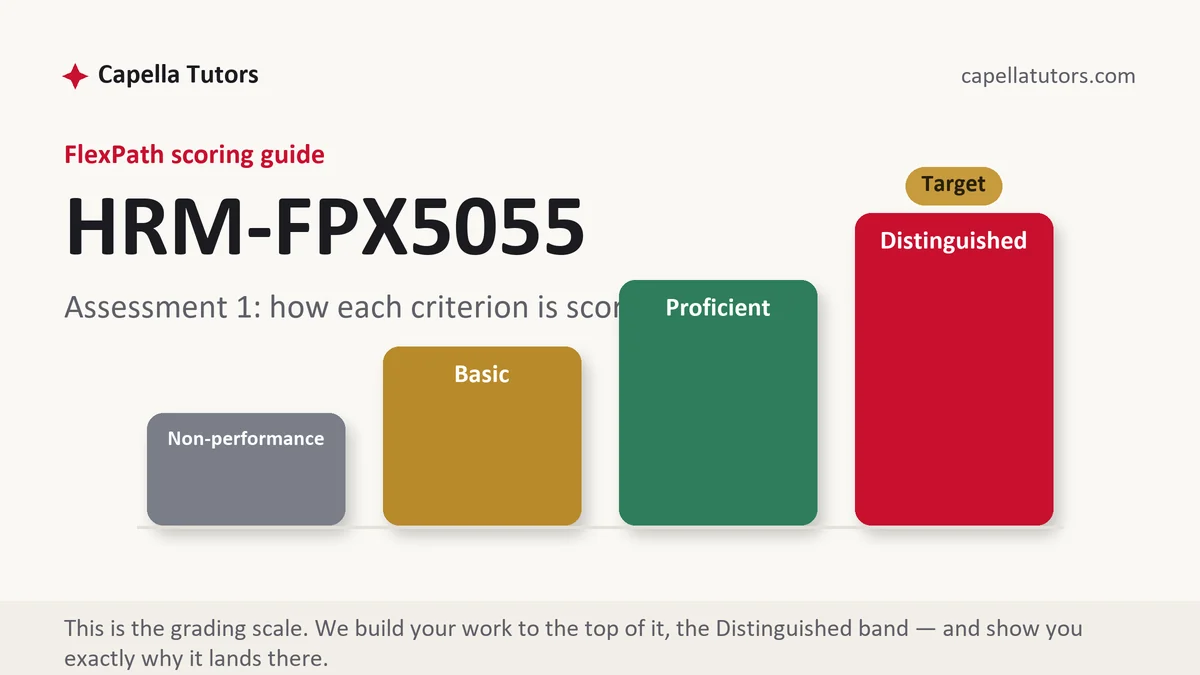
How HRM FPX 5055 Assessment 1 is scored
FlexPath awards no letter grades. Each criterion on your scoring guide is placed at one of four levels, and those level descriptions are the specification you are writing to:
| Level | What it means on a pay structure |
|---|---|
| Distinguished | Market data arrives with its publisher, effective date and scope, the aging is shown as arithmetic, the grade is derived rather than asserted, and the job matches are defended on content instead of on title. |
| Proficient | A complete structure with defensible market data behind it. Correct work whose numbers appear already finished rather than derived on the page. |
| Basic | Rates copied from a source into a table, with a midpoint nobody can trace and a range width nobody chose. The most common landing spot for a first compensation submission. |
| Non-performance | A required element is absent, usually the pay philosophy, which leaves every number that follows with no stated basis for existing. |
A compensation criterion is unusual in that it can be failed by arithmetic alone. If the midpoint in your narrative differs by a dollar from the midpoint in your table, the evaluator stops reading for argument and starts checking every figure, which is a reading posture no paper survives comfortably.
The HRM FPX 5055 Assessment 1 method, step by step
-
Write the pay philosophy as a sentence containing a percentile
Paying competitively is a mood. Naming a percentile, a survey and a geographic market produces a policy somebody can be held to, and every later decision in the paper depends on it. Justify the percentile from the organization's strategy in two sentences, and say what it means for jobs where the labour market is national rather than local.
-
Evaluate the jobs before you price any of them
Name the method, define the compensable factors, weight them, and produce a hierarchy. Then identify benchmark jobs, meaning the ones with enough survey coverage to price reliably, and plan to slot the rest against them. Pricing before evaluating produces a structure that reproduces the market's internal inconsistencies and calls them a design.
-
Match jobs on content, never on title
A title is a marketing artefact and varies by employer. Compare the scope statement in the survey against your own task list, and say in the paper how close the match is and where it is imperfect. A declared partial match is credible; an undeclared one is the flaw a faculty evaluator finds fastest.
-
Age the data to the date the structure takes effect
Survey data always describes a moment already gone. State the source effective date, the months between it and your structure date, the movement figure you are applying and where that figure came from, then do the multiplication in the open. An unaged rate is wrong on the morning the structure launches, by a margin you could have calculated.
-
Derive the grade, then show it holds together
Choose a range spread and say why. A midpoint sits halfway between minimum and maximum, so the three numbers constrain each other and only one of them is a free choice. Check that adjacent grades overlap sensibly, that progression between midpoints is wide enough for a promotion to feel like one, and that no incumbent has been left outside the range without comment.
-
Reconcile the tables against the prose, then self-score
Read every figure in the narrative against the table it came from, out loud if necessary. Then mark yourself D, P, B or N on each criterion and rewrite anything under D. Faculty have up to two business days to evaluate an attempt, so a Thursday submission is usually a result you see the following week.
A structure that maps to the criteria
These are our tutors' planning targets for a structure-building deliverable at master's level, not Capella requirements. Follow your own guide where its weighting differs.
| Section | What it must do | Guide |
|---|---|---|
| Pay philosophy | The market position chosen, the target percentile, the named survey and market, and the strategic reason. | ~200 words |
| Job evaluation | The method, the compensable factors and weights, the resulting hierarchy, and the benchmark jobs. | ~300 words |
| Market data and matching | Sources, publishers, effective dates, scope, and how closely each job matched. | ~250 words |
| Aging the data | Months elapsed, movement applied, source of the movement figure, and the multiplication shown. | ~200 words |
| The grade derived | Minimum, midpoint, maximum, range spread, and the incumbents plotted inside or outside it. | ~300 words |
| Compliance and references | The pay statutes touching this structure, applied where the numbers appear, and current APA. | ~200 words |
Annotated sample excerpt
An original model excerpt from our team, showing the register that scores at the top of the guide. It is study material: learn the moves, then write your own version.
The survey median for the member services representative benchmark is $54,800 at an effective date of 1 April, and the structure takes effect nine months later on 1 January.1 Published movement for the market runs 3.2 percent annualized, so nine months carries 2.4 percent and the median ages to $56,115, which the midpoint adopts at $56,120.2 A 44 percent range spread from a $46,000 minimum produces a $66,240 maximum, and $46,000 plus $66,240 halved returns the midpoint, so the three numbers agree. A representative at $52,400 therefore carries a compa-ratio of 0.93 and a range penetration of 32 percent, and five of the 41 incumbents sit below the new minimum at an average shortfall of $1,300, a $6,500 correction the paper prices rather than mentions.3
- 1Names the source figure and both dates in one sentence, so the reader knows the aging interval before the aging arithmetic appears.
- 2Shows the movement, the fraction of a year and the result, then discloses the rounding. Rounding declared is a design decision; rounding hidden is an error waiting to be found.
- 3Closes the loop by testing the three grade numbers against each other, then converts the structure into a cost the employer actually owes on day one. A band nobody costed is a diagram.
The full premium sample for your exact assessment, written fresh to your scoring guide and issue, is free to request. Study it, revise it into your own voice, and submit work you understand.
The five mistakes that cost Distinguished
- Market data with no effective date. A rate that was never aged to the structure date is already stale when the structure launches.
- Jobs matched on title. Two employers can use the same title for jobs two grades apart, and a criterion asking for defensible data is watching for exactly this shortcut.
- A midpoint that does not sit between the minimum and the maximum. The three numbers are arithmetically bound, and a reader who checks one checks all of them.
- Range spread chosen silently. Forty percent and sixty percent produce very different careers inside one grade, so the choice needs a stated reason.
- Employees below the new minimum left unmentioned. Every incumbent outside a range is a decision the employer now has to fund.
Pre-submission checklist
- The pay philosophy names a percentile, a survey and a geographic market
- Benchmark jobs identified before any pricing, with the evaluation method and factors stated
- Each job match described by content, with imperfect matches declared as imperfect
- Aging shown as arithmetic, with the movement figure attributed to a source
- Minimum, midpoint, maximum and spread reconciled against each other
- Every figure in the narrative re-checked against its table, and current APA verified both ways
Pay structure due this week?
Send the scoring guide, the jobs in scope and whatever survey extracts you hold. Our team of eight puts one premium original sample together inside 24 to 48 hours, with one reader doing nothing but confirming that every figure in the tables agrees with every figure in the prose.