This manual is for HIM FPX 4650 Assessment 3, start to submission. Assessment 3 is where the course puts information in front of the people who decide, and the assessment usually asks for a reporting or decision-support product plus the plan that keeps a measure honest over time. Restraint is what scores here: a handful of well-defined elements, each with a definition, a period, a base and a comparison behind it, will outscore twenty tiles a reader has to decode. Below is the method our tutors use for it, a structure that maps to the criteria, and an annotated sample excerpt. Prefer to hand it off? A premium original sample for this exact assessment comes back in 24 to 48 hours, revised free until it meets the guide. Capella's catalog lists the course as HIM-FPX4650, and some courserooms print HIM4650; both point to this same Assessment 3.
One honesty note before the manual: Capella revises courses and scoring guides over time, so always write to the exact scoring guide attached to your assessment in the courseroom. The course identity above is verified on capella.edu; the method and structure below are our tutors' approach to it, not Capella's official rubric text.
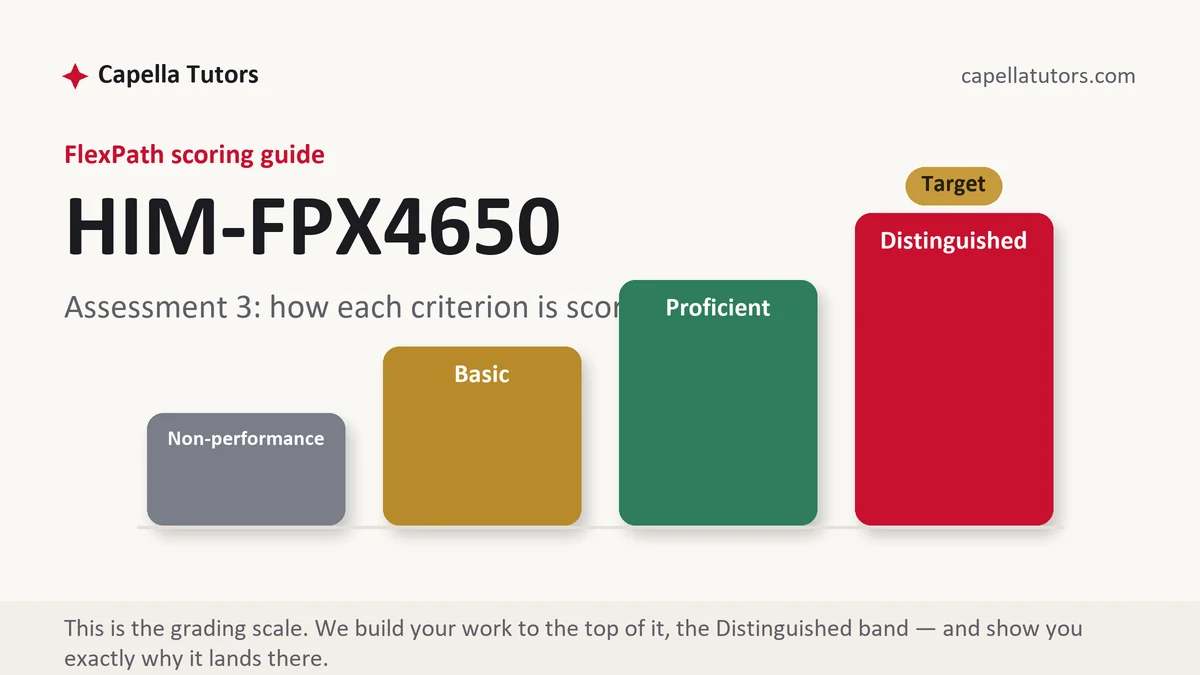
How HIM FPX 4650 Assessment 3 is scored
Four levels, one per criterion, and no averaging between them. The top level is a description of the work, so treat it as the specification:
| Level | What it means on a reporting and monitoring product |
|---|---|
| Distinguished | Every element answers a stated question, carries a definition, a period, a base and a comparison, and names an owner and a refresh cycle. The monitoring plan runs on data the organization already collects. |
| Proficient | A clear, well-organized product with defined measures and a workable plan. Complete, and it does not say how a reader should tell signal from noise. |
| Basic | Tiles showing whatever data was available, percentages with no base, and a plan that promises review without naming a cycle or a person. |
| Non-performance | The monitoring plan or the sustainability criterion goes unanswered, which is the most commonly empty row in this course. |
One idea to carry into the writing: some variation belongs to the process and some arrives from outside it, and a plan that investigates every monthly wobble will exhaust the department by spring. Say in the paper what would count as a signal, and you have answered a criterion most submissions never notice.
The HIM FPX 4650 Assessment 3 method, step by step
-
Start from the criteria, then name the reader and the decision
Headings from the guide first. Then write one sentence saying who opens this product and what they are about to decide, because that sentence is what lets you leave things out. A reporting product designed for nobody in particular grows until it says nothing, and the criteria here reward restraint.
-
Define every element before you place it
Each measure needs a numerator, a denominator, a period and a source before it earns a place on the page. A tile reading 92 percent tells a reader nothing about whether that is good or how many cases produced it, and the fastest way to lose a presentation criterion is to display a number no reader can interpret.
-
Give every value a comparison and a direction of travel
A current figure with no history cannot be read. Put the prior period, the target or a matched benchmark beside each value, and show which way the measure has been moving. Where an outcome is compared across organizations with different patient mixes, say so, and say whether the comparison adjusts for that or simply does not.
-
Write the rule that separates signal from noise
Decide in advance what triggers a look: a value outside the range the process has produced before, a run of periods on the same side of the average, or a steady climb across several periods. One poor month inside the usual range is not a finding, and reacting to it is the standard error of a new analyst. Putting the rule in writing is what keeps the plan usable.
-
Name an owner, a cycle and an escalation path
Say who maintains the product, how often the data refreshes, who reviews it, and what happens when the rule fires. A measure belonging to everybody is reviewed by nobody once the project team disbands, and the sustainability criterion exists precisely to catch that.
-
Check the plan against the data that exists, then submit
Walk each element back to a report the organization already produces and note the ones that would need manual abstraction, because those are the elements that quietly die. Then self-score every criterion and submit with time for one correction rather than none, given the two business days an evaluator may take.
A structure that maps to the criteria
Our tutors' planning targets for a product of this scope, not Capella rules; anything your scoring guide emphasizes should be longer.
| Section | What it must do | Guide |
|---|---|---|
| Purpose, reader and decision | Who opens the product, what they decide, and what the product deliberately omits. | ~175 words |
| Element definitions | Each measure with numerator, denominator, period, source and comparison named. | ~325 words |
| Layout and interpretation | What sits where, why, and the sentence that accompanies each element. | ~250 words |
| Reading the variation | The rule for what counts as a signal, and what an ordinary month looks like. | ~225 words |
| Ownership and cadence | Maintainer, refresh interval, reviewer, escalation path and the data source behind each. | ~225 words |
| Sustainability and references | Manual effort required, what would make the plan fail, and current APA both ways. | ~175 words |
Annotated sample excerpt
An original model paragraph from our team, showing how one reporting element reads when it has been specified rather than drawn. Learn the moves, then define your own elements the same way.
Quality leadership at Westmark asked for a monthly view the medical unit's director could read in two minutes before the operations meeting, so the product carries six elements and no more.1 The first is the 30-day return rate: the numerator counts unplanned inpatient returns within 30 days of a medical unit discharge, the denominator counts medical unit discharges in the same month, the source is the discharge abstract file, and the tile shows the current month, the twelve-month average and the count behind both.2 A month is flagged for review only when the rate falls outside the range of the previous twelve months or when three consecutive months sit above the average, and the health information analyst who refreshes the file on the fifth working day raises the flag with the director rather than waiting to be asked.3
- 1Names the reader, the moment of use and the limit on size in the first sentence. Everything that follows can be justified against it.
- 2Numerator, denominator, source and comparison for a single element, plus the case count. A reader can interpret the tile without asking anybody a question.
- 3A signal rule with two conditions and a named person who acts on it. Ownership and cadence in one sentence is what the sustainability criterion is buying.
The full premium sample for your exact assessment, written fresh to your scoring guide and issue, is free to request. Study it, revise it into your own voice, and submit work you understand.
The five mistakes that cost Distinguished
- Percentages with no base. A figure with no case count behind it cannot be interpreted, and a page of them cannot be defended.
- Everything included. A product built from whatever data was available answers no question, and the criteria here pay for what was left out.
- No comparison. A current value with no prior period, target or benchmark beside it gives a reader nothing to judge.
- Ordinary variation treated as a signal. Investigating every monthly movement burns the department's attention and frequently leaves the process less stable than before.
- A plan nobody owns. Without a named maintainer and a refresh interval, the product stops being updated the month the project ends.
Pre-submission checklist
- Each criterion answered in its own labeled section
- The reader and the decision named, with the omissions justified
- Every element carrying numerator, denominator, period, source and case count
- A comparison and a direction of travel beside each value
- A written rule for what counts as a signal worth investigating
- Maintainer, refresh cycle, reviewer and escalation path named, current APA throughout
Reporting product due at the end of the course?
Send the prompt, the criteria and whatever measures the organization already reports. We define each element before anything is laid out, then write the interpretation so every item on the page has a purpose and a named owner. Premium original sample back inside 24 to 48 hours, revised at no charge until each criterion is answered.