This manual is for HIM FPX 4650 Assessment 1, start to submission. Assessment 1 opens Decision Support and Quality Management in Health Information Management, and the assessment usually asks you to identify a performance problem and establish where the organization currently stands on it. That sounds like a writing task and it is really a definition task: the measure has to be specified before it can be reported, and a rate whose denominator was never written down cannot be checked, compared or defended. Below is the method our tutors use for it, a structure that maps to the criteria, and an annotated sample excerpt. Prefer to hand it off? A premium original sample for this exact assessment comes back in 24 to 48 hours, revised free until it meets the guide. Capella's catalog lists the course as HIM-FPX4650, and some courserooms print HIM4650; both point to this same Assessment 1.
One honesty note before the manual: Capella revises courses and scoring guides over time, so always write to the exact scoring guide attached to your assessment in the courseroom. The course identity above is verified on capella.edu; the method and structure below are our tutors' approach to it, not Capella's official rubric text.
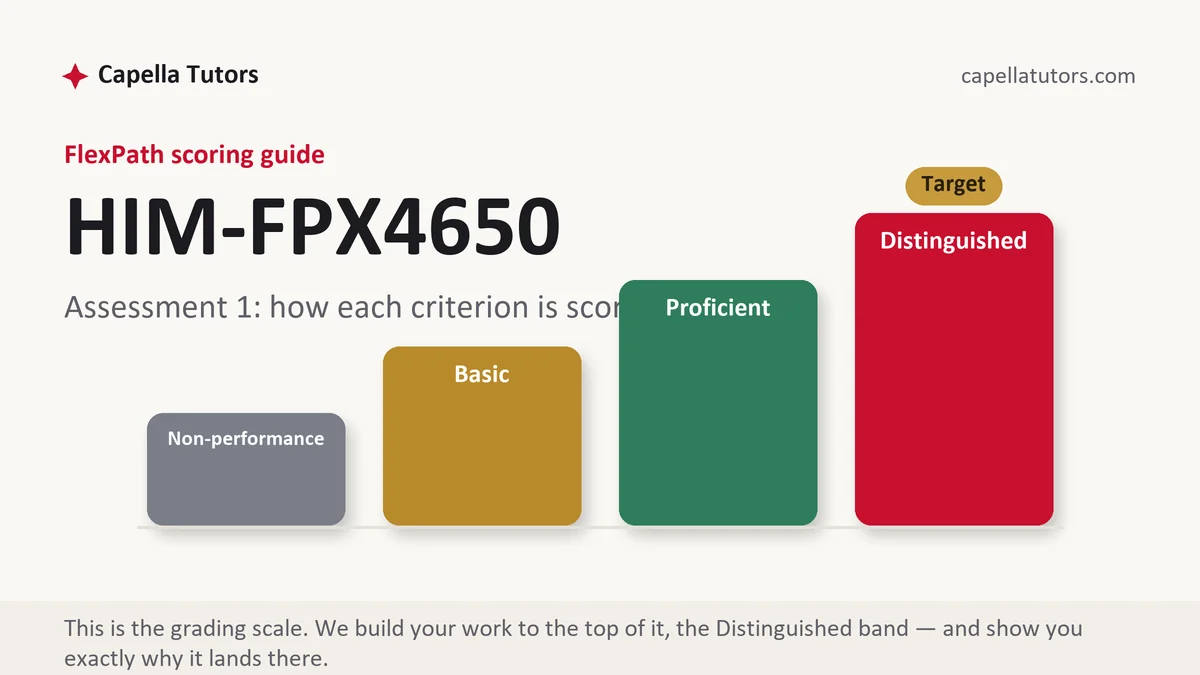
How HIM FPX 4650 Assessment 1 is scored
FlexPath replaces grades with levels, one per criterion, and the wording of the level you are aiming at is the clearest instruction available to you:
| Level | What it means on a problem statement and baseline |
|---|---|
| Distinguished | The measure is specified tightly enough for a reader to reproduce the rate from the same data, the baseline carries its period, and the comparison is matched on population. Data limitations are named with the direction each one pushes the rate. |
| Proficient | A real problem, a correct rate, a reasonable comparison. Everything checks out and nothing has been stress-tested. |
| Basic | A performance gap asserted with a percentage attached and no specification behind it. The usual first-attempt shape in this course. |
| Non-performance | The measure definition or the baseline is absent, and the paper describes a concern rather than measuring one. |
The single highest-value paragraph in this deliverable is a short block naming the numerator, the denominator, the exclusions, the period and the data source. Most submissions do not contain it, and it is what lets everything after it be verified.
The HIM FPX 4650 Assessment 1 method, step by step
-
Build headings from the criteria before you choose a topic
Copy each criterion into the document as a heading and note underneath what evidence would satisfy it. The guide is the outline. Deciding what to write about before reading the criteria is how students end up with an interesting paper that answers three rows out of six.
-
Pick a measure somebody else has already specified
A measure drawn from a published reporting program arrives with a written numerator, a denominator and an exclusion set, so your definition section is sourced instead of invented. Then apply three filters: the organization can plausibly collect the data, the volume is large enough that the rate holds still, and a department owns the underlying process. Anything clearing all three will carry a full paper.
-
Write the specification out before you compute anything
Name the population the measure looks at, the denominator it holds the organization responsible for, what is excluded and why, what the numerator counts, the period, and the version of the specification you used. Specifications get revised, so last year's rate was built under last year's rules and saying which set you applied protects every figure that follows.
-
Separate an exclusion from an exception in writing
Cases the measure was never meant to cover leave the denominator. Cases where a documented reason justifies not doing the thing are handled differently, and treating the two as interchangeable moves your rate without moving performance. Two organizations delivering identical care can report rates several points apart on this decision alone, which is exactly why the criteria want it stated.
-
Compare against something matched, and say how it is matched
A benchmark is only useful when the population and the period line up with yours. Your own prior year, computed the same way, is often the strongest comparison available to an undergraduate paper, and it is honest in a way an unattributed national average never is. When you use an external figure, cite the source and name the population behind it.
-
Test the data before you defend the number, then submit early
Report completeness for the fields the measure depends on, since a value that is optional in the record will sit blank for part of the population and produce a rate describing only the documented. Then self-score each criterion and submit with days left, because an attempt can sit with an evaluator for two business days before you learn anything.
A structure that maps to the criteria
Lengths here are our tutors' planning targets for a baseline paper, not Capella requirements, and your scoring guide decides where more is needed.
| Section | What it must do | Guide |
|---|---|---|
| The problem and why it matters | The performance gap, the organization it sits in, and who is affected by it. | ~175 words |
| Measure specification | Population, denominator, exclusions, numerator, period, source and specification version. | ~275 words |
| Baseline | The computed rate with its counts, and the trend if more than one period is available. | ~250 words |
| Comparison | The benchmark used, how it was matched, and what the gap between the two amounts to. | ~225 words |
| Data quality and limits | Completeness of the fields involved, and the direction each limitation pushes the rate. | ~250 words |
| What follows and references | The question the next stage of work has to answer, in current APA throughout. | ~150 words |
Annotated sample excerpt
An original model paragraph from our team, written to show what a specified measure looks like on the page. Study the moves and then specify your own.
The measure is colorectal cancer screening, taken from the published specification for the 2025 reporting year, with the denominator defined as patients in the eligible age band who had at least one visit to a network clinic during the year, and the numerator as those with a completed screening on file within the interval the specification allows for the test used.1 Across the five Westmark clinics, 214 patients with a documented total colectomy were removed from the denominator as specification exclusions, leaving 8,940 patients, of whom 5,682 were up to date, a rate of 63.6 percent for the calendar year.2 The same calculation applied to the prior year gives 59.8 percent on a denominator of 8,415, and both figures were produced from the registry extract rather than from claims, so neither includes screenings performed outside the network and not documented in the record.3
- 1Names the specification and the reporting year in the first sentence, then defines both halves of the fraction. A reader could apply this definition to their own data and get a comparable number.
- 2Shows the exclusion by count before showing the rate, so the denominator arrives explained rather than asserted. The counts and the percentage agree, which is the property an evaluator can actually verify.
- 3Gives a matched comparison computed the same way, then states the limitation and its direction: outside screenings missing means the true rate is no lower than reported.
The full premium sample for your exact assessment, written fresh to your scoring guide and issue, is free to request. Study it, revise it into your own voice, and submit work you understand.
The five mistakes that cost Distinguished
- A rate with no specification behind it. A percentage nobody can rebuild carries no weight in a quality paper, however accurate it happens to be.
- Exclusions and exceptions collapsed together. Handling both as denominator removals shifts the rate for reasons that have nothing to do with care.
- An unattributed benchmark. A national average with no source and no population behind it is the weakest sentence this paper can contain.
- A measure the organization cannot collect. A definition requiring data nobody holds proposes work that cannot be performed.
- Data quality asserted. Calling the registry reliable is not the same as reporting how complete the fields the measure depends on actually are.
Pre-submission checklist
- Every criterion answered under a heading taken from the guide
- Numerator, denominator, exclusions, period and source stated in one block
- The specification version and reporting year named
- Baseline counts and rate that agree with each other arithmetically
- A benchmark matched on population and period, with its source cited
- Field completeness reported, each limitation given a direction, current APA both ways
Baseline due and the measure still undefined?
Send the prompt, the criteria and any counts you hold. We pin the specification, the period, the population and the exclusions before a paragraph is written, then recompute your figures and tell you where the recomputation disagrees. The premium original sample lands inside 24 to 48 hours, and revision stays free until the guide is answered.