This manual is for HIM FPX 3620 Assessment 3, start to submission. Assessment 3 takes the department to its boundary with the outside world, and the assessment usually asks for guidance somebody could follow: how long records are kept, what triggers the clock, and how a request for information is answered. Requests are not one category, and flattening them is the mistake that costs the most here, because a patient exercising a right of access, a court order and an attorney's subpoena carry different force and different obligations. Below is the method our tutors use for it, a structure that maps to the criteria, and an annotated sample excerpt. Prefer to hand it off? A premium original sample for this exact assessment comes back in 24 to 48 hours, revised free until it meets the guide. Capella's catalog lists the course as HIM-FPX3620, and some courserooms print HIM3620; both point to this same Assessment 3.
One honesty note before the manual: Capella revises courses and scoring guides over time, so always write to the exact scoring guide attached to your assessment in the courseroom. The course identity above is verified on capella.edu; the method and structure below are our tutors' approach to it, not Capella's official rubric text.
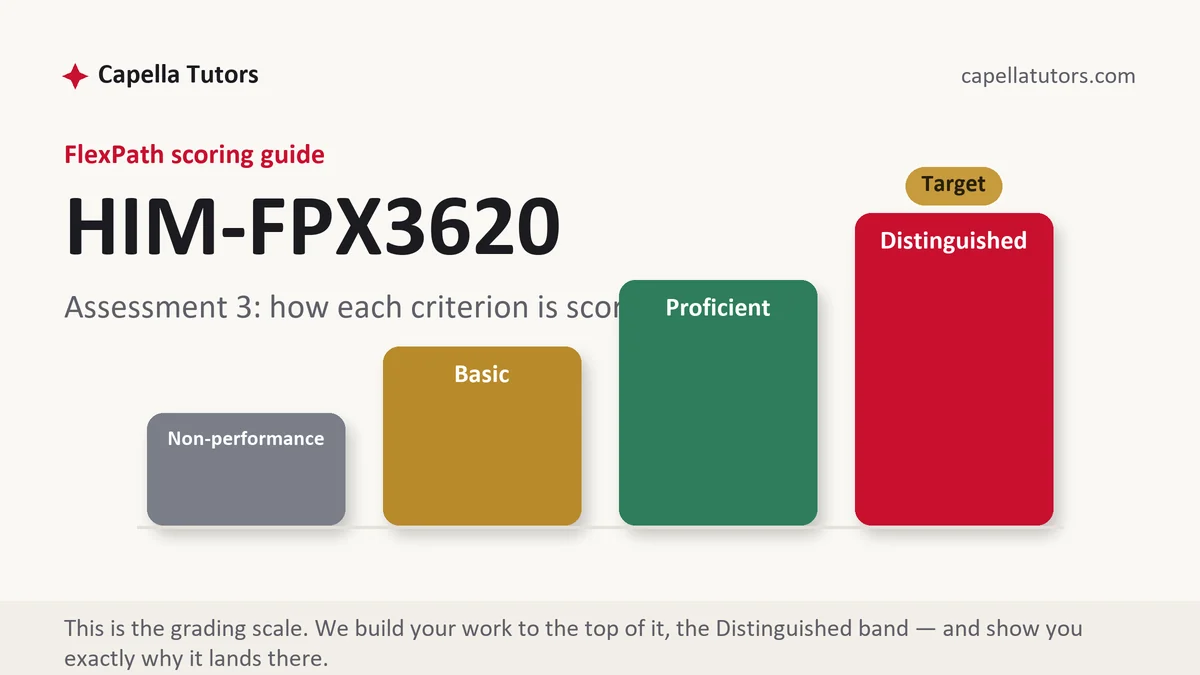
How HIM FPX 3620 Assessment 3 is scored
There is one level per criterion and no partial credit between them. The description of the top level is your specification for that section:
| Level | What it means on retention and disclosure guidance |
|---|---|
| Distinguished | Retention tied to a named jurisdiction and authority with the trigger event stated, request types separated correctly, verification steps and turnaround written down, and guidance a department could adopt without editing it. |
| Proficient | Accurate rules, correctly applied, presented clearly. Complete work that reads as a summary rather than as departmental guidance. |
| Basic | Retention periods quoted with no jurisdiction attached and all outside requests treated as one process. |
| Non-performance | A required element never appears, most often the destruction evidence, the legal hold, or the handling of a request the department cannot honor. |
Two details separate columns in this deliverable. Retention is a state matter with federal, accreditation and payer requirements layered on top, so a number with no jurisdiction beside it cannot be right or wrong. And destruction is a documented act rather than a deletion, which means the paper needs a record of what was destroyed, when, by whom and under what authority.
The HIM FPX 3620 Assessment 3 method, step by step
-
Build headings from the criteria, then fix the setting
Take the rows of the guide as your outline, then state the facility type and the state your guidance is written for. Both change the answer. A multi-site physician group and a small hospital differ in who holds the record and who answers for it, and an evaluator working in this field will see the difference immediately.
-
Put retention in a table with four columns
Record type, retention period, the event the clock starts from, and the statute or standard requiring it. The trigger is the column students omit and the one that decides everything: the clock generally runs from the last date of service, and records of minors carry their own longer rule tied to the age of majority. A table with an authority in every row is worth more than three pages of prose.
-
Separate the request types before you write any workflow
An individual exercising a right of access, a court order, a subpoena signed only by an attorney and an authorization from the patient permitting release to a third party are four different situations. Say what each one compels, what the department must satisfy itself of first, and what turnaround applies. Collapsing them is the single most common error in this assessment.
-
Treat a valid authorization as a checklist
A specific description of the information, who discloses, who receives, the purpose, an expiration event or date, the individual's signature and date, the right to revoke, and notice that information may be redisclosed once it leaves. Check a real or constructed authorization against that list in the paper and say which element fails, since testing beats describing in every criterion in this course.
-
Write what happens to a request you cannot honor
Guidance that only covers the straightforward case is not guidance. Say who verifies the requester, what the department does when an element is missing, who is consulted when the request is compelled but incomplete, and how the refusal or the delay is documented. This is the paragraph that makes the recommendation credible.
-
Close with monitoring, then submit with room to revise
Say who audits released records, on what sample, how often, and how the department would know in six months whether the guidance is being followed. Then submit early in the week, since each attempt can sit with an evaluator for two business days and a course finished on schedule is one that planned for a revision.
A structure that maps to the criteria
Our tutors' planning targets for guidance of this scope rather than Capella rules; where your scoring guide asks for more, give it more.
| Section | What it must do | Guide |
|---|---|---|
| Purpose, setting and scope | The facility type, the jurisdiction, and which records the guidance governs. | ~175 words |
| Retention schedule | Record types, periods, trigger events and the authority behind each row. | ~250 words |
| Holds and destruction | What suspends the clock, the method of destruction, and the evidence retained afterwards. | ~200 words |
| Request types | Each type, what it compels, what must be verified first, and the turnaround that applies. | ~300 words |
| Exceptions and refusals | Requests that are incomplete or cannot be honored, and how each is documented. | ~225 words |
| Monitoring and references | Audit sample, cycle, owner, and authorities cited directly in current APA. | ~175 words |
Annotated sample excerpt
An original model paragraph from our team, written to show how departmental guidance reads when it distinguishes between requests. Learn the moves and write your own.
Two requests reached the Ardsley Medical Group release desk in the same week and they are handled differently from the first minute.1 A former patient asking for her own record is exercising a right of access, so the department verifies her identity, releases in the form she asked for where the record can be readily produced that way, charges no more than the reasonable cost permitted, and answers within thirty days, with one thirty-day extension available if she is told why in writing.2 The second request arrived as a subpoena signed by an attorney with no judge's signature and no accompanying order, which does not by itself compel production, so the guidance directs the desk to hold the release until it has confirmed that the patient was notified or that a protective order exists, and to log the date of that confirmation beside the request.3
- 1Sets up a contrast between two live requests instead of defining categories in the abstract. The paper is applying rules from the first sentence.
- 2Verification, format, fee limit and turnaround in one sentence, with the extension condition attached. Every element here is something a clerk could follow tomorrow.
- 3Names what the second request does not compel, then says what has to be satisfied before anything moves and where it is recorded. Separating force from paperwork is the criterion most submissions miss.
The full premium sample for your exact assessment, written fresh to your scoring guide and issue, is free to request. Study it, revise it into your own voice, and submit work you understand.
The five mistakes that cost Distinguished
- A retention period with no jurisdiction. A number floating free of the state or standard requiring it cannot be evaluated at all.
- The trigger event omitted. Ten years from what? Without the starting event the schedule cannot be applied to a single record.
- All outside requests merged. Treating a compelled request and a patient's own access request as one workflow collapses the criterion they were written to test.
- Destruction described as deletion. Without a method suited to the medium and a permanent record of the act, the disposition row is unanswered.
- Only the easy case covered. Guidance that never addresses a missing authorization element or a hold is not usable by the department that asked for it.
Pre-submission checklist
- Every criterion answered in its own labeled section
- Facility type and jurisdiction stated in the opening paragraph
- Retention table carrying period, trigger event and authority in every row
- Request types separated, each with verification steps and turnaround
- Holds, destruction method and destruction evidence all addressed
- An audit sample, cycle and owner, with authorities cited directly in current APA
Departmental guidance due and the rules are jurisdictional?
Send the prompt, the criteria and the state or facility type if the prompt names one. Retention rows come back with an authority attached rather than a number floating on its own, and each request type gets its own workflow. Premium original sample in 24 to 48 hours, revised free until the criteria are met.