This manual is for HIM FPX 3620 Assessment 2, start to submission. Assessment 2 turns to the quality of what the record contains, and the assessment usually asks you to evaluate a data integrity problem and say what the department should do about it. The vocabulary is already settled in this field, so the paper is graded partly on whether you use it: accuracy, completeness, consistency, currency, granularity, precision, timeliness and relevance let you say exactly what is wrong with a field instead of calling the data poor. Below is the method our tutors use for it, a structure that maps to the criteria, and an annotated sample excerpt. Prefer to hand it off? A premium original sample for this exact assessment comes back in 24 to 48 hours, revised free until it meets the guide. Capella's catalog lists the course as HIM-FPX3620, and some courserooms print HIM3620; both point to this same Assessment 2.
One honesty note before the manual: Capella revises courses and scoring guides over time, so always write to the exact scoring guide attached to your assessment in the courseroom. The course identity above is verified on capella.edu; the method and structure below are our tutors' approach to it, not Capella's official rubric text.
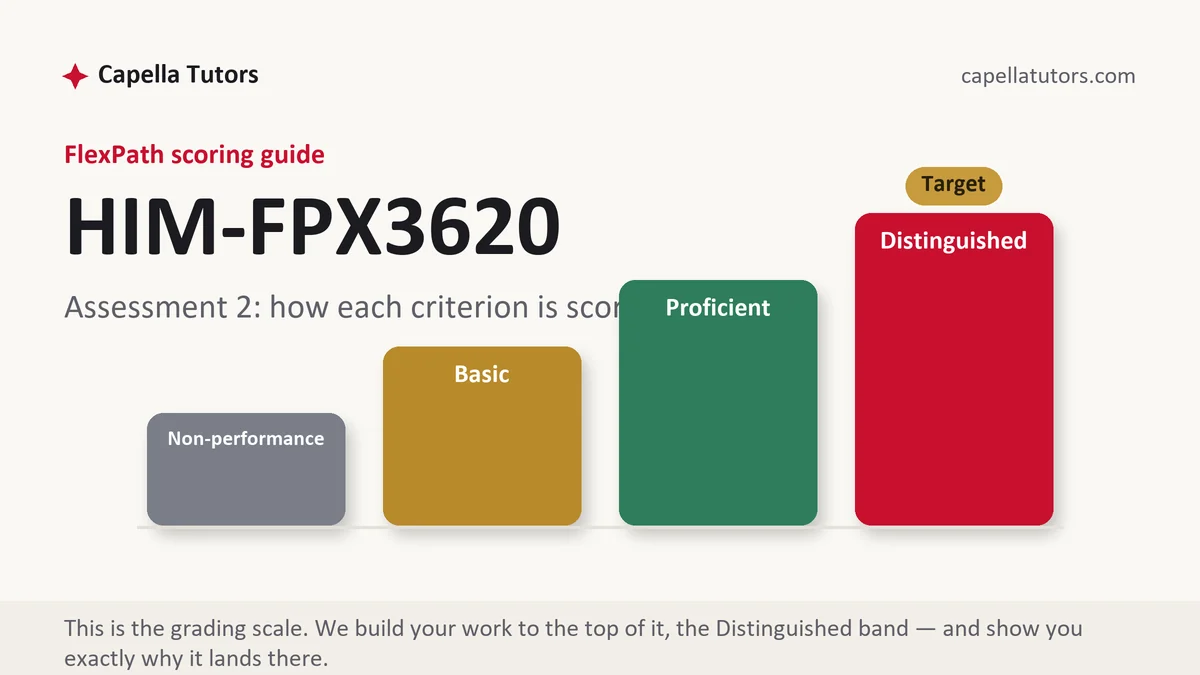
How HIM FPX 3620 Assessment 2 is scored
Criteria carry the grade in FlexPath and each one resolves to a single level. Read the top level as a description of the work rather than as praise:
| Level | What it means on a data integrity review |
|---|---|
| Distinguished | The defect is named with the data quality characteristic it violates, measured against a base, traced to the workflow that produces it, and answered with a control that keeps the original record retrievable. |
| Proficient | The problem is identified accurately and a sound fix proposed. Correct throughout, and it never says how the defect entered the record. |
| Basic | The data called unreliable, with the characteristics listed in the abstract and no measurement of anything in the prompt. |
| Non-performance | An element the criterion required is absent, commonly the measurement or the correction workflow. |
One rule of this profession shapes the whole deliverable. A record is never edited into a cleaner version of itself: a correction leaves the original retrievable, with who changed what and when. Students arriving from other fields find that counterintuitive, since every other document they have handled improves by having its mistakes removed, and here the removal is the offense.
The HIM FPX 3620 Assessment 2 method, step by step
-
Outline from the criteria, then name the characteristic at issue
Headings first, straight from the guide. Then decide which data quality characteristic your problem actually breaks, because a field that is filled in wrongly, a field that is filled in late and a field two departments define differently are three separate failures needing three separate fixes.
-
Measure the defect instead of describing it
State how many records you examined, over what window, and how many carried the defect. A rate makes the problem fundable and a description does not, and the difference between the two is usually a single afternoon of counting.
-
Find the workflow step where the defect enters
Follow the field from the screen where somebody fills it to the report where somebody relies on it. Defects enter at a specific point: a value that is optional at entry, a template that fires the same text whether or not the work happened, a field two departments populate with different meanings. Name the point, because that is where a control can be placed.
-
Say what the defect does downstream
A quality problem inside the record becomes a wrong number in a report and then a wrong decision in a meeting. Trace one of those chains in the paper. It answers the criterion asking why the problem matters far better than a paragraph about the importance of good data, and it takes three sentences.
-
Design the correction so the original survives
Any fix has to preserve the prior version and identify who changed what and when. Write the workflow: who may amend, who reviews the amendment, how the entry is labeled, and where the earlier version remains retrievable. A control that quietly overwrites is not a control, it is a second integrity problem wearing the first one's clothes.
-
Add prevention with a cycle, then self-score and submit
Correction handles the records you already have; prevention handles next month's. Give the monitoring a sample size, an interval and an owner by role. Then mark your draft against each criterion honestly and submit early in the week, because two business days of evaluation plus one revision is the arithmetic that decides whether you finish on time.
A structure that maps to the criteria
Planning targets our tutors work to on a review of this size, not Capella limits; expand whatever your scoring guide leans on.
| Section | What it must do | Guide |
|---|---|---|
| The problem and its characteristic | The defect, the field it lives in, and the data quality characteristic it violates. | ~200 words |
| Measurement | Records examined, window, defects found, and the rate the two produce. | ~250 words |
| How it enters | The workflow step, the missing control, and who owns that step today. | ~275 words |
| Downstream effect | One traced chain from the field to a report to a decision somebody makes. | ~200 words |
| Correction and prevention | The amendment workflow that preserves the original, plus monitoring with a cycle and an owner. | ~300 words |
| References | Practice guidance and regulation cited to the source, current APA in text and list. | as needed |
Annotated sample excerpt
An original model paragraph from our team, showing how an integrity finding reads when it has been measured and located. Take the structure and write your own version.
A review of 210 daily progress notes drawn from 42 completed rehabilitation stays at Coyle Rehabilitation Hospital found 46 notes, or 21.9 percent, in which the functional status paragraph was identical to the previous day's text while the therapy flowsheet for that day recorded a change in the patient's assist level.1 The failure is one of currency rather than accuracy, since each paragraph was true when it was first written and none of them was false at the moment of entry.2 The notes were built by carrying the previous entry forward into a template that presents the paragraph already populated, so the default is to accept text that no longer describes the patient, and the control the record lacks is a prompt requiring the author to confirm or replace that paragraph before the note can be closed.3
- 1Sample, base, rate and the contradiction that identifies the defect. The finding rests on two sources disagreeing, which is stronger than an opinion about note quality.
- 2Names the specific characteristic at issue and rules out the one a casual reader would reach for. Precision in this vocabulary is exactly what the course is examining.
- 3Traces the defect to the moment of entry and names the missing control. A default nobody has to override is a design problem, and design problems can be fixed.
The full premium sample for your exact assessment, written fresh to your scoring guide and issue, is free to request. Study it, revise it into your own voice, and submit work you understand.
The five mistakes that cost Distinguished
- The characteristics recited. Listing all ten qualities of good data, then applying none of them to the prompt, is the classic middle-column paper here.
- A defect with no rate. Records examined and defects found are two numbers, and without both the problem cannot be sized or funded.
- Correction by overwriting. A fix that removes the earlier version breaks the rule the record exists to satisfy.
- Blame instead of design. Attributing the defect to careless staff ends the analysis, while naming an unconfirmed default opens a fix.
- Prevention with no interval. Monitoring that lacks a sample size, a cycle and an owner will not survive the month the project ends.
Pre-submission checklist
- Each criterion answered under its own heading
- The data quality characteristic named precisely, and the near-miss alternative ruled out
- Records examined, window and defect count reported together
- The entry point of the defect located in a workflow step with an owner
- An amendment workflow that keeps the original retrievable and identifies the author
- Monitoring with sample size, interval and owner, in current APA throughout
Integrity review due and nothing counted yet?
Send the prompt, the criteria and any audit results you hold, even rough ones. We measure the defect against a stated base, locate the entry point in the workflow, and write the correction so the original entry survives it. Premium original sample in 24 to 48 hours, revisions free until the criteria are satisfied.