This manual is for HIM FPX 3620 Assessment 1, start to submission. Assessment 1 opens Foundations of Health Information Management, and the assessment usually asks you to apply documentation standards to a records practice rather than to summarize what those standards are. That distinction is the whole grade. Explaining that entries need an author, a date and an authentication is knowledge; testing named entries against a stated rule and reporting what you found is application, and only the second one satisfies the criteria. Below is the method our tutors use for it, a structure that maps to the criteria, and an annotated sample excerpt. Prefer to hand it off? A premium original sample for this exact assessment comes back in 24 to 48 hours, revised free until it meets the guide. Capella's catalog lists the course as HIM-FPX3620, and some courserooms print HIM3620; both point to this same Assessment 1.
One honesty note before the manual: Capella revises courses and scoring guides over time, so always write to the exact scoring guide attached to your assessment in the courseroom. The course identity above is verified on capella.edu; the method and structure below are our tutors' approach to it, not Capella's official rubric text.
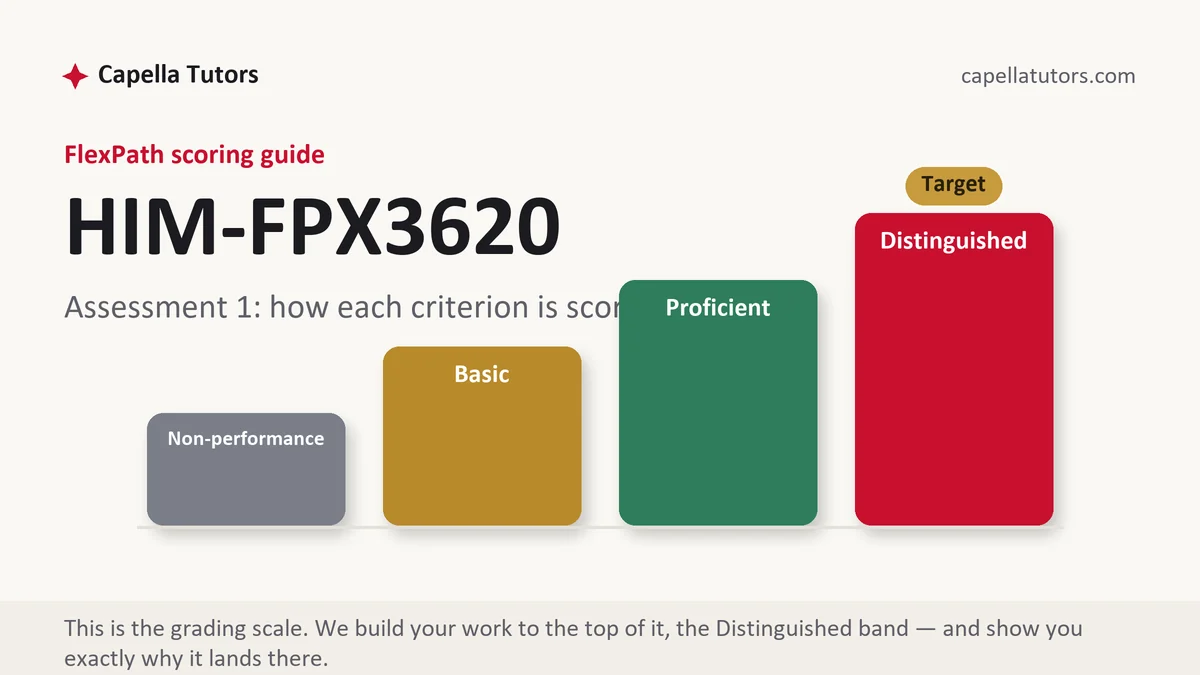
How HIM FPX 3620 Assessment 1 is scored
FlexPath has levels rather than grades. Each criterion in your guide lands on one of four, and the level text is the most direct writing instruction you will be given:
| Level | What it means on a documentation standards review |
|---|---|
| Distinguished | The record set under examination is defined, specific entries are tested against a stated rule, the defects are counted with their base, and the pattern behind them is addressed rather than the individual error. |
| Proficient | Standards named correctly and applied to the situation completely. Accurate, and it stops at the instance instead of reaching the pattern. |
| Basic | A competent summary of what documentation standards require, with the practice in the prompt appearing only in passing. |
| Non-performance | A criterion goes unanswered, most often the definition of which record set the paper is about or the recommendation at the end. |
Vocabulary carries more weight in this course than in most. The legal health record, the designated record set and everything the system stores are three different boundaries around one patient, and using the terms interchangeably costs a criterion that cannot be recovered later in the paper.
The HIM FPX 3620 Assessment 1 method, step by step
-
Turn the guide into a skeleton before you form an opinion
One heading per criterion, the top-level description pasted underneath, and nothing written until that frame exists. It takes ten minutes and it prevents the most expensive mistake in the course, which is a well-written paper that answers the prompt rather than the criteria.
-
Say which record set the paper is about, in the first paragraph
Name the boundary you are working inside and define it in your own words. An evaluator reading a paper that treats the official account of care and the broader set used to make decisions about a patient as one thing will mark the definition row down, and every later section inherits that confusion.
-
Quote the rule you are applying, then find its source
Write the requirement as a rule with a number in it wherever one exists: authentication inside a stated window, countersignature of verbal orders within a stated period, late entries labeled as late. Cite the professional guidance, regulation or accreditation standard that sets it, not a lecture slide that summarized it, and name the jurisdiction if the rule is a state matter.
-
Test real entries and count what fails
Pick a defined sample, state how many records you reviewed and over what window, then report failures as a count against that base. A review of a stated number of records with a stated number of defects is evidence. A sentence saying documentation is often late is an impression, and the criteria cannot pay for impressions.
-
Move from the instance to the pattern
One late entry is a correction. Fourteen late entries concentrated in two authors is a workflow problem, and naming that concentration is what turns an audit into an analysis. Say where the defects cluster, by author, by day of the week, by document type, and let the cluster choose your recommendation for you.
-
Write a recommendation with edges, then submit early
Say who reviews, how often, on what sample size, and what happens when the same clinician appears three times. Close with how anybody would know in six months whether it worked. Then submit with days left in the session, since an evaluator can take two business days for each attempt.
A structure that maps to the criteria
Lengths below are our tutors' planning targets for a review of this kind rather than Capella rules, and any criterion your guide weights heavily deserves more.
| Section | What it must do | Guide |
|---|---|---|
| Purpose and record set | The organization, the practice examined, and which record set the paper covers, defined. | ~175 words |
| The standards that apply | Each requirement stated as a rule with its window, cited to the body that sets it. | ~250 words |
| Review method | Sample size, selection, review window, and the elements each record was tested against. | ~200 words |
| Findings | Defects as counts against the base, with where they cluster reported plainly. | ~300 words |
| Recommendation | Who reviews, how often, on what sample, and what a repeat occurrence triggers. | ~250 words |
| References | Practice guidance, regulation and jurisdictional law cited directly, current APA both ways. | as needed |
Annotated sample excerpt
An original model paragraph from our team, written to show how an applied finding reads next to a described one. Study the moves, then run your own review the same way.
Halloway Surgical Partners requires operative reports to be authenticated within seven days of the procedure, a window its medical staff bylaws set and its accreditation survey checks.1 Of the 84 operative reports completed at the Bell Street site during February, 19 were authenticated after that window closed, a defect rate of 22.6 percent, and the interval ran from eight to thirty-one days with a median of eleven.2 Thirteen of the 19 belong to two surgeons who operate on Fridays and dictate at the end of the list, which makes this a scheduling and reminder problem rather than nineteen separate lapses of attention, and it is the reason the recommendation below changes when the reminder fires rather than adding a policy sentence.3
- 1States the rule with its window and the authority behind it before any finding appears. The standard is testable, which is what makes the next sentence a finding.
- 2Count, base, rate and the spread of the interval. A reader can recompute the percentage and can see how far past the window the worst case ran.
- 3Locates the cluster and names the workflow behind it, then lets that choose the recommendation. Addressing the pattern instead of the instance is the top-column move in this course.
The full premium sample for your exact assessment, written fresh to your scoring guide and issue, is free to request. Study it, revise it into your own voice, and submit work you understand.
The five mistakes that cost Distinguished
- Terms used loosely. Writing chart where the paper means the legal health record is the kind of imprecision this course exists to remove.
- Standards described, never applied. An accurate summary of documentation requirements answers a question the criteria did not ask.
- A defect rate with no base. Nineteen late reports means nothing until a reader knows how many were reviewed and over what window.
- Vendor charts used as legal authority. A records-copying company's summary table is marketing material and is often out of date.
- A recommendation with no reviewer. Naming nobody and no cycle turns the final criterion into a statement of good intentions.
Pre-submission checklist
- Every criterion has its own labeled section
- The record set named and defined in the writer's own words
- Each standard written as a rule with its window and its source
- Sample size, selection and review window stated before the findings
- Defects reported as counts against the base, with the cluster identified
- A reviewer, a cycle and a repeat-occurrence rule, in current APA throughout
Want this assessment done with backup?
Send the prompt, the scoring guide, and the state or facility type if your prompt names one, since a records policy for a small physician group and one for a hospital differ in ways an evaluator notices. A team of eight, including a research analyst and two QA reviewers, returns a premium original sample in 24 to 48 hours, revised free until the criteria are met.