This manual is for EDD FPX 8524 Assessment 3, start to submission. Assessment 3 usually asks for scenarios rather than a forecast, and the difference is graded. A scenario set takes the two uncertainties that would most change your district's next several years, crosses them, and writes distinct futures each of which would demand a different decision. Your scoring guide decides the deliverable and how much of the environmental evidence must be documented. Below are the method, a section plan the criteria dictate, and one annotated excerpt. Want it handed over instead? A premium original sample reaches you inside 24 to 48 hours, with revisions included until every row clears. Capella's catalog lists the course as EDD-FPX8524, and some courserooms print EDD8524; both point to this same Assessment 3.
One honesty note before the manual: Capella revises courses and scoring guides over time, so always write to the exact scoring guide attached to your assessment in the courseroom. The course identity above is verified on capella.edu; the method and structure below are our tutors' approach to it, not Capella's official rubric text.
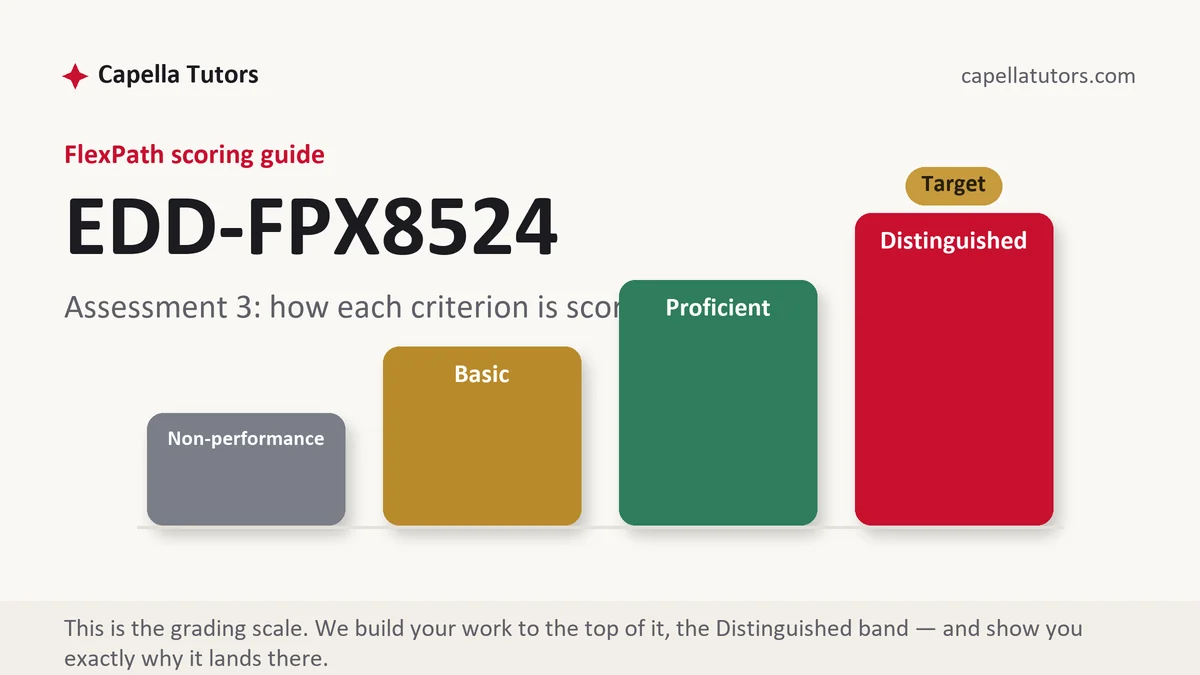
How EDD FPX 8524 Assessment 3 is scored
Criteria here resolve to four levels rather than to a percentage, and the language of those levels is the assignment:
| Level | What it means on a scenario set |
|---|---|
| Distinguished | The two uncertainties are chosen with a reason, the futures would force different decisions, each carries an early indicator already collected locally, and one move paying off across all of them is identified. |
| Proficient | Four coherent futures with implications drawn. Complete, and short of the row above wherever the futures converge on the same decision or the indicators are not local. |
| Basic | Optimistic, pessimistic and likely versions of one future, plus a paragraph of technology nouns. Nothing that would change a decision. |
| Non-performance | A required element is absent, most often the uncertainties themselves, or the implications the criterion asked for. |
Foresight is not one activity, and saying so is usually worth a criterion by itself. Demography can be extended, fiscal politics has to be branched, and technology adoption is a set of governance decisions a district controls rather than a wave it awaits.
The EDD FPX 8524 Assessment 3 method, step by step
-
Choose two uncertainties that actually cut
The pair has to pass two tests: each could plausibly resolve either way inside your horizon, and each would change what the district should do. A state course-access requirement and the supply of licensed secondary teachers are uncertainties. Rising expectations and accelerating change are not, since they resolve one way and imply nothing.
-
Cross them and name the four futures
Build the two by two grid and give each cell a short name a board would remember. Naming matters more than it sounds: a future with a name gets discussed and an unnamed quadrant gets skipped. Then check the grid honestly, since two cells implying the same decision mean you chose the wrong second uncertainty.
-
Write the first ninety days under each
Under every future, say what the district does immediately, what it must already have prepared for that response to be possible, and what it stops doing to free the capacity. Ninety days is the right window because it is short enough to force specifics and long enough to contain a board meeting.
-
Attach an early indicator you already collect
Each future needs the signal that tells you it is arriving, drawn from something the district counts anyway: licensed applicants per posted secondary vacancy, students enrolled in courses delivered from outside the building, the date the state releases a rule for comment. Put a threshold and a review date on each.
-
Handle technology as governance
Adoption is a decision with a contract behind it rather than a trend. Write the conditions under which the district would take on any external provider or tool: what evidence standard the claim must meet, what student data leaves the building and under what agreement, who reviews for disparate effect, who approves classroom use, and what the exit looks like.
-
Find the robust move, then self-score
Close on the one action worth taking under most of the four futures, with its cost and its owner. A move paying off across scenarios is the most valuable output of the exercise and the part a superintendent will actually read. Then mark each criterion honestly and name the class of shock your analysis would miss entirely.
A structure that maps to the criteria
These are our planning numbers for a scenario deliverable rather than Capella requirements. Weight the futures and their indicators, since those rows separate this from a magazine article.
| Section | What it must do | Guide |
|---|---|---|
| Horizon, unit and the environment | Years covered, the district in question, and the evidence describing its current position. | ~250 words |
| The two critical uncertainties | Each named, sourced, and defended as both genuinely uncertain and decision-changing. | ~250 words |
| The four futures | Each cell named and described in enough detail to be recognizable, with assumptions stated. | ~350 words |
| First ninety days under each | The immediate response, the preparation it requires, and what stops to fund it. | ~250 words |
| Early indicators | The local signal for each future, with a threshold and a review date. | ~200 words |
| The robust move, blind spots, references | The action worth taking across futures, the shock you would miss, current APA both ways. | ~200 words |
Annotated sample excerpt
One original paragraph from our writers, at the specificity a scenario criterion rewards. Take the moves, then build a grid around your own two uncertainties.
Call the first quadrant Thin Bench, Open Catalog: the state course-access requirement takes effect on schedule and licensed secondary applicants keep falling, so the district meets its catalog obligation almost entirely through externally delivered courses.1 Inside ninety days that means a provider contract, a data agreement covering what leaves the building, a proctoring assignment for two paraprofessionals, and a decision about which two in-person electives close to fund the seat licenses; the preparation it requires is a board-approved data agreement template, which we do not currently have.2 The indicator is licensed applicants per posted secondary vacancy, counted in our own hiring records and currently 1.4; below 1.0 across two consecutive spring cycles, this quadrant is arriving.3
- 1A named quadrant with both uncertainties resolved in a stated direction. The name is what lets a board discuss the future without rereading the grid.
- 2Specific first actions, plus the preparation the district lacks. Naming the missing prerequisite is more useful than any prediction in the paragraph.
- 3An indicator the district already collects, with a current value, a threshold and a counting rule. That converts speculation into monitoring.
The full premium sample for your exact assessment, written fresh to your scoring guide and issue, is free to request. Study it, revise it into your own voice, and submit work you understand.
The five mistakes that cost Distinguished
- One future written four times. Quadrants implying the same decision have tested nothing, and the criterion is looking for the point where the right move changes.
- Uncertainties that are not uncertain. A trend resolving in only one direction belongs in the environmental section, not in the grid.
- Indicators drawn from national reports. A signal a district does not itself collect will never be watched, so the monitoring plan is decorative.
- Adoption written as destiny. Adoption carries a contract, a data agreement and an evidence standard, all of which the district decides.
- No robust move. A scenario set ending without the action worth taking across futures leaves a superintendent with four essays and no decision.
Pre-submission checklist
- Two uncertainties named, sourced, and defended as decision-changing
- Four futures, each with a name and stated assumptions
- No two futures implying the same district decision
- A ninety-day response under each, including what stops to fund it
- One locally collected indicator per future, with a threshold and a review date
- A robust move identified, and the class of shock your analysis would miss named
Scenario set due for review?
Send the prompt, the guide, your district's size and state, and the two pressures your leadership team is already arguing about. Eight people, including a research analyst and two QA reviewers, return a premium original sample in 24 to 48 hours with named futures and local indicators attached, revised free until every criterion is satisfied.