This manual is for EDD FPX 8524 Assessment 1, start to submission. Assessment 1 usually asks for an analysis of the environment a leader cannot opt out of, and the sharpest version of that is a single rule read closely. The assessment tends to want the instrument itself, the obligations it creates, the decisions it constrains in your own district, and the difference between what the text requires and what local habit has added. What form it takes and who reads it are decided by the guide attached to your assessment. Below is how our tutors work it, the sections that result, and an annotated excerpt. Prefer to hand it off? A premium original sample for this deliverable arrives within 24 to 48 hours and is revised free until the criteria are met. Capella's catalog lists the course as EDD-FPX8524, and some courserooms print EDD8524; both point to this same Assessment 1.
One honesty note before the manual: Capella revises courses and scoring guides over time, so always write to the exact scoring guide attached to your assessment in the courseroom. The course identity above is verified on capella.edu; the method and structure below are our tutors' approach to it, not Capella's official rubric text.
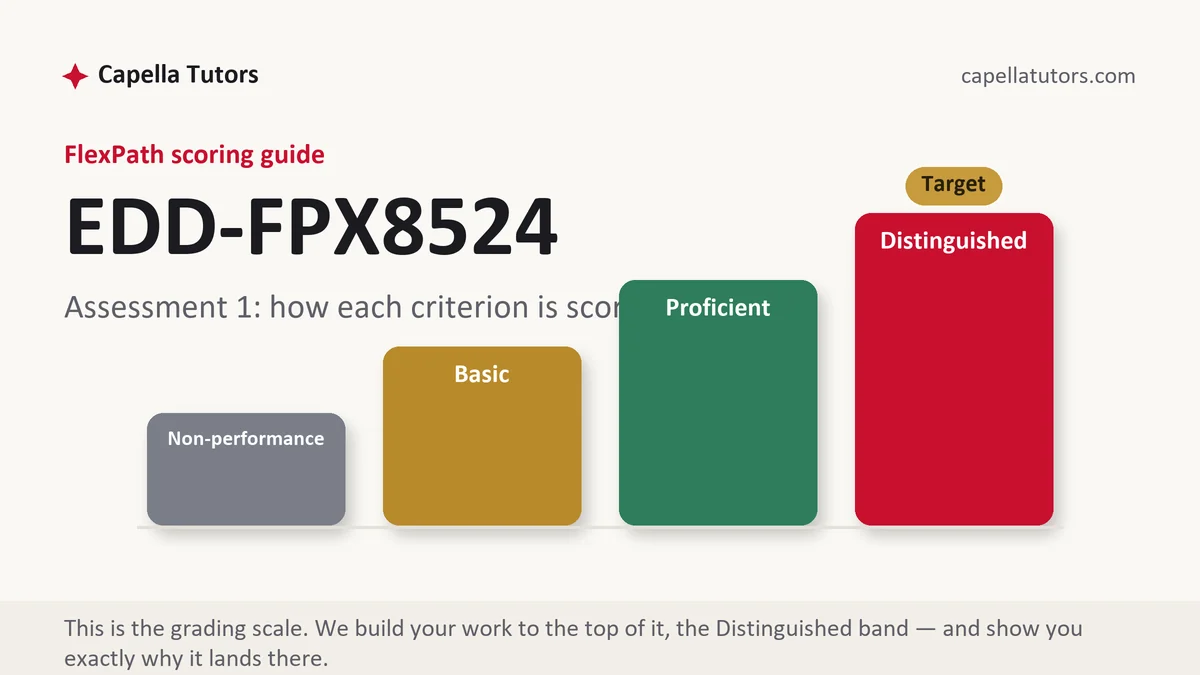
How EDD FPX 8524 Assessment 1 is scored
FlexPath reports levels rather than points. Each criterion on your guide lands on one of four, and the level wording is the specification:
| Level | What it means on a policy analysis |
|---|---|
| Distinguished | The rule is read from its own text, obligations are separated from local practice, the consequence is worked in your district's numbers, and the fact-specific limits are stated. |
| Proficient | The policy described accurately with its effects identified. Complete, and one move short wherever the analysis rests on commentary or stops before the local arithmetic. |
| Basic | A summary of a rule with general observations about accountability. No primary citation, no district consequence, nothing a board could act on. |
| Non-performance | A named element is missing, most often the primary source, or the application to the writer's own setting. |
Two habits separate a doctoral policy analysis from a briefing note. The first is reading the instrument rather than an article about it. The second is naming what the rule leaves free, because the space where a district is legally unconstrained and merely habitual is where a leader can move this year.
The EDD FPX 8524 Assessment 1 method, step by step
-
Read the instrument itself
Find the text that actually binds: the statute, the administrative rule, the approved state plan, the board policy. The federal frame is the Every Student Succeeds Act, in force since 2015 in place of No Child Left Behind, which left plan design to each state while retaining subgroup reporting and participation rules. Almost everything operational lives in state code.
-
Separate the obligation from the practice
Write two columns: what the rule requires, and what your district currently does. The gap is usually large and it runs in both directions, since local practice tends to over-comply in some places and quietly under-comply in others. That gap, named precisely, is the finding most analyses at this level never reach.
-
Work the consequence in local numbers
A rule becomes real when it is priced. Take the indicator the rule weights, apply it to your own counts, and show what moves. Report the denominator every time, because an indicator computed on a subgroup of 22 students behaves nothing like the same indicator computed on 400, and the minimum group size rules usually matter more than the weights.
-
Say who decides what, and by when
Read the compliance calendar alongside the rule. A response requiring board action in June with a thirty-day posting requirement has already failed if you are writing in May. Name what the superintendent decides, what the board must approve, what the state must be notified of, and where district counsel reviews before anything is published.
-
State the fact-specific limits
Describe obligations as they bind a class of situations rather than issuing a ruling on your own facts. Application turns on the state, the program and the individual case, and obligations under disability and civil rights statutes run separately from any accountability rule. Saying so reads as professional judgment; a confident legal conclusion drawn from a summary article reads as the opposite.
-
Recommend one thing, then self-score
Close on the action worth taking under most readings of the rule, with its cost, its owner and the tradeoff it forces. One defensible recommendation beats five aspirational ones. Then mark each criterion at the honest level, check every legal statement against the document it came from, and submit once the citations hold.
A structure that maps to the criteria
These word targets are our planning numbers for a policy deliverable rather than Capella requirements. Expand whichever section your guide describes in the most detail.
| Section | What it must do | Guide |
|---|---|---|
| The rule and its source | What the instrument is, who issued it, when it took effect, and the text that does the work. | ~200 words |
| Obligations created | Each requirement stated plainly, cited to the primary document, with its deadline attached. | ~300 words |
| Obligation against current practice | What your district does now, where it exceeds the rule, and where it falls short. | ~250 words |
| Local consequence | The arithmetic: the indicator applied to your own counts, denominators shown, thresholds identified. | ~300 words |
| Decision rights and calendar | Who must act, in what order, by which date, and where counsel reviews. | ~200 words |
| Recommendation, limits, references | The action worth taking, the tradeoff it forces, the fact-specific caveat, current APA both ways. | ~200 words |
Annotated sample excerpt
One original paragraph from our writers at the standard a policy criterion rewards. Learn the moves, then run them on your own rule and your own counts.
Under the revised index the chronic absence indicator carries 15 percent of the elementary score, and absence is defined as missing 10 percent or more of enrolled days, which on our 172-day calendar is 18 days.1 Applied to last year's roster, 96 of 611 elementary students crossed that line, or 15.7 percent, but the figure reaches 31 percent among the 42 students in the two transitional-housing feeder areas, a subgroup small enough that the instrument's minimum size rule suppresses it from public reporting while it still moves the district total.2 Nothing in the rule requires the daily-contact protocol our schools adopted three years ago; that is local habit, and it is the only part of the response the superintendent can change without board action.3
- 1The definition and the local calendar are both stated, so the threshold converts from a percentage into a number of days a principal can act on.
- 2Denominators throughout, plus a disaggregation, plus the suppression rule taken from the instrument itself. This is the paragraph a board can use.
- 3Separates what the rule requires from what the district merely does. Naming the free space is what turns an analysis into a recommendation.
The full premium sample for your exact assessment, written fresh to your scoring guide and issue, is free to request. Study it, revise it into your own voice, and submit work you understand.
The five mistakes that cost Distinguished
- Law read through commentary. An obligation described from a summary article rather than the statute or rule invites the one correction faculty always make.
- An indicator with no denominator. A percentage applied to an unnamed population cannot be checked, and minimum group size rules usually decide the outcome.
- Local practice mistaken for legal requirement. Habits adopted after a rule get confused with the rule, and the confusion hides the room a leader has.
- A national summary standing in for state code. Attendance counting, graduation requirements and board authority live in state law.
- Recommendations with no calendar. A response requiring board approval inside a posting window that has already closed is a wish rather than a recommendation.
Pre-submission checklist
- Every obligation cited to the instrument that creates it, with its effective date
- The local calendar or roster used to convert each threshold into a countable number
- Denominators shown on every rate, and the minimum group size rule named
- A column separating what the rule requires from what the district merely does
- The fact-specific caveat stated, and the point where counsel reviews identified
- One recommendation with a cost, an owner and the tradeoff it forces
Policy analysis on the calendar?
Send the prompt, the guide, your state, and your district's size. Eight people, including a research analyst and two QA reviewers, return a premium original sample in 24 to 48 hours with every legal statement checked against the primary text and every rate shown against its denominator, revised free until the guide is met.