This manual is for DB FPX 9802 Assessment 3, start to submission. Assessment 3 of DB FPX 9802, Data Analysis Practice and IRB Approval, usually asks you to run your own plan once on data that does not matter: a practice file shaped like the one you expect, cleaning and assumption checks performed and written up, and the planned test executed so no output table is new on the day real responses arrive. The criteria examine whether you can operate your own plan. Below sits the sequence our tutors follow, the structure it produces, and an annotated excerpt. Want the rehearsal run for you? A premium original sample of the deliverable lands inside 24 to 48 hours, with free revision until the guide is met. Capella's catalog lists the course as DB-FPX9802, and some courserooms print DB9802; both point to this same Assessment 3.
One honesty note before the manual: Capella revises courses and scoring guides over time, so always write to the exact scoring guide attached to your assessment in the courseroom. The course identity above is verified on capella.edu; the method and structure below are our tutors' approach to it, not Capella's official rubric text.
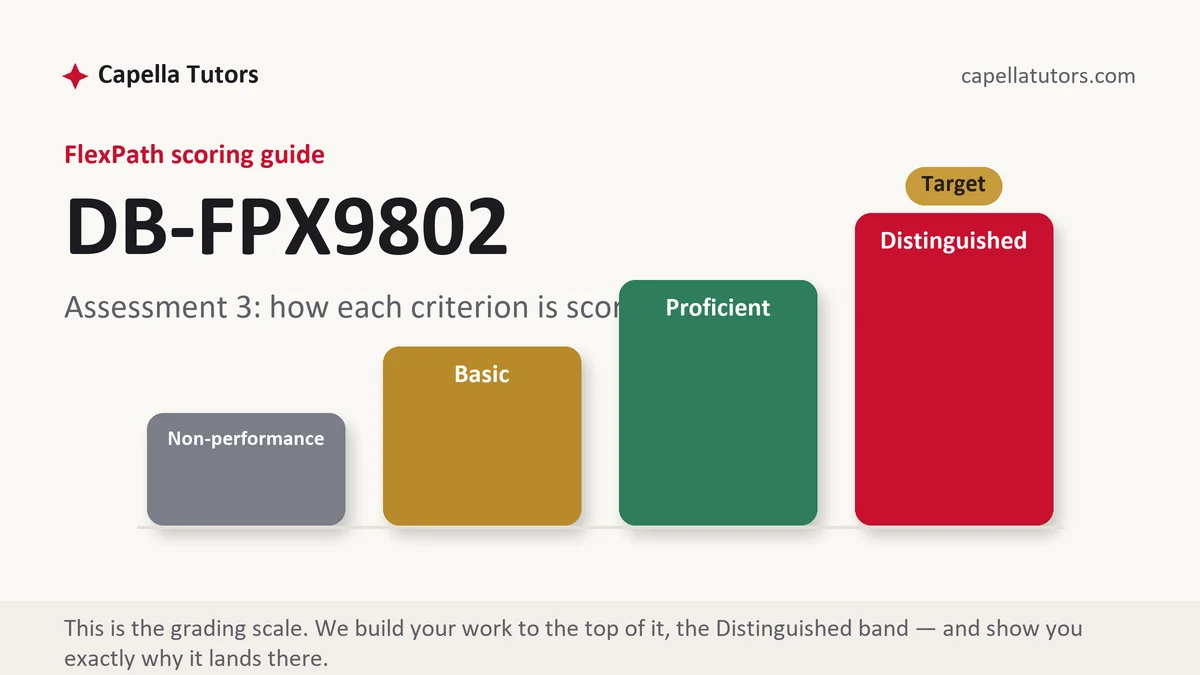
How DB FPX 9802 Assessment 3 is scored
There are no letter grades in FlexPath. Each criterion on the scoring guide lands on one of four levels, and the level language is the writing brief:
| Level | What it means on an analysis rehearsal submission |
|---|---|
| Distinguished | The rehearsal is performed rather than described, assumptions are checked in writing with the consequence stated, and every decision that could flatter the data is fixed in advance. The extra move is naming the alternative test before an assumption fails. |
| Proficient | The analysis is run correctly and reported accurately. Competent, and still silent about what happens when a check comes back badly. |
| Basic | Software output pasted in with narration attached, no assumption checks, and a missing data rule invented after the file was seen. |
| Non-performance | A required element is absent, most often the assumption checks or the codebook, or an analysis that does not answer the questions the proposal asked. |
The rehearsal exists to make the real analysis boring, and the criteria are built to test exactly that. Nothing is graded on the result, which is why practising on a synthetic file carrying your own variables and measurement levels is the point rather than a shortcut. Two things carry forward intact. Every decision rule written now, the missing data threshold, the outlier rule, the coding boundary, is the rule you are held to when the data is real, and changing it after seeing the numbers is what a reviewer is trained to notice. And the practice output rehearses the reporting as much as the computing, so write the sentences you would publish, because that paragraph is what the results course grades.
The DB FPX 9802 Assessment 3 method, step by step
-
Build a file shaped like the one you expect
Same variables, same measurement levels, same expected sample size, generated or drawn from a public dataset with comparable structure. A rehearsal on a teaching dataset with different variables teaches the software rather than the study.
-
Write the cleaning rules before the file exists
Missing data threshold, outlier handling, reverse-scored items, and the exclusion criteria. A respondent skipping more than a tenth of a scale is dropped under a rule you declared, not averaged quietly because the sample was thin.
-
Check the conditions your test depends on
Normality, equal variances, independence and the absence of severe collinearity are conditions rather than formalities. Examine each one, report what it showed, and where something breaches, say so and name the remedy or the alternative test you moved to.
-
Run the test and read the output correctly
Statistic, degrees of freedom, exact p value, effect size and interval, every time. Knowing which number in which table answers which question is most of what this criterion is testing, and it is easier to learn now than in the week the data arrives.
-
Rehearse reliability with the item count in view
Compute scale reliability on the practice file and report it beside the number of items, since an alpha of .82 across 24 items is far weaker evidence than the same figure across five. Cite the developer's reported figure alongside yours.
-
Do the qualitative rehearsal as well
Build the codebook with a definition and a boundary example for every code, code two practice transcripts, have a second reader code a fifth of them, and record the agreement target before any coding starts. Memos written during coding count; memos written afterwards are reconstruction.
A structure that maps to the criteria
The targets below are our tutors' planning figures for a rehearsal submission, not Capella rules; expand wherever your scoring guide asks for more.
| Section | What it must do | Guide |
|---|---|---|
| Practice data description | Where the file came from, how it was built, and how closely its shape matches the study you plan. | ~250 words |
| Cleaning and screening | Missing data rule, exclusions applied, reverse scoring, and the case count after each step. | ~300 words |
| Assumption checks | Each condition the test requires, how it was examined, what it showed, and the remedy if it failed. | ~350 words |
| Planned analysis, executed | The test run for each question, with statistic, degrees of freedom, exact p value, effect size and interval. | ~400 words |
| Reliability and measurement | Reliability computed on the practice file, item counts, and what the figure does and does not show. | ~250 words |
| Codebook and coder agreement | Code definitions, boundary examples, the share double coded, and the agreement target set beforehand. | ~250 words |
Annotated sample excerpt
An original model excerpt from our team, written on an insurance operations scenario, showing how a rehearsed result gets reported. Learn the order of operations, then run it on your own variables.
The practice file holds 240 simulated claims adjusters, the sample this design expects, with autonomy and discretionary effort measured on the same seven-point scales the study will use.1 Residuals from the planned regression were inspected before anything was interpreted: the distribution is acceptably symmetric, variance inflation across the three predictors runs between 1.1 and 1.4, and one case with a standardized residual beyond 3.3 was retained because the declared rule excludes only cases failing the completeness threshold rather than cases that are merely extreme.2 On this file autonomy predicts discretionary effort at b = 0.28, SE = 0.07, p < .001, 95 percent CI [0.14, 0.42], with the model accounting for 19 percent of variance, which is the set of numbers the results chapter needs and the sentence it needs them in.3
- 1Names the shape of the practice file and ties it to the planned design, so a reader sees a rehearsal of this study rather than of the software.
- 2Checks run before interpretation, the outlier reported, and the decision defended by a rule that existed first. That order is what the criterion pays for.
- 3Reports the test as current APA requires, and says out loud that the rehearsal covers the writing as well as the computing.
The full premium sample for your exact assessment, written fresh to your scoring guide and setting, is free to request. Study it, revise it into your own voice, and submit work you understand.
The five mistakes that cost Distinguished
- Output pasted instead of analysis reported. Software tables with narration underneath tell a reader nothing about which conditions mattered.
- Assumption checks treated as formalities. Normality, equal variances and collinearity are what the conclusion rests on, not boxes to tick.
- A missing data rule written after the file was seen. Decisions taken once the numbers are visible look like decisions taken to help them.
- Reliability reported without the item count. An alpha of .82 across 24 items is much weaker evidence than the same figure across five.
- A codebook with definitions and no boundaries. Two coders need to know what falls outside a code, which is where agreement actually breaks.
Pre-submission checklist
- Practice file matches the planned variables, measurement levels and expected sample size
- Cleaning rules, missing data threshold and exclusions all written before the file was examined
- Every condition the test requires checked, reported in prose, with the remedy or alternative named
- Each test reported with statistic, degrees of freedom, exact p value, effect size and interval
- Reliability computed on the practice file and reported beside its item count
- Codebook with definitions and boundary examples, a share double coded, and an agreement target set in advance
Analysis rehearsal, with no data to rehearse on?
Send the proposal, the guide and your variable list. We generate a synthetic file carrying your variables, your measurement levels and your expected sample, run the planned analysis end to end, and return a premium original sample inside 24 to 48 hours with the checks written in prose and the output already reading like a results chapter. Revisions run free until the criteria clear.