This manual is for DB FPX 9802 Assessment 2, start to submission. Assessment 2 of DB FPX 9802, Data Analysis Practice and IRB Approval, usually asks for the consent and privacy half of the package: a consent document a participant can actually use, a confidentiality claim your mechanism can deliver, and a recruitment route that keeps your own authority out of the invitation. What the guide rewards here is a document a participant could follow, not a document a lawyer could defend. The method our tutors use follows, with a criterion-mapped structure and an annotated excerpt. Rather hand the drafting over? One premium original sample of this deliverable comes back within 24 to 48 hours, revised at no cost until every criterion clears. Capella's catalog lists the course as DB-FPX9802, and some courserooms print DB9802; both point to this same Assessment 2.
One honesty note before the manual: Capella revises courses and scoring guides over time, so always write to the exact scoring guide attached to your assessment in the courseroom. The course identity above is verified on capella.edu; the method and structure below are our tutors' approach to it, not Capella's official rubric text.
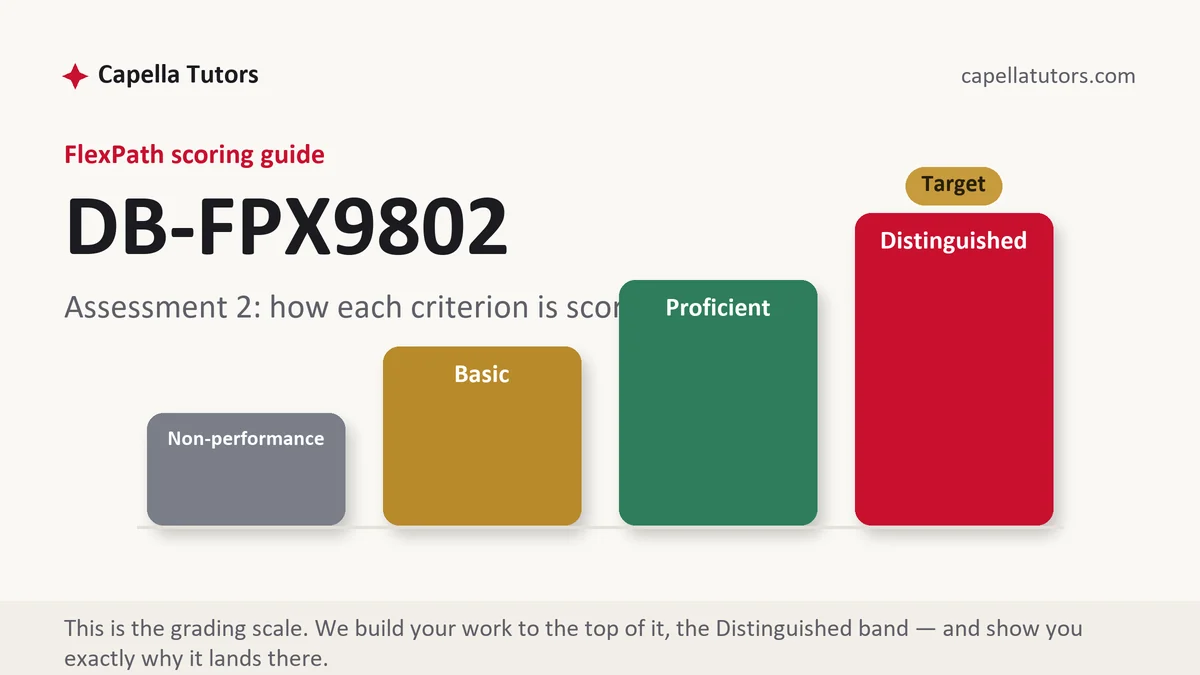
How DB FPX 9802 Assessment 2 is scored
There are no letter grades in FlexPath. Each criterion on the scoring guide lands on one of four levels, and the level language is the writing brief:
| Level | What it means on a consent and confidentiality submission |
|---|---|
| Distinguished | Consent reads at a level a participant can use, the workplace risk is stated plainly, and confidentiality is claimed only where the described mechanism delivers it. The extra move is a withdrawal rule saying what happens to data already given. |
| Proficient | Every required consent element is present and accurate. Adequate, and still written in the register of a contract rather than a conversation. |
| Basic | A form assembled from a template, promising anonymity a video interview cannot deliver and describing the risk as none. |
| Non-performance | A required element is missing, most often withdrawal or the route for a complaint, or an insider study that never mentions insider pressure. |
Two realities shape this section. Consent is a process rather than a page, so a board is judging what a participant experiences, and the paragraph you write becomes the words you will say out loud. Identifiability is arithmetic: organization plus role often equals one person, so naming the firm and describing its only director of revenue operations identifies that individual to every colleague, whatever the form promised. Whatever clears review also governs the results stage, since a mechanism that forbids quoting job titles decides how findings can be presented months later. Write it knowing you have to live inside it.
The DB FPX 9802 Assessment 2 method, step by step
-
Write consent at the level a participant reads
Short sentences, second person, roughly an eighth grade reading level, and no clause that needs a second reading. Test it by reading the document aloud to somebody outside the study; wherever they ask what that means, rewrite rather than explain.
-
Cover the elements a board counts
Purpose, what participation involves, how long it takes, foreseeable risks, the fact that participation is voluntary, how to withdraw, what happens to data already given, how information is stored and for how long, and who to contact with a complaint. Missing elements are scored as missing, not as weak.
-
Claim confidentiality, and never anonymity
A named person on a video call is not anonymous and cannot be described that way. Confidentiality is claimable only with the mechanism attached: pseudonyms assigned at transcription, identifiers stripped from quotations, encrypted storage, a stated destruction date.
-
Do the identifiability arithmetic
Count how many people in the named organization hold the role you are about to attribute a quotation to. Where the answer is one, aggregate upward to function and tenure band, and paraphrase anything that names a product, a customer or a number only one person would know.
-
Remove your authority from the invitation
If you supervise, appraise or pay these people, their agreement is not freely given. Move the invitation to somebody with no authority over them, keep the participant list away from management, make it opt in, and send no reminder from anyone in the chain of command.
-
Write the withdrawal rule, then test it against the analysis
Say how a participant stops, what happens to what they already gave, and the date after which removal is no longer possible because analysis has begun. Then check that rule against your own timeline, since a promise to delete data at any time collides with a completed results chapter.
A structure that maps to the criteria
Word counts below are our tutors' planning targets for a consent and privacy submission, not Capella rules; your scoring guide decides how much each criterion needs.
| Section | What it must do | Guide |
|---|---|---|
| Purpose and participation | What the study is for and exactly what a participant will be asked to do, written in the second person. | ~200 words |
| Time, risk and benefit | Minutes required, the foreseeable risks including the workplace one, and no benefit that is not real. | ~300 words |
| Voluntariness and withdrawal | That taking part is a choice, how to stop, and what happens to information already provided. | ~250 words |
| Confidentiality mechanism | Pseudonyms, de-identification steps, storage and encryption, who holds access, retention and destruction dates. | ~350 words |
| Recruitment route | Who issues the invitation, why that person holds no authority over participants, and how silence is treated. | ~250 words |
| Contacts and documentation | Researcher and complaint contacts, how consent is documented, and the attached recruitment wording. | ~200 words |
Annotated sample excerpt
An original model excerpt from our team, written on a pricing governance scenario, showing how a confidentiality claim is earned rather than asserted. Study the structure and rebuild it for your own setting.
Interviews about discount approval are held over video with named participants, so this study cannot offer anonymity and does not claim it; what it offers is confidentiality, delivered by a stated procedure.1 Each participant receives a pseudonym at transcription, recordings are deleted once the transcript is verified, transcripts sit in an encrypted volume only the researcher can open, and retention ends 36 months after the project is accepted, when the files are destroyed.2 Because the sample spans three business units of one firm and several roles exist only once inside it, quotations are attributed by function and tenure band rather than by title, and any quotation naming a product line, a customer or a deal size is paraphrased before it reaches the findings.3
- 1Refuses the promise the design cannot keep, in the first clause, and replaces it with one the procedure can support.
- 2Each safeguard arrives as a step with an owner and a date, which is what turns a claim into a mechanism a board can approve.
- 3Does the identifiability arithmetic out loud, then commits to a presentation rule that binds the results chapter as well as the interview.
The full premium sample for your exact assessment, written fresh to your scoring guide and setting, is free to request. Study it, revise it into your own voice, and submit work you understand.
The five mistakes that cost Distinguished
- Anonymity promised in an identifiable study. A video interview with a named person is confidential at best, and the form has to say so plainly.
- Risk described as none. Every workplace study carries the risk that a candid answer is repeated, and naming it costs nothing.
- Consent written for a lawyer. A document a participant cannot follow is not informed consent, however complete its clauses.
- Recruitment run by the participants' own supervisor. Agreement given to the person who writes your appraisal is not freely given.
- No rule for information already collected. A withdrawal clause that stops at participation leaves the reviewer to ask the obvious next question.
Pre-submission checklist
- Purpose, procedures, duration, risks, voluntariness, withdrawal, data fate, storage, retention and a complaint contact all present
- The document reads at roughly an eighth grade level, in the second person, and survives being read aloud
- Anonymity refused where the design cannot support it, and confidentiality claimed only with its mechanism attached
- De-identification, storage, access, retention and destruction each written as a step with a date
- Invitation issued by someone with no authority over participants, opt in, with no reminders from management
- Role and organization checked together for identifiability, and a quotation rule written for the findings
Consent language holding up the whole project?
Send the protocol draft, the setting and the guide. A premium original sample returns inside 24 to 48 hours with consent written at a readable level, the confidentiality mechanism described step by step, a recruitment route that removes your authority from the invitation, and a withdrawal rule that survives contact with your own timeline. Revisions cost nothing until the criteria clear, and reviewer comments re-enter the same queue free.