This manual is for DB FPX 9802 Assessment 1, start to submission. Assessment 1 of DB FPX 9802, Data Analysis Practice and IRB Approval, usually asks for the protocol package: your study described for readers who have never seen the proposal, procedures written as steps somebody else could follow, and every figure in the application matching the figure in the document it came from. Your scoring guide decides which elements it wants and in what order. What follows is the sequence our tutors work in, a structure built on the criteria, and an annotated excerpt. Would you rather not build it yourself? A premium original sample of this exact deliverable arrives in 24 to 48 hours and is revised free until the guide is satisfied. Capella's catalog lists the course as DB-FPX9802, and some courserooms print DB9802; both point to this same Assessment 1.
One honesty note before the manual: Capella revises courses and scoring guides over time, so always write to the exact scoring guide attached to your assessment in the courseroom. The course identity above is verified on capella.edu; the method and structure below are our tutors' approach to it, not Capella's official rubric text.
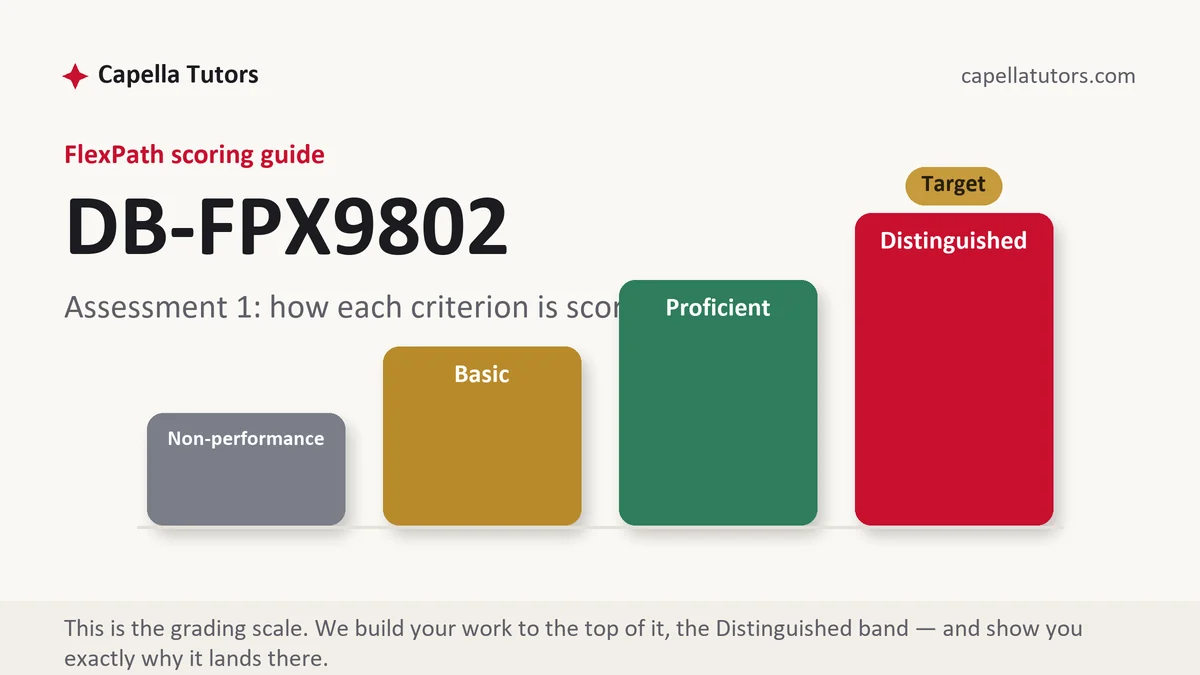
How DB FPX 9802 Assessment 1 is scored
There are no letter grades in FlexPath. Each criterion on the scoring guide lands on one of four levels, and the level language is the writing brief:
| Level | What it means on a research protocol submission |
|---|---|
| Distinguished | The protocol reads as a study a stranger could run, risk is described honestly including the workplace kind, and every figure matches the proposal behind it. The extra move is the appendix a reviewer expected to have to ask for. |
| Proficient | All required sections are complete and internally consistent. Approvable, and still leaning on the reader to infer procedures you could have written out. |
| Basic | A protocol assembled from a template rather than from your own design, procedures in the passive voice, and risk called minimal by assertion. |
| Non-performance | A required element is absent, most often the site permission evidence or the instrument appendix, or a protocol describing a study the proposal does not. |
Two facts about review govern how this gets written. Nothing may be collected before written approval exists, and that includes a friendly pilot interview, an email sent to gauge interest and a link shared to test wording, so anything gathered early is unusable. The pathway is also not yours to pick, since exempt, expedited and full review are determinations the board makes on the evidence you supply. What you write here becomes the recruitment script and consent process you actually execute later, so a procedure you cannot perform is a promise you will be amending in the middle of collection.
The DB FPX 9802 Assessment 1 method, step by step
-
Copy forward, field by field
Open the approved proposal beside the blank application and transfer rather than rewrite. Sample size, collection window, item counts and minutes of participant time all appear twice, and every one of those pairs has to match exactly. Drift between the two documents is the commonest reason a package returns unread.
-
Write the summary for a stranger
The first reader is intelligent and outside your field, so the summary carries design, setting, questions and procedures with no construct vocabulary in it. If a sentence needs your literature review to make sense, it belongs somewhere else.
-
Describe procedures as executable steps
Name who acts, in what order, using what words, on what platform. Participants will be recruited hides the only thing under review, which is the identity of the person doing the asking. Write it as a sequence somebody could follow while you were unavailable.
-
Price the participant burden honestly
State the minutes: survey completion, interview length, transcript review, any diary or log entry. Boards weigh burden against benefit, and an application silent on time reads as one that has not counted it. Add the recording and storage arrangements in the same paragraph.
-
Assemble the appendices before the narrative
Instrument, interview guide, consent document, recruitment message, and a site permission letter your sponsor can sign without redrafting. Evidence attached settles a question; evidence promised on request converts one review into two.
-
Run a two-document consistency check
Build a mapping table putting each application field beside the page of the proposal that answers it, then read the pairs rather than the pages. Finish by self-scoring every criterion at Distinguished, Proficient, Basic or Non-performance and giving anything lower one more pass.
A structure that maps to the criteria
These lengths are our tutors' planning figures for a protocol submission at doctoral level, not Capella requirements; the criteria in your guide set the real proportions.
| Section | What it must do | Guide |
|---|---|---|
| Protocol summary | Purpose, design, questions and setting compressed for a reader who has never seen the proposal. | ~250 words |
| Participants and eligibility | Who qualifies, how many, why that number, and who is deliberately excluded. | ~250 words |
| Recruitment procedures | Who issues the invitation, in what words, how often, and how a non-response is treated. | ~300 words |
| Data collection steps | Each step in order, with the wording, the platform, the burden in minutes and who is present. | ~350 words |
| Risk, benefit and data handling | Foreseeable risks including workplace ones, the benefit claimed, storage, access and destruction dates. | ~300 words |
| Appendices and permissions | Instrument, guide, consent document, recruitment message, and the signed site permission letter. | as needed |
Annotated sample excerpt
An original model excerpt from our team, written on a software firm scenario, showing the register a protocol summary needs. Learn the moves and rebuild it around your own study.
This action research study examines how long cross-functional pricing and release decisions take at a 340-person business software firm, and what the delay is made of.1 Participants are the 26 managers holding approval authority in product, finance and customer success; each completes a 12-item decision log for four consecutive weeks and then joins one 45-minute interview, a total burden of about 110 minutes per person.2 No customer records, compensation figures or performance-review content are collected, and the only identifier retained is role, which is recoded to a function label before analysis begins.3
- 1One sentence a reader outside the field can follow, naming design, setting and what is measured, with no construct vocabulary in it.
- 2Participants, count, instruments and total burden in minutes, the figure boards check and applications most often leave out.
- 3Saying what is not collected narrows the risk picture faster than any paragraph claiming the risk is minimal.
The full premium sample for your exact assessment, written fresh to your scoring guide and setting, is free to request. Study it, revise it into your own voice, and submit work you understand.
The five mistakes that cost Distinguished
- Numbers that drift between documents. An application asking for 30 participants against a proposal justifying 26 comes back before anyone reads the design.
- Procedures written in the passive. Participants will be invited conceals the one detail under review, which is who does the inviting.
- Risk declared minimal by assertion. Name the workplace consequence a candid participant could face, then say what prevents it.
- Appendices promised rather than attached. The instrument will be provided upon request turns one round of review into two.
- A pathway announced in advance. Writing that this study is exempt tells a reviewer you have mistaken your role for theirs.
Pre-submission checklist
- Every figure appearing twice matches: sample size, window, item counts, minutes of burden
- The summary is readable by someone outside your field, with no construct jargon in it
- Recruitment and collection written as steps, naming who acts and in what words
- Total participant burden stated in minutes, and what is not collected stated as well
- Instrument, guide, consent document, recruitment message and signed site permission all attached
- No collection of any kind has happened yet, and no review pathway is claimed on the board's behalf
Protocol package due and the proposal will not line up?
Send the approved proposal, the blank application and the guide. Inside 24 to 48 hours a premium original sample returns with the summary written for a stranger, procedures written as steps, appendices assembled, and a mapping table putting each application field beside the page that answers it. One reviewer checks nothing except whether the two documents describe the same study, and revisions run free until the criteria clear.