This manual is for DB FPX 9801 Assessment 3, start to submission. Assessment 3 of DB FPX 9801, Proposal Writing, usually asks for the half of the document that decides whether the project can be built at all: the design with its rejected alternatives, the population and the frame you can genuinely reach, the instrument and its permission status, and an analysis plan fixed before a single response exists. The guide in your courseroom scores each of those as its own criterion. Below is the method our tutors use, a criterion-mapped structure, and an annotated excerpt. Prefer somebody else drafted it? A premium original sample of the deliverable lands within 24 to 48 hours and is revised at no cost until the guide is met. Capella's catalog lists the course as DB-FPX9801, and some courserooms print DB9801; both point to this same Assessment 3.
One honesty note before the manual: Capella revises courses and scoring guides over time, so always write to the exact scoring guide attached to your assessment in the courseroom. The course identity above is verified on capella.edu; the method and structure below are our tutors' approach to it, not Capella's official rubric text.
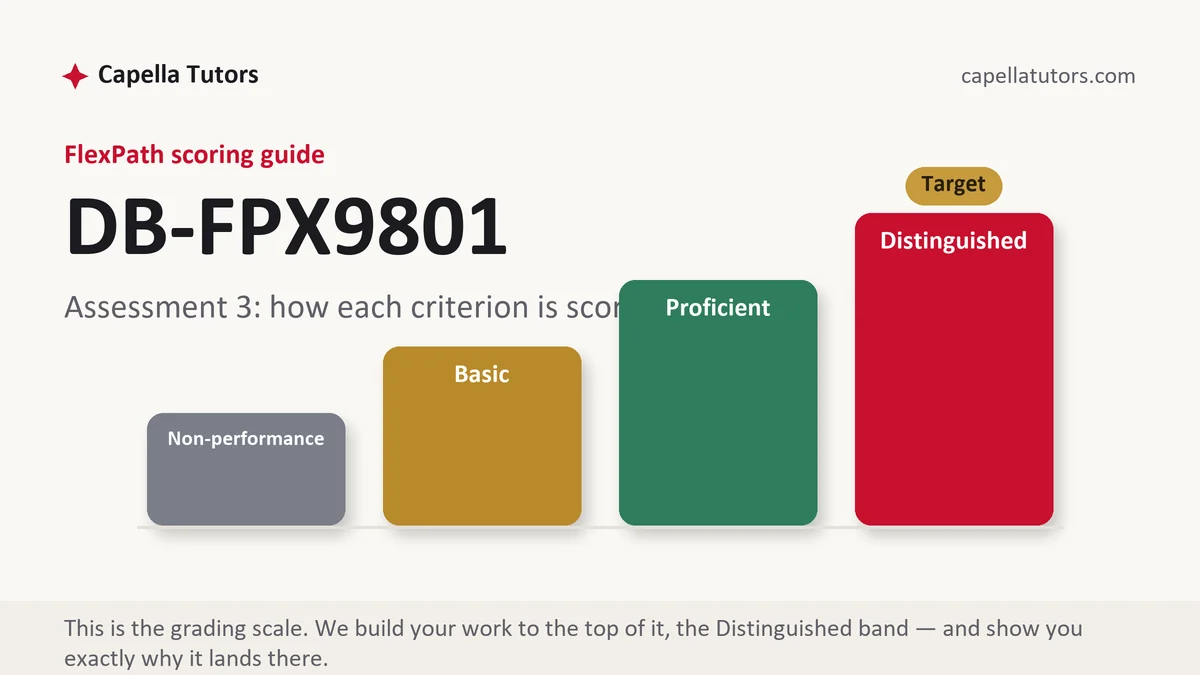
How DB FPX 9801 Assessment 3 is scored
There are no letter grades in FlexPath. Each criterion on the scoring guide lands on one of four levels, and the level language is the writing brief:
| Level | What it means on a design and feasibility submission |
|---|---|
| Distinguished | Design matched to question type with rejected alternatives dismissed on evidence, a sample size defended by arithmetic, access attached to someone who can grant it, and an analysis plan specific enough for another person to run. The extra move is a fallback written before anyone asks. |
| Proficient | Design, population, instrument and analysis are present and defensible. Sound, and still silent on what the project becomes if the site withdraws. |
| Basic | A method section describing procedures in general terms, with the sample size asserted and access described as anticipated rather than secured. |
| Non-performance | A required element is missing, most often the size justification or the analysis plan, or a design that cannot answer the questions the proposal asked. |
Write this section as though a review board is already reading it, because in effect one is. Participant counts, minutes of participant time, interview question totals and storage arrangements all get copied forward into a protocol application, and a figure that shifts between the two is a common reason a package comes back unread. Decide nothing about your review pathway, since exempt, expedited and full review are determinations the board makes on the evidence you submit.
The DB FPX 9801 Assessment 3 method, step by step
-
Let the question type pick the design
How much, how many and what relates to what are quantitative questions, while how and why a practice unfolds inside a firm is qualitative. Then name two designs you rejected and dismiss each on evidence rather than preference, since the criterion pays more for what you ruled out.
-
Do the sample arithmetic in public
For quantitative work state the effect you are powered to detect, where that expectation came from, the alpha, the power and the resulting number. For interview work state the saturation logic and when you will judge it reached. Either way the number arrives derived rather than announced.
-
Name a frame that can actually yield the sample
Count the eligible people, apply the response rate your setting has actually produced, and see whether the arithmetic closes. Where it does not, widen the population across sites, move to a construct held in existing records, or switch to a design where a smaller number is defensible.
-
Settle the instrument and its permission now
Every construct needs a measure, with the reliability and validity evidence its developer reported and the population reported in. Licensed scales need documented permission, adapted items need the adaptation described, and items you wrote yourself need a rationale and two readers who know the setting.
-
Fix the analysis before any data exists
One named test per question, matched to measurement level, with the assumptions you will check, the remedy if one fails, the missing data rule stated in advance and the software named. For interview work the equivalent is a coding approach, a second coder on a share of transcripts, and an agreement target set beforehand.
-
Write the feasibility paragraph and the fallback
Say who signs site permission and what authority they hold, what data already exists and who owns it, and how long collection runs. Then write what the project becomes if access fails, with the date that triggers the switch, because a chair can approve a fallback in advance and nobody can approve one mid crisis.
A structure that maps to the criteria
These targets are our tutors' planning figures for a design and feasibility submission, not Capella rules; the criteria in your scoring guide decide the real proportions.
| Section | What it must do | Guide |
|---|---|---|
| Design and justification | The design, why the questions require it, and two alternatives rejected with the evidence behind each rejection. | ~400 words |
| Population, frame and sample | Who is eligible, how many are reachable, how many are needed, and the arithmetic connecting those three numbers. | ~400 words |
| Instruments and measures | What measures each construct, the reliability and validity evidence reported for it, permission status, and any items written locally. | ~350 words |
| Procedures and timeline | Recruitment route, collection window, participant burden in minutes, and who does what in which week. | ~300 words |
| Analysis plan | One test or coding approach per question, assumptions to be checked, the missing data rule, and the software named. | ~400 words |
| Feasibility, ethics sketch and references | Who signs site permission, whose information the study touches, the fallback design, and current APA both directions. | ~300 words |
Annotated sample excerpt
An original model excerpt from our team, written on a logistics scenario, showing how sample size and feasibility are argued rather than announced. Learn the arithmetic, then run it on your own setting.
The design requires a regression with three predictors and one covariate, so detecting the incremental effect comparable operations studies report, an R squared change near .06, at a five percent alpha with 80 percent power calls for roughly 129 usable responses.1 The third-party logistics operator hosting the study employs 604 warehouse associates across four distribution centers, and its last two internal surveys returned 27 and 31 percent, which puts 129 usable responses in reach only if the invitation goes to the whole population rather than one building.2 Site permission will be signed by the vice president of operations, who controls scheduling at all four centers; if that signature has not arrived by the end of week three, the study converts to a comparison of the two automated buildings using pick-rate records the operator already keeps, answering a narrower version of the same question with no new participants.3
- 1The number is derived rather than asserted, and the effect it is powered to detect comes from comparable published work.
- 2Ties the required sample to a real frame and a real response history, the arithmetic reviewers check first and drafts skip most often.
- 3Names the person with actual authority, dates the decision, and describes the fallback closely enough for a chair to approve it now.
The full premium sample for your exact assessment, written fresh to your scoring guide and setting, is free to request. Study it, revise it into your own voice, and submit work you understand.
The five mistakes that cost Distinguished
- A sample size with no arithmetic. Approximately 120 participants will be recruited stays a wish until a power calculation stands under it.
- A frame that cannot yield the sample. Needing 129 usable responses from 180 eligible people at a 30 percent response history fails at execution rather than at review.
- An instrument named without permission. A licensed scale used with no documented right to use it stops the project after approval, the worst available moment.
- An analysis plan written as a category. Data will be analyzed in SPSS names software, not a test, and conceals which assumptions the conclusion depends on.
- A design with no rejected alternatives. Saying what you did not do, and why, is most of what the justification criterion is actually paying for.
Pre-submission checklist
- Design matched to question type, with two alternatives named and rejected on evidence
- Sample size derived by power analysis or a stated saturation logic, with the target effect sourced
- A frame large enough to produce that sample at the response rate your setting has actually recorded
- Instrument permission settled in writing, every construct matched to a measure
- One named analysis per question, with assumption checks, a missing data rule and the software stated
- Site permission attached to a named signatory, plus a fallback design and the date that triggers it
Method section that has to survive a chair?
Send the guide, your questions and the access you actually hold. Inside 24 to 48 hours a premium original sample returns with the size arithmetic laid out, the permission position stated, one analysis named per question and a fallback already drafted. One reader does nothing but trace the chain from the analysis plan back to the condition, and revisions cost nothing until the criteria clear.