This manual is for DB FPX 9801 Assessment 2, start to submission. Assessment 2 of DB FPX 9801, Proposal Writing, usually asks for the evidence half of the proposal: a review with a search method a reader could repeat, evidence organized by claim rather than by author, and a framework applied closely enough to this setting that it will still be visible when the instrument is built. Each criterion lands on one of four levels against the guide in your courseroom. Below is the method our tutors use, a criterion-mapped structure, and an annotated excerpt. Not keen on drafting it? One premium original sample of this deliverable arrives inside 24 to 48 hours, with free revision until every criterion clears. Capella's catalog lists the course as DB-FPX9801, and some courserooms print DB9801; both point to this same Assessment 2.
One honesty note before the manual: Capella revises courses and scoring guides over time, so always write to the exact scoring guide attached to your assessment in the courseroom. The course identity above is verified on capella.edu; the method and structure below are our tutors' approach to it, not Capella's official rubric text.
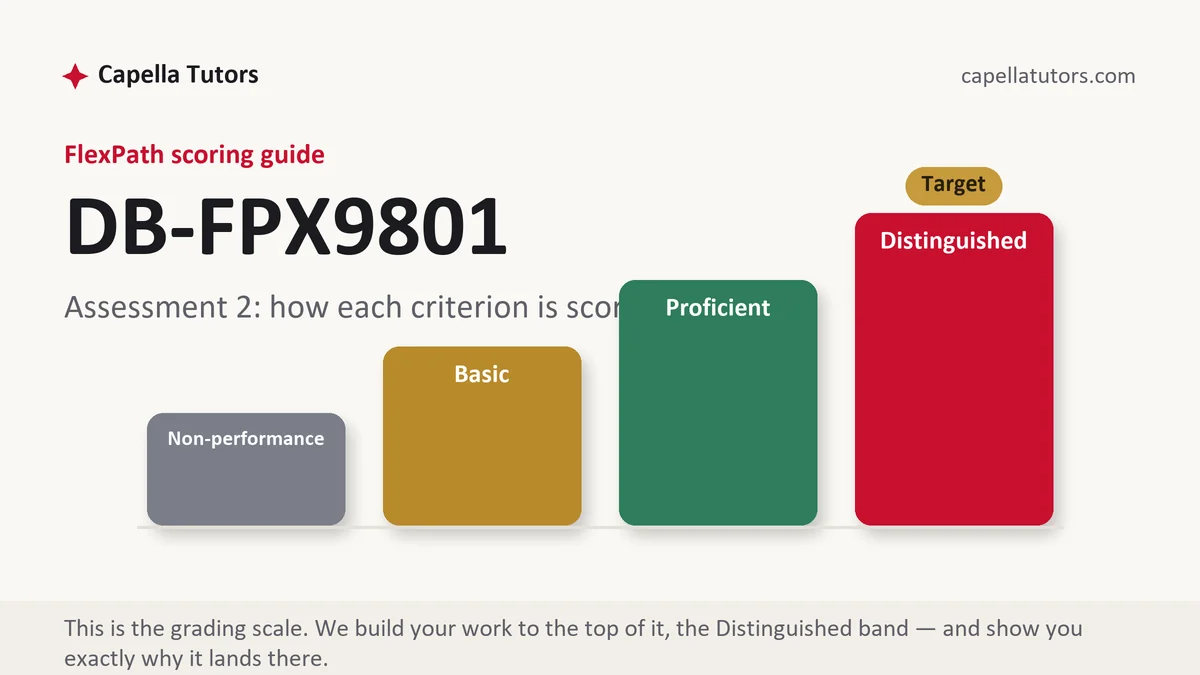
How DB FPX 9801 Assessment 2 is scored
There are no letter grades in FlexPath. Each criterion on the scoring guide lands on one of four levels, and the level language is the writing brief:
| Level | What it means on a literature and framework submission |
|---|---|
| Distinguished | The search is reproducible, the evidence is arbitrated instead of accumulated, and the framework predicts something specific here. The gap emerges from the synthesis rather than being announced ahead of it. |
| Proficient | Coverage is complete and the framework is described correctly. Competent, and still a summary where the guide pays for an argument. |
| Basic | Consecutive source summaries with a gap sentence bolted to the end, and a theory named in one paragraph that never returns. |
| Non-performance | A required element is missing, most often the framework itself, or a synthesis with no stated search method behind it. |
This section is also read as a promise about measurement, which most drafts do not anticipate. Every construct reviewed here has to reappear as something an instrument can capture, so 900 words on organizational culture with no measure named leaves a hole the design stage inherits and the protocol stage pays for. Record the date you ran the search, because in a sequence spanning terms you will be asked to run it again.
The DB FPX 9801 Assessment 2 method, step by step
-
Write the search down as a method
Name the databases, the terms and their Boolean combinations, the date window, the inclusion rules, how many records returned, how many survived screening, and the date you ran it. Business Source Complete and ABI/INFORM through the Capella library are the expected starting points. A reader who cannot repeat the search has no reason to accept the gap.
-
Sort the pile before writing a word
Split every source into peer reviewed empirical work, seminal theory, and public or industry data, then check that each construct has empirical evidence of its own, including the variables you plan to control for. No criterion counts your sources and every reader notices how they are composed.
-
Organize by claim, then arbitrate
Write the chapter as three lists rather than a parade of authors: what the evidence settles, what it contests, and what nobody has examined. Where studies disagree, weigh design and setting before magnitude, since a correlation across 900 respondents at one firm and an effect from a 40 unit trial are different species of evidence.
-
Choose one framework and make it work
Pick the theory that predicts a behavior you can observe in your setting, cite it to whoever built it rather than the textbook that compressed it, and read the original closely enough to know what its author claimed. Then write the prediction out: if the theory holds here, the data will look like this.
-
Show the gap instead of asserting it
The gap is what your own synthesis failed to find, so let the reader watch it appear, then narrow the claim to the size the evidence supports. Nobody has studied this is almost always false and always checkable. The effect is settled above 200 units and below 30, and not in between, is defensible and more useful.
-
Audit the section the way a reviewer will
Check every construct for empirical support, every framework mention for a consequence, and every citation against the list in both directions. Then read the gap paragraph beside your purpose statement and confirm they use the same words, since a review arguing for one study while the purpose describes another loses alignment on its own.
A structure that maps to the criteria
These lengths are our tutors' planning targets for a proposal literature submission at doctoral level, not Capella requirements; expand wherever your scoring guide asks for more.
| Section | What it must do | Guide |
|---|---|---|
| Introduction to the review | Name the constructs the chapter must cover and the order the argument takes, so the reader knows what is coming and when it ends. | ~200 words |
| Search method | Databases, terms, window, inclusion and exclusion rules, records screened and retained, and the date of the search. | ~250 words |
| Theoretical framework | The theory cited to its originator, what it claims, and the specific prediction it makes about this population. | ~450 words |
| Synthesis by claim | What the evidence settles, what it contests, and the moderators that explain the disagreement, construct by construct. | ~900 words |
| The gap and this study | The unsettled question stated in the vocabulary the purpose statement uses, with the study positioned inside it. | ~250 words |
| References | Current APA both directions, weighted toward recent peer reviewed empirical work, seminal theory cited to the original. | as needed |
Annotated sample excerpt
An original model excerpt from our team, written on a franchise scenario, showing how a synthesis paragraph arbitrates rather than lists. Study the moves and build your own version from your own sources.
That standardization raises unit-level consistency in franchise systems is settled, reported repeatedly on service-time and audit-score measures across independent samples.1 What it contests is whether standardization survives contact with local demand, and the disagreement carries a visible moderator: studies of systems under 30 units call franchisee deviation adaptation that protects revenue, studies above 200 units call the same behavior leakage that erodes the brand promise, and the range where a 60-unit operator sits is almost unexamined.2 Agency theory predicts deviation wherever monitoring is cheap to evade and the residual gain stays local, which makes menu-level departure from the operations manual the behavior this study can measure and brand sentiment the one it cannot.3
- 1Opens on what the evidence settles, in one clause, so the reader sees the chapter arbitrating rather than cataloguing.
- 2Names the contested finding and the moderator behind it, then locates the unknown at a specific system size. The gap is demonstrated, not declared.
- 3The framework earns its place by predicting an observable behavior, and the last clause draws the measurement boundary the design stage must respect.
The full premium sample for your exact assessment, written fresh to your scoring guide and setting, is free to request. Study it, revise it into your own voice, and submit work you understand.
The five mistakes that cost Distinguished
- A review with no method. A search a reader cannot repeat leaves your gap resting entirely on your word.
- Consistent with the literature offered as a finding. Consistency has a direction and a magnitude, and naming neither is a summary wearing the clothes of a synthesis.
- A framework used as decoration. Theory that predicts nothing in your setting will not survive the discussion chapter either.
- Textbook citations for seminal ideas. Attribute a theory to the person who built it, and read the original closely enough to know its limits.
- A construct reviewed with no measure in sight. If nothing in the literature captures it, the instrument will not either, and the design stage inherits the gap.
Pre-submission checklist
- The search is written as a method, with databases, terms, window, inclusion rules and the date it was run
- Sources sorted into empirical, theoretical and public data, with empirical support behind every construct
- The synthesis is organized by claim, and contested findings are arbitrated on design and setting
- One framework, cited to its originator, making at least one testable prediction about this population
- The gap paragraph uses the same vocabulary as the purpose statement
- References current APA both directions, with nothing load-bearing resting on a vendor report
Literature chapter reading like a list?
Send the guide, your constructs and whatever sources you have pulled. The premium original sample returns inside 24 to 48 hours with the search written as a method, the evidence sorted by claim, and the framework tied to something an instrument can capture. Revisions run free until every criterion clears, and chair comments re-enter the queue at no charge.