This manual is for DB FPX 9801 Assessment 1, start to submission. Assessment 1 of DB FPX 9801, Proposal Writing, usually asks for the front end of the doctoral project: a problem statement carrying evidence, a purpose sentence written in the verbs its design can support, and research questions that ask only what the purpose promised. The guide in your courseroom scores each piece as its own criterion, and the criteria pay for a chain that holds rather than a topic that impresses. Below is the method our tutors use, a criterion-mapped structure, and an annotated sample excerpt. Would you rather not write it? A premium original sample of this exact deliverable comes back within 24 to 48 hours and keeps being revised, free, until the guide is satisfied. Capella's catalog lists the course as DB-FPX9801, and some courserooms print DB9801; both point to this same Assessment 1.
One honesty note before the manual: Capella revises courses and scoring guides over time, so always write to the exact scoring guide attached to your assessment in the courseroom. The course identity above is verified on capella.edu; the method and structure below are our tutors' approach to it, not Capella's official rubric text.
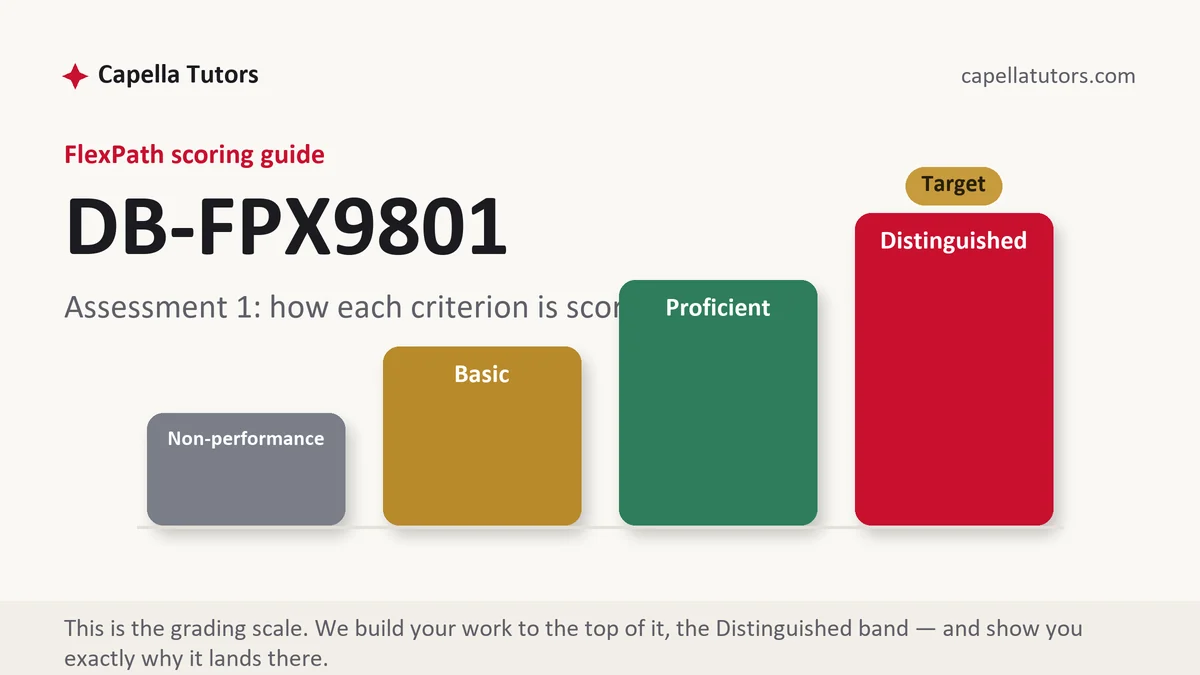
How DB FPX 9801 Assessment 1 is scored
There are no letter grades in FlexPath. Each criterion on the scoring guide lands on one of four levels, and the level language is the writing brief:
| Level | What it means on a problem-and-purpose submission |
|---|---|
| Distinguished | The condition carries a magnitude, a denominator and a window, the purpose sentence names design, constructs, population and setting, and the questions add nothing the purpose did not promise. The extra move is a decision a reader can picture somebody making. |
| Proficient | Problem, purpose and questions are present and consistent. Defensible, and still one move short of the reader who can name who acts on the finding. |
| Basic | A topic with worry attached to it. The problem reads as something unfixed rather than something unknown, and the questions drift wider than the purpose that produced them. |
| Non-performance | A required element is absent, most often research questions that match the stated purpose, or a condition asserted with no evidence of size behind it. |
Read the criteria as a chain rather than a list, because every course after this one inherits whatever you leave loose. The purpose sentence written here becomes the population and instrument description in the protocol package, and a purpose naming people you cannot practically recruit becomes a determination-of-review problem months later, where a term is the unit of delay. Chairs read this stage for scope, and one signs the question a single project can answer.
The DB FPX 9801 Assessment 1 method, step by step
-
Start from the decision, not the topic
Write the sentence saying who does something differently once the answer exists, and name that person by role. If the sentence will not finish, the topic is not yet a doctoral problem. A practice doctorate is judged on contribution to practice, so a question nobody would act on can be interesting and unfundable at once.
-
Convert the irritation into a measured condition
Give the condition a magnitude, a denominator, a window and a source. Attrition is worrying is a mood; 11 of 38 relationship managers resigning inside one fiscal year, against 16 percent two years earlier, is a condition a reader can audit. Pull the figure from a report you can cite, and name it.
-
Separate what is broken from what is unknown
Organizations usually know a problem exists and not what drives it, and the doctoral version lives in that second half. Write both sentences: here is the condition, and here is the distance between what practice assumes and what evidence supports.
-
Write the purpose sentence in the verbs the design owns
One sentence naming design, constructs, population, setting and window. Explore how belongs to qualitative descriptive work, examine the relationship between to correlational work, compare to designs with groups. Determine the effect of belongs to designs that manipulate something, so unless yours does, do not borrow it.
-
Derive the questions and then stop
Each question restates the purpose interrogatively and adds nothing. Two is usually enough and three is the ceiling, since a question needing its own sampling frame is a second study wearing a subheading. Write the analysis beside each one, and delete any question that has none.
-
Test the chain backwards, then against the guide
Read from the questions to the purpose to the condition and check that each link is forced by the one under it. Then self-score every criterion honestly at Distinguished, Proficient, Basic or Non-performance, and give anything below the top one more pass. File the attempt early in the week rather than late, because evaluation can take up to two business days.
A structure that maps to the criteria
Word counts are planning targets our tutors use for a front-end proposal submission at this level, not Capella rules; your scoring guide decides how much each criterion needs.
| Section | What it must do | Guide |
|---|---|---|
| Opening and context | Name the setting, the pressure it is under and the decision at stake, in the sector's own vocabulary rather than in academic abstraction. | ~200 words |
| The condition, evidenced | State the magnitude with its denominator, window and source, then say what practice currently does about it and on what assumption. | ~350 words |
| The gap, as something unknown | Show what current evidence settles and where it stops, so the unknown is demonstrated by the reading rather than announced by you. | ~300 words |
| Purpose statement | One sentence naming design, constructs, population, setting and window, with a verb the design can keep. | ~120 words |
| Research questions | Two or three questions restating the purpose interrogatively, each with one named analysis able to answer it. | ~150 words |
| Significance, scope and references | Who acts on the answer, what the project deliberately excludes, and current APA checked in both directions. | ~250 words |
Annotated sample excerpt
An original model excerpt from our team, written on a regional banking scenario, showing the register that scores at the top of the guide. It is study material: learn the moves, then write your own version on your own setting.
Between July 2024 and June 2025, 11 of the 38 commercial relationship managers at a seven-branch regional bank in the upper Midwest resigned voluntarily, 28.9 percent against the 16.4 percent the same institution recorded two years earlier.1 Exit interviews are filed and summarized, and the summaries name compensation in nearly every case, which is also the answer a departing manager has least to lose by giving; the institution knows the size of its problem and not its drivers, and has allocated two retention budgets on the assumption that the interviews are accurate.2 The purpose of this qualitative descriptive study is to explore how commercial relationship managers who left this institution during that window describe the conditions preceding their decision, so that the chief lending officer can direct retention spending at causes rather than at exit-interview vocabulary.3
- 1Magnitude, denominator, window and internal comparison in one sentence, with nothing resting on an adjective.
- 2Separates what the organization knows from what it does not, which is where the doctoral problem sits, and prices the current guess.
- 3One purpose sentence carrying design, participants, setting and window, closing on the person who acts.
The full premium sample for your exact assessment, written fresh to your scoring guide and setting, is free to request. Study it, revise it into your own voice, and submit work you understand.
The five mistakes that cost Distinguished
- A problem the organization has already solved. If a reader can name the remedy in one sentence, the study answers a question nobody needed asked.
- Purpose and questions written on different days. Questions that reach past the purpose tell a reviewer the alignment was never checked once.
- A causal verb the design cannot support. Drives, influences and causes belong to designs that manipulate something or follow it over time.
- A magnitude with no denominator. Turnover is high describes a feeling; 11 of 38 inside twelve months describes a condition.
- Three questions that are really three studies. Scope is a criterion in disguise, and a chair returns the second and third question regardless of how good they are.
Pre-submission checklist
- Every criterion has its own labeled section, with the Distinguished wording pasted underneath while you draft
- The condition carries a number, its denominator, its window and the report it came from
- The gap is written as something unknown, and the reading that demonstrates it is described
- One purpose sentence names design, constructs, population, setting and window
- Each research question restates the purpose and has one named analysis beside it
- The decision maker appears by role, and the chain reads clean backwards from questions to condition
Problem statement going round in circles?
Send the scoring guide, the setting and whatever numbers you can already defend. A team of eight returns a premium original sample written to the Distinguished column in 24 to 48 hours, alignment table attached, revised until the criteria clear. Get this stage right and the courses after it inherit a spine instead of a repair job.