This manual is for DB FPX 8840 Assessment 3, start to submission. The closing deliverable of a topic development seminar usually asks for the whole topic in one document: the problem and its evidence, the purpose and questions, the literatures the study will join, the feasibility case, and the contribution a general manager somewhere else could use. DB FPX 8840 is a 3-point seminar in the General Management specialization, taught in FlexPath inside the 45-point Doctor of Business Administration, and this is the document your literature review seminar will inherit. Below is the method our doctoral tutors use to assemble it, a structure built from the criteria, and an annotated sample excerpt. Rather hand it over? A premium original doctoral sample for this exact assessment returns in 24 to 48 hours, revised at no charge until the guide is met. Capella's catalog lists the course as DB-FPX8840, and some courserooms print DB8840; both point to this same Assessment 3.
One honesty note before the manual: Capella revises courses and scoring guides over time, so always write to the exact scoring guide attached to your assessment in the courseroom. The course identity above is verified on capella.edu; the method and structure below are our tutors' approach to it, not Capella's official rubric text.
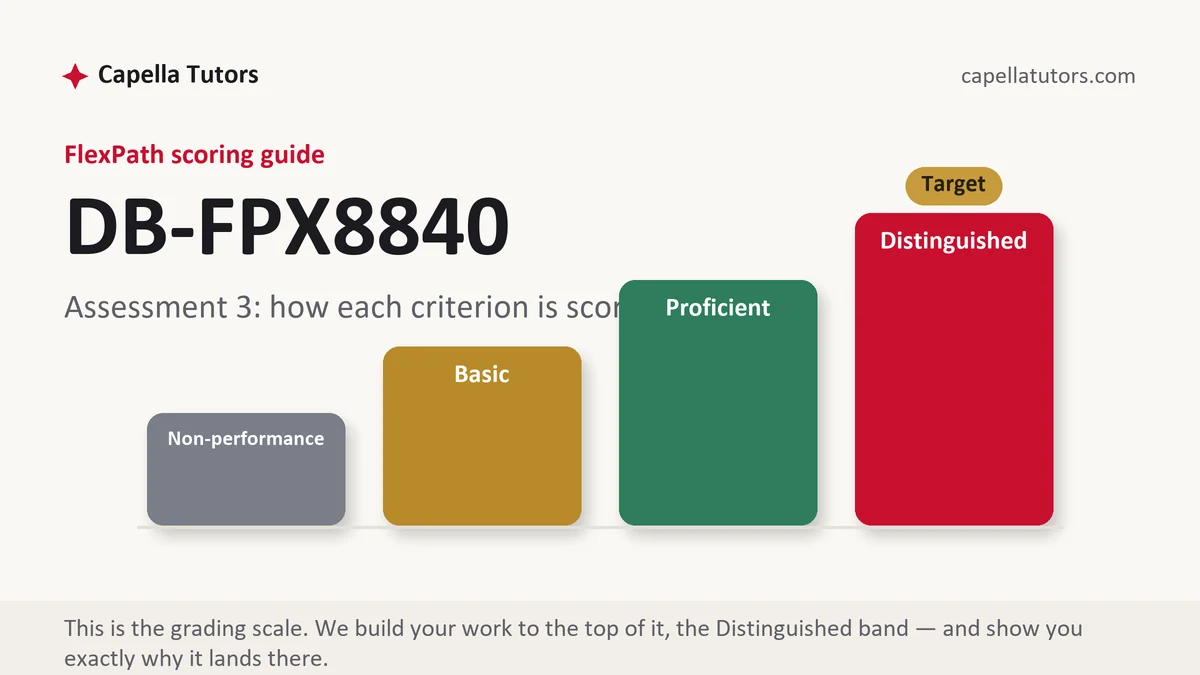
How DB FPX 8840 Assessment 3 is scored
A FlexPath guide carries four levels and no grades. The wording of each level tells you exactly what the submission has to do, criterion by criterion:
| Level | What it means on an assembled topic paper |
|---|---|
| Distinguished | Every part of the topic supports every other part, the literatures are ranked with one named as carrying the argument, feasibility is argued from access you can name, and the contribution is a decision a named role would make differently. One further move sits in the wording; make it. |
| Proficient | All the parts are present and each of them is sound. What is missing is the argument that they belong together. |
| Basic | A competent assembly of sections written at different times, with a problem from one draft and questions from another. The commonest doctoral topic paper there is. |
| Non-performance | A required part is absent, most often the feasibility case or a contribution to practice stated in terms somebody could act on. |
This paper is also a handoff. Whatever it settles is where the literature review seminar starts, so the literatures you rank here decide what you read next and the boundary you defend here decides what counts as in scope. Leaving the boundary soft does not save work. It moves the work into a course where reading has already been done against the wrong edges.
The DB FPX 8840 Assessment 3 method, step by step
-
Reconcile the drafts before you assemble them
Sections written across a term drift, so read the problem, purpose and questions back to back in one sitting and fix the seams before anything else. A gap that widened by one clause per draft is invisible while you are writing and obvious to a reader who meets the whole document at once.
-
Rank the literatures and say which one carries the argument
List the bodies of work the study joins, order them by how much of the argument each one carries, and name the primary literature outright. A ranked set with a stated primary reads as judgment. An unranked list of four frames reads as an author who has not chosen yet, and the next seminar will make the choice for you.
-
Argue feasibility from access you can name
Feasibility is a claim about a specific organization, a specific data set and a specific window. Name who authorizes the access, what form the data is in, who has to pull it, and what happens to the study if that person leaves. A feasibility section built out of hope is the section that sends a topic back.
-
Settle the research review realities in the paper rather than after it
Say now what kind of review your design will require, whether the data are existing organizational records or newly collected from people, and whether the employer holds a review of its own alongside the university's. A study run inside your own workplace attracts questions about consent and about pressure on subordinates, and those are answerable at the design stage and awkward once fieldwork has started.
-
Write the contribution as a decision, then name who makes it
Finish this sentence: once the question is answered, the holder of role X would decide Y differently, because Z. Keep every term concrete. Contribution to practice means almost nothing on its own and a great deal when a reader can picture the meeting where the finding gets used.
-
Self-score the document, then read it as the next course will
Mark each criterion yourself and rewrite anything below the top level. Then read the paper the way your review seminar will read it and ask whether it tells you what to search, in which fields, inside which boundary. If it does not, the topic is not finished, whatever the criteria say about it.
A structure that maps to the criteria
These are the planning targets our doctoral tutors use for an assembled topic paper, not Capella rules; widen any section your scoring guide leans on.
| Section | What it must do | Guide |
|---|---|---|
| Problem and evidence | The problem restated with internal indicators and published work, each doing the job only it can do. | ~400 words |
| Purpose and questions | The purpose and questions as they now stand, reconciled with the problem word by word. | ~250 words |
| Literatures, ranked | The bodies of work the study joins, ordered by argumentative weight, with the primary one named. | ~350 words |
| Design, review path and feasibility | The design the questions imply, the review that data will require, and the access behind the promise. | ~400 words |
| Contribution to practice | The decision a named role would make differently, and the evidence that would let them. | ~200 words |
| References | Current APA both ways, with founding work in the primary literature cited to its original publication. | as needed |
Annotated sample excerpt
An original model paragraph from our team's doctoral desk, built to the top of the column. Study the moves, then rebuild them around your own system and its numbers.
When a franchisor buys back a territory it converts a royalty stream into an operating business, and the decision belongs to a development committee that can price the acquisition precisely and cannot predict what the conversion does to the franchisees who remain.1 At the 214-unit quick service system proposed as the study site, the nine territories repurchased since 2019 raised system revenue per unit by 8 percent and coincided with a fall in franchisee-funded local marketing contributions in the same markets, from 91 to 74 percent of eligible units, a pairing nobody has examined because the two figures are owned by different departments.2 Answering the question would let the development committee weigh a buyback against its effect on the cooperation of the operators it keeps, which the current appraisal model omits entirely, and would give the franchise relations director a measured basis for an objection now made on instinct.3
- 1Names the decision and the committee that owns it, then states precisely what that committee cannot see. Contribution arguments are strongest when the reader's blind spot is the thing the study fills.
- 2Two figures from two departments, joined. An integrative contribution usually looks like this: neither number is new, and the pairing has never been examined.
- 3Contribution written as two roles deciding differently, with the mechanism named. Compare the version that says the study will benefit franchise organizations, which asserts as much and gives a committee nothing to test.
The full premium sample for your exact assessment, written fresh to your scoring guide and issue, is free to request. Study it, revise it into your own voice, and submit work you understand.
The five mistakes that cost Distinguished
- Sections written weeks apart and never reconciled. Drift between the problem and the questions is the fault a reader meeting the whole document finds fastest.
- Four theoretical frames offered as breadth. Rank them and name the one carrying the argument, or the review seminar opens by making you do it under time pressure.
- Feasibility asserted rather than sourced. Access with no named authorizer, no data custodian and no window is a wish with a heading over it.
- The research review path left for later. Whether the data are existing records or newly collected from employees changes the design, and learning that after fieldwork begins costs a term.
- A contribution nobody could act on. Benefit to the organization is a category; a named role deciding differently on stated evidence is a contribution.
Pre-submission checklist
- Problem, purpose and questions read as one document rather than three drafts
- The literatures are ranked and the primary one is named in the text
- Feasibility names the authorizer, the data custodian, the format and the window
- The likely research review path is stated, including any employer review of its own
- The contribution names a role, a decision and the evidence that would change it
- Self-scored at the top level on every criterion, submitted early in the week
Assembling the whole topic paper?
Send the criteria and every draft section you have, however uneven they are. A doctoral-register assembly returns in 24 to 48 hours with the seams reconciled, the literatures ranked, feasibility sourced to named access and the contribution written as a decision, revised free until the criteria clear.