This manual is for DB FPX 8840 Assessment 2, start to submission. By the middle of a topic development seminar the assessment usually asks for the candidate topic as an aligned set: a problem statement with figures under it, a purpose sentence naming what the study does, and research questions that could not be settled by asking somebody's opinion. The course sits in the General Management specialization of the 45-point Doctor of Business Administration and runs in FlexPath for 3 program points, so alignment is graded the way a committee grades it, sentence against sentence. What follows is the method our doctoral tutors use once the topic has a name, a structure that maps to the criteria, and an annotated sample excerpt. Would you rather have it drafted? A premium original doctoral sample for this exact assessment comes back in 24 to 48 hours, with revisions until the guide is satisfied. Capella's catalog lists the course as DB-FPX8840, and some courserooms print DB8840; both point to this same Assessment 2.
One honesty note before the manual: Capella revises courses and scoring guides over time, so always write to the exact scoring guide attached to your assessment in the courseroom. The course identity above is verified on capella.edu; the method and structure below are our tutors' approach to it, not Capella's official rubric text.
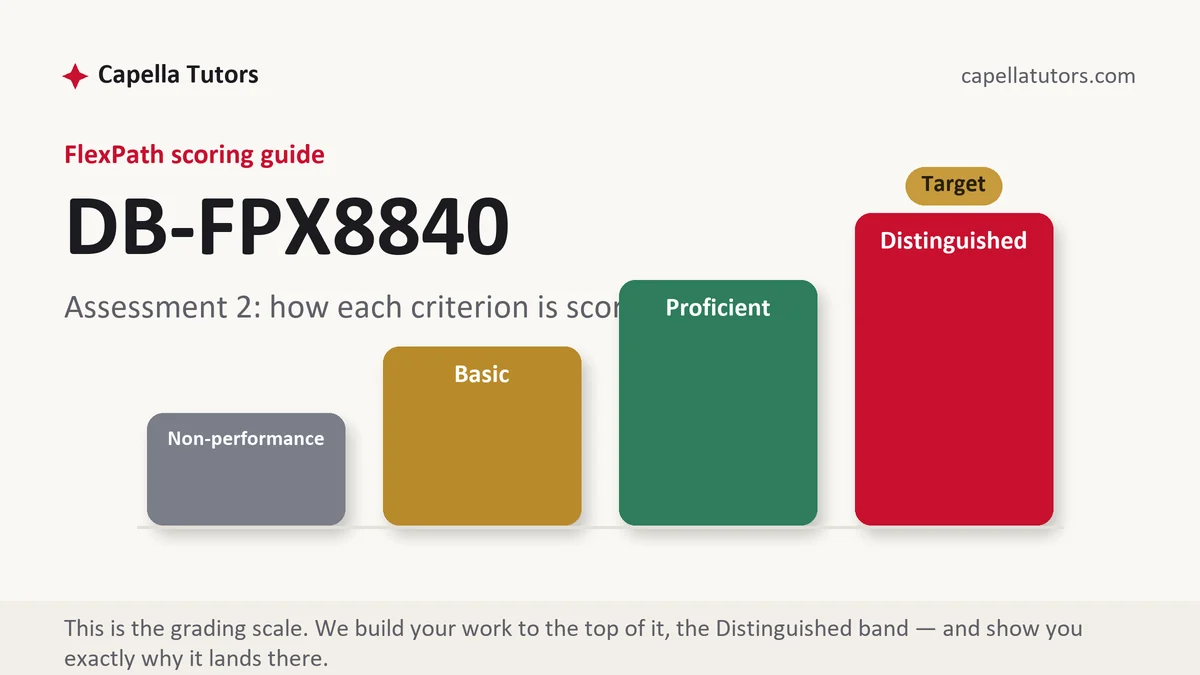
How DB FPX 8840 Assessment 2 is scored
No letter grade is issued in FlexPath. Every criterion comes to rest on one of four levels, and the wording of those levels is the specification for what you write:
| Level | What it means on a problem and purpose deliverable |
|---|---|
| Distinguished | Problem, purpose and questions read as one chain, each sentence entailing the next, and the design the questions imply is named along with what it will not be able to show. The top column always asks for one move past complete; the wording tells you which. |
| Proficient | The three elements are present and defensible on their own, with the joins between them left for the reader to make. |
| Basic | A problem restated as a purpose and then restated again as a question, which looks like alignment and adds nothing at either step. |
| Non-performance | An element is absent or contradicts another, most often questions asking for a relationship the purpose never promised to study. |
Alignment is cheap to repair here and expensive later. Every course after this one inherits these three sentences, and a question that quietly asks for a comparison the purpose does not authorize will surface at the point where a design has already been built on it. How much of the alignment argument has to be written out rather than left implied is something your scoring guide decides.
The DB FPX 8840 Assessment 2 method, step by step
-
Write the problem statement in three parts and stop there
The general situation in organizations of this kind, the specific gap with figures attached, and what the organization loses by leaving the gap in place. No solution belongs in those three parts. If implement, adopt or improve has appeared, you have written an aim, and the criterion that pays for problem definition will find nothing of its own to score.
-
Convert the problem into a purpose that names the study, not the outcome
A purpose sentence says what the study will do, in verbs a design can deliver: describe, compare, explain, explore, in a stated setting with a stated population. It does not say the study will improve anything, because studies do not improve things, and a purpose promising improvement has skipped the design and gone to the recommendations.
-
Write questions that require data to answer
Test each question by asking what evidence would settle it. If the answer is a conversation with the executive team, the item is a consulting brief. If the answer is a number, a pattern across cases, or a comparison of records, you have a research question. Two or three are plenty at this stage, and each has to trace back to a clause of the purpose.
-
Run the alignment audit as a table rather than as a feeling
Put the problem clauses in the left column, the purpose clauses in the middle and the questions on the right, then check that every row is populated. An empty cell is either a promise you did not keep or a question you cannot justify, and a reader spots both in about ten seconds.
-
Name the design your questions already imply, and its limits
Questions about magnitude imply measurement, questions about mechanism imply interviews or cases, and questions about both imply a sequence rather than two studies running at once. Say which one your questions have committed you to, then say what that choice cannot show, because a declared limit reads as command of the method and an undeclared one reads as an oversight.
-
Self-score, then hand the three sentences to a stranger
Mark each criterion yourself against the guide and rewrite whatever is not at the top level. Then give the problem, purpose and questions to somebody outside your field and ask what the study will do. If their answer differs from yours, the chain is broken somewhere in the middle, and finding that now is cheaper than finding it in the review seminar.
A structure that maps to the criteria
The lengths below are the planning targets our doctoral tutors use for a problem and purpose submission, not Capella requirements; stretch any section your criteria weight heavily.
| Section | What it must do | Guide |
|---|---|---|
| Problem statement | The general situation, the specific gap with figures, and the consequence of leaving the gap where it is. | ~350 words |
| Purpose | What the study does, in what setting, with which population, in verbs a design can deliver. | ~150 words |
| Research questions | Two or three questions traceable to purpose clauses, each answerable only with evidence. | ~200 words |
| Alignment argument | The chain shown explicitly, problem clause to purpose clause to question, with nothing orphaned. | ~250 words |
| Implied design and limits | The design the questions commit you to, the data it needs, and what it will not be able to show. | ~300 words |
| References | Current APA both ways, with sector figures labeled as practice evidence rather than as findings. | as needed |
Annotated sample excerpt
An original model passage from our doctoral team, cut to the register a committee expects. Read it for the moves, then make them with your own site and your own figures.
Regional credit unions hold branch networks built for transaction volumes that have moved to phones, and the decision to keep or convert branch capacity is taken by executives who can price a branch precisely and cannot predict what withdrawing service from one does to member behavior.1 At the nineteen-branch institution proposed as the study site, teller transactions fell 43 percent over four years while branch operating cost fell 6 percent, and the two branches where Saturday hours ended in 2024 lost 11 and 14 percent of member deposit balances over the following year against 3 percent across the network.2 The purpose of this study is to explain how member account behavior responds to reductions in branch service capacity at one regional credit union, using four years of account-level transaction and balance records for members attached to branches with and without hours reductions.3
- 1States the general situation and the decision-maker's blind spot in the same breath, which is what makes this a management problem rather than an industry observation.
- 2The specific gap arrives as figures with windows and a comparison, so the size of the asserted effect is visible. Two percentages from the institution's own records outweigh a paragraph of sector commentary.
- 3The purpose names an action a design can deliver, a setting, a population and a data source, and promises nothing about improving anything. Notice which questions this sentence authorizes: questions about response, not about whether to close branches.
The full premium sample for your exact assessment, written fresh to your scoring guide and issue, is free to request. Study it, revise it into your own voice, and submit work you understand.
The five mistakes that cost Distinguished
- A purpose that promises improvement. Studies describe, compare and explain; the improvement belongs to whoever acts on the findings afterward.
- Three sentences saying the same thing. Restating the problem as a purpose and the purpose as a question is repetition wearing the costume of alignment.
- A question no data could settle. If the honest answer is that you would ask the leadership team, the item is a consulting engagement rather than a research question.
- Questions that outrun the purpose. A comparison in the questions with no comparison in the purpose is the alignment break committees find first.
- The design left unnamed. Questions imply a method whether or not you write it down, and an unstated method is graded as absent rather than as flexible.
Pre-submission checklist
- The problem statement carries a general situation, a specific gap with figures, and a consequence
- No solution verb appears anywhere inside the problem statement
- The purpose sentence names an action, a setting and a population
- Every question traces to a purpose clause, and every purpose clause has a question
- The implied design is named, with one thing it cannot show stated plainly
- Self-scored at the top level on every criterion, submitted early in the week
Problem, purpose and questions not lining up?
Send the criteria, your current three sentences and the data you can actually reach. A doctoral-register rewrite returns in 24 to 48 hours with the chain audited clause by clause and the implied design named alongside its limits, revised free until the criteria clear.