This manual is for DB FPX 8840 Assessment 1, start to submission. The opening deliverable of a topic development seminar usually asks you to convert the management concern you arrived with into a candidate topic: a recurring decision somebody owns, evidence that the decision is being made on thin information, and a boundary you can defend to a committee. DB FPX 8840 carries 3 program points as a seminar in the General Management specialization, delivered in FlexPath inside the 45-point Doctor of Business Administration, so the criteria are doctoral and the reader is a committee. What follows is the approach our doctoral tutors take to this stage, a structure assembled from the criteria, and an annotated sample excerpt. Would you rather hand it over? A premium original doctoral sample written to this exact assessment returns in 24 to 48 hours, revised at no cost until the criteria clear. Capella's catalog lists the course as DB-FPX8840, and some courserooms print DB8840; both point to this same Assessment 1.
One honesty note before the manual: Capella revises courses and scoring guides over time, so always write to the exact scoring guide attached to your assessment in the courseroom. The course identity above is verified on capella.edu; the method and structure below are our tutors' approach to it, not Capella's official rubric text.
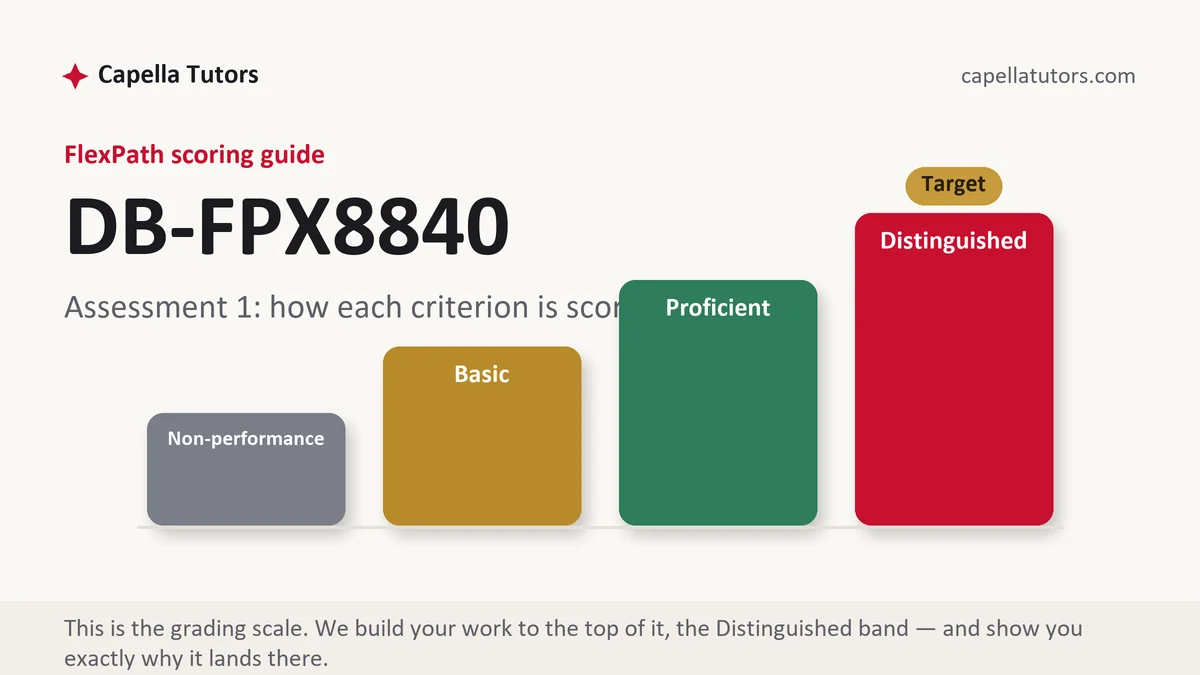
How DB FPX 8840 Assessment 1 is scored
There are four levels against every criterion on a FlexPath guide and no letter grade anywhere above them, so the level wording is the only brief you have:
| Level | What it means on a topic identification deliverable |
|---|---|
| Distinguished | The concern arrives as a decision with an owner and a frequency, the trade-off is quantified from the organization's own figures, and the boundary is justified against real access. Each criterion hides one move past complete; locate it and make it. |
| Proficient | The topic is identified, evidenced and bounded. Sound work that stops one deliberate move below the top of the column. |
| Basic | An industry level subject described competently, with the decision and its owner left for the reader to infer. The usual landing place for a first doctoral topic. |
| Non-performance | A required element is absent, most often evidence that the problem exists anywhere except in the candidate's own building. Missing rather than weak is what puts a criterion on the floor. |
Two things get graded here that no criterion will name. The first is register, because a hedged claim costs more at doctoral level than it did in a master's course. The second is whether the topic survives the courses after this one, since the review seminar inherits whatever boundary you draw, and a loose boundary gets renegotiated with a year of reading already done against it.
The DB FPX 8840 Assessment 1 method, step by step
-
Turn the criteria into the outline before you write a word about your topic
The prompt describes the deliverable and the criteria award the levels, so copy each criterion into an empty document and paste its top level wording underneath. At this stage the criteria usually cluster around the concern and its evidence, the decision it belongs to, and the boundary that makes studying it possible. Anything you cannot file under one of those headings is not part of this submission.
-
Find the decision, then find the person who signs it
A concern becomes researchable at the moment it attaches to a decision somebody makes on a schedule. Write the decision as a present tense sentence, name the role that owns it, and state how often it comes round. If no role owns it, you are holding a symptom of a decision one level up that you have not identified yet.
-
Put the trade-off on paper as two numbers
General management problems are trade-offs, so show what improves and what degrades when the decision goes each way, in the organization's own units. Rough figures are acceptable and adjectives are not, because numbers on both sides are what tell a committee the decision is genuinely hard.
-
Prove the problem exists outside your own building
Two kinds of evidence do two jobs here and merging them is the common failure. Internal indicators establish that the problem is real at your site, and published empirical work establishes that it is a pattern rather than a local accident. Label each for what it is, and cite the internal figures to the report that produced them.
-
Draw the boundary, then test it arithmetically
Scope arguments end faster when they are settled by counting. Price the constructs your emerging question commits you to: predictors against the accessible population at roughly fifteen observations apiece, interviews at five to six hours including transcription and coding, papers to appraise at about twenty-five minutes each. Compare the total to the weeks in front of you and cut until the arithmetic fits.
-
Self-score, then read the decision sentence to somebody who makes it
Mark every criterion D, P, B or N yourself and rewrite anything under the top level. Then read your decision sentence to a manager who actually holds that decision, because if they do not recognize their own quarter in it the topic is describing a literature rather than a practice. Submit early in the week, since doctoral feedback cycles are slower than coursework ones.
A structure that maps to the criteria
These lengths are planning targets our doctoral tutors use for a topic identification submission, not Capella rules; expand whichever section your scoring guide weights hardest.
| Section | What it must do | Guide |
|---|---|---|
| Concern and its origin | The management concern stated plainly, where you met it, and why it persists instead of resolving. | ~250 words |
| The decision and its owner | The recurring decision the concern belongs to, the role that makes it, and the information that role currently has. | ~300 words |
| The trade-off, quantified | What is gained and given up on each side of the decision, in the organization's own units, with the arithmetic shown. | ~300 words |
| Evidence that it generalizes | Peer-reviewed empirical work showing the pattern beyond your site, kept distinct from the internal indicators. | ~350 words |
| Boundary and feasibility | What the study will and will not cover, the access behind that promise, and the constructs the question commits you to. | ~250 words |
| References | Current APA matched both ways, with internal reports and sector data labeled as practice evidence. | as needed |
Annotated sample excerpt
An original model paragraph from our doctoral team, written where the top column of a doctoral guide sits. Treat it as study material: read the moves, then make them with your own organization's numbers.
At the subscription software firm proposed as the study site, the vice president of revenue decides each quarter how to split 34 quota-carrying sellers between a land-and-expand motion aimed at teams of under fifty seats and an enterprise motion aimed at accounts above one thousand.1 The two motions produce different economics in the firm's own records: land-and-expand closed 218 deals last year at a median first-year value of 11,400 dollars and 71 percent gross retention, while enterprise closed 19 at a median of 240,000 dollars, an eleven-month median cycle and 94 percent retention, and implementation, support and marketing are all resourced for the first pattern.2 Nothing inside the firm reconciles the two, so the split is reargued every quarter from the results of the quarter just closed, and it is that reargument, rather than the question of which motion is superior, that this study examines.3
- 1Decision, owner and frequency in one sentence. A topic fastened to a recurring decision already has a boundary; a topic fastened to a theme has to be given one later, usually by faculty.
- 2The trade-off in the firm's own figures, function by function. Two numbers on each side of a decision is what separates a doctoral problem from a management opinion held strongly.
- 3Says what the study is about and what it is not, which stops a committee reading the paper as a strategy recommendation with citations attached.
The full premium sample for your exact assessment, written fresh to your scoring guide and issue, is free to request. Study it, revise it into your own voice, and submit work you understand.
The five mistakes that cost Distinguished
- A theme where a decision belongs. Pricing strategy is a subject; the quarterly split of a sales force between two motions is a decision, and only the second comes with a boundary.
- Both sides of the trade-off written in adjectives. Stronger retention and better efficiency are positions, not evidence, and a committee has no way to weigh them.
- Internal figures doing scholarly work. A dashboard proves the problem is here and cannot establish that it is general, and the criteria usually pay separately for each job.
- A question committed to constructs you cannot measure. Counting observations per predictor before the design is chosen prevents the narrowing you would otherwise do three times.
- A contribution claim with nobody in it. Say which role would decide differently and on what evidence, since a benefit stated in general terms is not a contribution anyone can test.
Pre-submission checklist
- Every criterion on the guide has its own labeled section
- The decision is one present tense sentence carrying an owner and a frequency
- Both sides of the trade-off carry a figure from the organization's own records
- Internal indicators and peer-reviewed evidence are labeled separately throughout
- The construct count has been priced against the accessible population and the calendar
- Self-scored at the top level on every criterion, submitted early in the week
Topic paper due and the scope still moving?
Send the criteria, the concern you brought into the program, and whatever access you actually hold. A doctoral-register draft returns in 24 to 48 hours with the decision named, the trade-off costed and the boundary priced against your population, revised free until every criterion clears.