This manual is for DB FPX 8750 Assessment 3, start to submission. Assessment 3 of Seminar: Strategy and Innovation Literature Review usually asks for the appraisal and the synthesis: each study recorded with its design, level, data source, measure, and theoretical lens, then themes organized by theoretical position with the causes of each disagreement named, ending in a gap that points at an observable you could obtain. It is the deliverable where a competent review either becomes an argument or stays a catalogue. The working order our doctoral tutors use is below, with a structure tied to the criteria and an annotated sample excerpt. Prefer to pass it across? A premium original sample keyed to this assessment comes back in 24 to 48 hours, revised at no cost while any criterion remains unmet. Capella's catalog lists the course as DB-FPX8750, and some courserooms print DB8750; both point to this same Assessment 3.
One honesty note before the manual: Capella revises courses and scoring guides over time, so always write to the exact scoring guide attached to your assessment in the courseroom. The course identity above is verified on capella.edu; the method and structure below are our tutors' approach to it, not Capella's official rubric text.
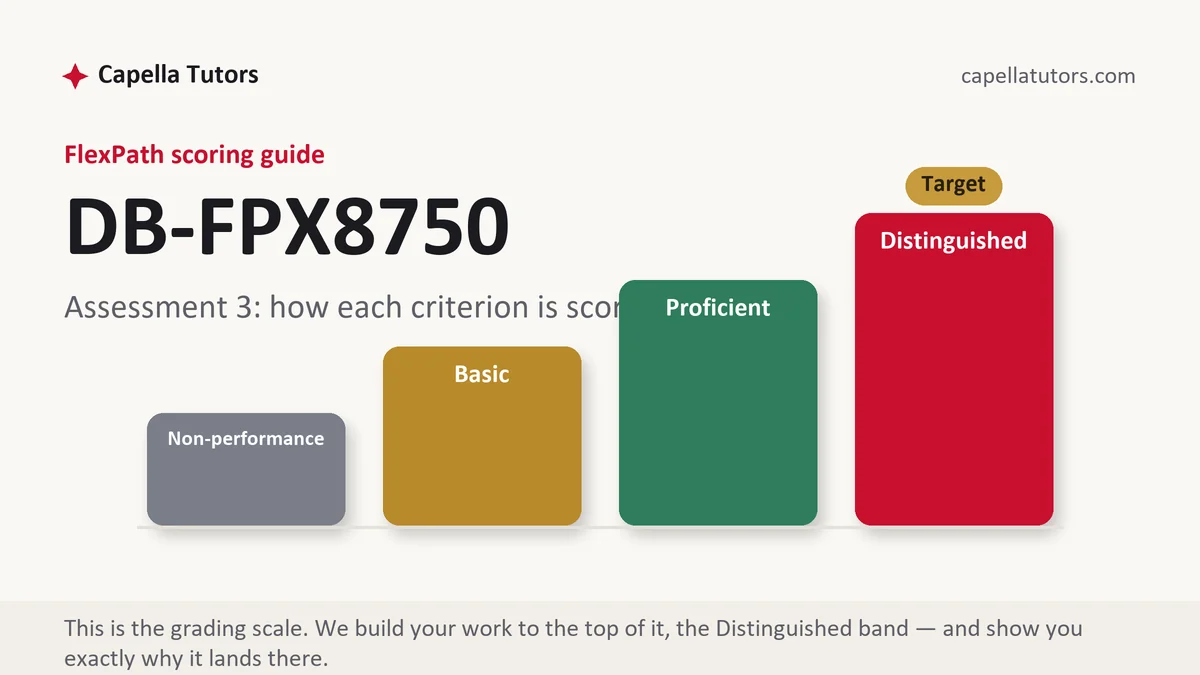
How DB FPX 8750 Assessment 3 is scored
Criteria are placed independently at one of four levels, and the top level names the move rather than praising the writing:
| Level | What it means on an appraisal and synthesis |
|---|---|
| Distinguished | Archival and case evidence are weighed for what each can establish rather than ranked against one standard, themes are organized by theoretical position, each divergence has a named probable cause, and the gap points at an observable the candidate could obtain. |
| Proficient | A thematic synthesis with studies appraised and a gap stated. Careful work in which case evidence is treated as weaker rather than as different. |
| Basic | Studies grouped by topic and reported in turn, agreement emphasised, and a gap announced that the reading did not produce. |
| Non-performance | A required component is absent, most often synthesis across theoretical positions. A sequence of accurate summaries has not attempted the criterion. |
Two things travel into the proposal. The first is the gap sentence, which becomes the reason your study exists, and the tighter it is the shorter that argument has to be. The second is the observable: a gap that requires a record nobody keeps is a comment about the literature rather than a study, so name what would be counted or asked and where it sits. If your review has drawn on firm documents rather than only on published scholarship, settle the review determination for that material now, since the answer affects what you may quote and how the source can be described.
The DB FPX 8750 Assessment 3 method, step by step
-
Record the theoretical lens alongside the method
Design, level of analysis, data source, measure, and the theory the authors were working within. In strategy the lens predicts the finding often enough that recording it is a form of measurement, and a corpus sorted by lens usually explains disagreements that a corpus sorted by topic cannot.
-
Judge each evidence type by what it can establish
Archival panel work can establish association across many firms and rarely explains mechanism. A close case study can establish mechanism in one setting and cannot establish prevalence. Ranking them on a single quality scale destroys exactly the information you need.
-
Organize the synthesis by position, not by chronology
Group the studies by the explanation they advance, then set the groups against each other. This field's conversations are structured by competing accounts of where returns come from, and a review that follows publication dates has hidden the only structure the reader needs.
-
Name the probable cause of every divergence
Different conception operationalized, different level of analysis, different sector conditions, different period, different data source. Say which one you think explains the disagreement and why, and where none of them does, record it as genuinely open.
-
Separate definitional conflict from empirical conflict
Two studies reporting opposite effects on the same labelled construct are often measuring different things, and your classification rule from the earlier stage will show it. Making that visible is one of the clearest markers of a candidate who has read the field rather than searched it.
-
Write the gap as an observable
Not a topic nobody has covered, but a specific thing that could be counted, asked, or documented, at a level you could reach, in a setting where the existing work has not looked. A gap you cannot operationalize will not survive the proposal stage.
A structure that maps to the criteria
These targets are our planning defaults for a doctoral synthesis, not Capella rules; the appraisal matrix belongs in an appendix and does not count toward prose.
| Section | What it must do | Guide |
|---|---|---|
| Appraisal approach | The fields recorded per study, why the lens is one of them, and how evidence types were weighed. | ~250 words |
| Position one | The explanation advanced, the studies advancing it with designs and levels, and what it accounts for. | ~300 words |
| Position two | The rival explanation, its evidence base, and the observations it handles better. | ~300 words |
| Divergence analysis | Each disagreement with its probable cause named, and the definitional conflicts separated out. | ~300 words |
| What the corpus establishes | Claims the evidence supports, claims it does not, and the confidence attached to each. | ~250 words |
| Gap and references | The observable a study could obtain, where and at what level, plus current APA both ways. | ~250 words |
Annotated sample excerpt
An original model paragraph from our team, written for a review of business model reconfiguration among regional newspaper groups. It shows evidence types weighed rather than ranked.
Whether subscription reconfiguration improves operating margin is reported positively in four archival studies and negatively or neutrally in six case accounts, and the divergence is almost entirely explained by what each design can see.1 The archival studies work from published financial series across 40 to 300 firms and measure margin two to four years after a reported change in revenue mix, which captures the survivors and cannot observe the groups that attempted reconfiguration and were acquired or closed before the second observation; the case accounts follow single groups through the attempt itself and describe the cost of running two revenue models in parallel during transition, a cost that leaves no separate line in published accounts and so is invisible to the panel studies by construction.2 Read together the two literatures are not in conflict about the world, they are answering different questions, and this review records the position accordingly: reconfiguration is associated with improved margin among groups that complete it, the completion rate is unmeasured in every archival study retrieved, and the observable this review points at is the transition-period cost structure, which regional groups do record internally and no retrieved study has obtained.3
- 1States the disagreement with counts on both sides and immediately attributes it to design capability rather than to error. That attribution is the argument the paragraph exists to make.
- 2Explains precisely what each design can and cannot observe, including the survivorship problem and the reason the transition cost has no published line. This is weighing evidence types rather than ranking them.
- 3Dissolves the apparent conflict, states what the corpus does and does not establish, and lands on an observable that exists in internal records and has not been obtained. The gap now arrives as a consequence of the appraisal.
The full premium sample for your exact assessment, written fresh to your scoring guide and issue, is free to request. Study it, revise it into your own voice, and submit work you understand.
The five mistakes that cost Distinguished
- Case evidence rated as weak evidence. A close case account establishes mechanism, which no panel study can, and grading it against an archival standard throws away what it is for.
- Themes organized by publication date. Chronology tells a reader when work appeared and hides the competing explanations that structure the field.
- Divergence reported as mixed findings. Naming the probable cause is the criterion; recording that results vary is the observation that precedes analysis.
- Theoretical lens left unrecorded. In this field the lens frequently predicts the finding, and a matrix without it cannot explain why two competent studies disagree.
- A gap with no obtainable observable. If nobody keeps the record your gap requires, you have written a comment about the literature rather than the beginning of a study.
Pre-submission checklist
- The appraisal records design, level, data source, measure, and theoretical lens
- Archival and case evidence are weighed by what each can establish
- Themes are organized by theoretical position rather than by date or topic
- Every divergence carries a named probable cause, or is recorded as open
- Definitional conflicts are separated from empirical ones using the classification rule
- The gap names an observable, its level, its setting, and where the record sits
Synthesis or gap statement due?
Send the criteria and your corpus, matrix included if you have one. We record the theoretical lens beside the method, weigh archival and case evidence for what each can establish, organize the synthesis by position, and write a gap that points at a record somebody actually keeps. First sample at no charge.