This manual is for DB FPX 8750 Assessment 2, start to submission. Assessment 2 of Seminar: Strategy and Innovation Literature Review usually asks how the corpus was actually built: databases, strings, limiters and dates, plus backward chaining through the reference lists of anchor papers and forward citation searching on the most-cited works, each reported separately and counted. Strategy work concentrates in a small number of outlets and uses inconsistent vocabulary, so a keyword search alone reliably misses important papers. Below is the sequence our doctoral tutors follow, a structure tied to the criteria, and an annotated sample excerpt. Rather delegate it? A premium original sample for this assessment returns within 24 to 48 hours, reworked free while a criterion is short. Capella's catalog lists the course as DB-FPX8750, and some courserooms print DB8750; both point to this same Assessment 2.
One honesty note before the manual: Capella revises courses and scoring guides over time, so always write to the exact scoring guide attached to your assessment in the courseroom. The course identity above is verified on capella.edu; the method and structure below are our tutors' approach to it, not Capella's official rubric text.
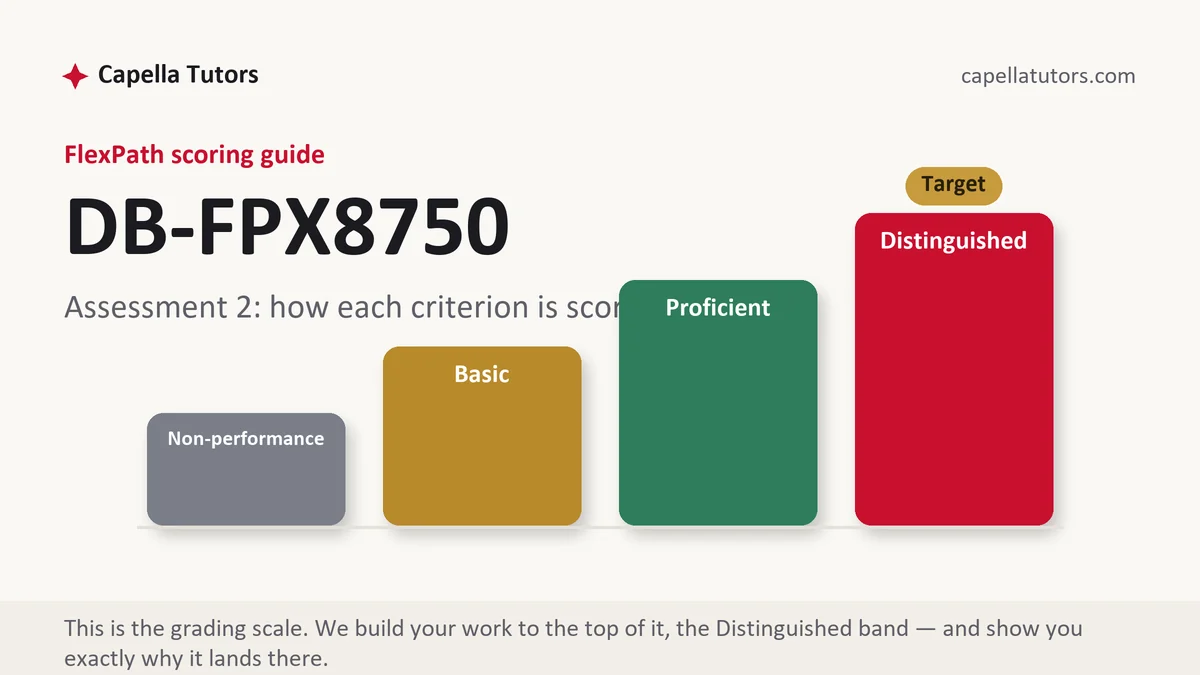
How DB FPX 8750 Assessment 2 is scored
Four levels, applied one criterion at a time, with the top level naming a demonstration rather than a virtue:
| Level | What it means on a search and chaining record |
|---|---|
| Distinguished | Databases, strings, limiters, and run dates are reported; backward and forward chaining are described as separate procedures with their own counts; and the number of records chaining added is stated along with what that says about the keyword search. |
| Proficient | A documented database search with chaining mentioned. Solid method in which the chaining yield is not counted and so cannot be judged. |
| Basic | Two databases and a keyword list, a final source count, and a claim that the search was comprehensive. |
| Non-performance | A required element is absent, most often the chaining procedure. A strategy review built on keyword retrieval alone has skipped a step every experienced reviewer expects. |
The sentence that establishes you understand this field's citation structure is the one giving the chaining yield as a proportion. If a third of your corpus arrived through reference lists and citation searches, the keyword search on its own would have produced a review missing a third of the evidence, and saying that plainly is worth more than any claim of comprehensiveness. It also tells your reader how to interpret the boundary of what you found rather than asking them to trust it.
The DB FPX 8750 Assessment 2 method, step by step
-
Run the database search first and freeze the output
Export the results, save them, and record the counts before you touch anything else. Chaining yields have to be attributable, and a corpus assembled in one continuous session cannot be separated into what the string found and what the reference lists found.
-
Choose anchor papers deliberately and say why
Four to six works that define the conversation: the originating statement, one or two influential empirical tests, and any systematic review in the area. Name them, say why each was chosen, and treat that list as part of the method rather than as background reading.
-
Chain backward through the anchors' reference lists
Read the references of each anchor against your eligibility rules, not against interest. Record how many candidates each anchor produced and how many survived screening, because a reference list that yields nothing tells you something about your boundary.
-
Chain forward on the most-cited works
Use the citation index to find work that cites your anchors, then screen it the same way. Forward chaining is where recent studies using different vocabulary appear, which is exactly the material a fixed string cannot reach.
-
Report the two procedures separately and count the yield
Backward and forward are different operations with different biases, and merging them hides which one did the work. State how many records each added, then give the chaining total as a proportion of the final corpus.
-
Stop when a full round adds nothing and say so
Run chaining until a complete pass over the newest additions produces no new eligible record. Reporting that the last round added zero is a defensible stopping rule, and it replaces the claim of comprehensiveness that nobody can verify.
A structure that maps to the criteria
Word targets are our planning defaults for a doctoral search paper rather than Capella requirements; strings, anchor lists, and yield tables usually sit in appendices.
| Section | What it must do | Guide |
|---|---|---|
| Database procedure | Indexes, strings as executed, limiters, run dates, and the counts each search returned. | ~300 words |
| Eligibility applied | The rules used at screening, restated, and how they were applied to records from every source. | ~200 words |
| Anchor selection | The anchor works, why each was chosen, and what role each plays in the conversation. | ~250 words |
| Backward chaining | How reference lists were screened, the candidates each anchor produced, and the survivals. | ~300 words |
| Forward chaining | The citation index used, the works chained forward, the candidates found, and the survivals. | ~250 words |
| Yield and stopping rule | Totals by source, chaining as a proportion of the corpus, the terminating round, and current APA. | ~250 words |
Annotated sample excerpt
An original model paragraph from our team, written for a review of open innovation in the seed and crop-input sector. It shows chaining reported as a procedure with a yield.
The database searches of Business Source Complete and Web of Science returned 843 records, 690 after deduplication, of which 41 met the eligibility rules and entered the corpus.1 Backward chaining through the reference lists of six anchor works produced 87 candidates of which 14 survived screening, and forward citation searching on the three most-cited anchors produced 156 candidates of which 9 survived, so the corpus stands at 64 studies and 23 of them, or 36 percent, were invisible to the keyword search: most of the 23 use sector vocabulary such as germplasm collaboration or licensed trait access rather than any variant of open innovation, which is a fact about how this literature is written rather than a defect in the string.2 Chaining was run in three rounds and terminated when a full pass over the fourteen most recent additions produced no further eligible record, which is the stopping rule this review reports instead of a claim to comprehensiveness, and the residual risk is stated: a study published in a sector journal that neither cites nor is cited by any of the six anchors would still be missed, and that risk is real rather than theoretical in a field with this much practitioner-facing publication.3
- 1The database yield in one sentence with both the raw and deduplicated counts, so the chaining figures that follow have a baseline to be compared against.
- 2Both chaining procedures with candidates and survivals for each, then the proportion, then the explanation of why the string missed them. The vocabulary point turns a methodological number into a finding about the field.
- 3Gives a stopping rule that can be checked, refuses the unverifiable claim, and then names the residual risk the method cannot close. Volunteering the remaining hole is what makes the rest of the account credible.
The full premium sample for your exact assessment, written fresh to your scoring guide and issue, is free to request. Study it, revise it into your own voice, and submit work you understand.
The five mistakes that cost Distinguished
- Chaining performed and not reported. Most candidates do some reference-list following, and a review that does not count it cannot claim credit for it.
- Backward and forward merged into one figure. The two procedures have different biases, and a combined number hides which of them found the recent work.
- Anchors chosen by convenience. An anchor list assembled from whatever was read first shapes the whole corpus, and the reason each anchor was selected belongs in the method.
- Comprehensiveness claimed. No search in this field is complete, and asserting it invites the one question the method cannot answer.
- No stopping rule. Chaining without a termination condition either stops arbitrarily or continues forever, and a reader needs to know which round was the last and why.
Pre-submission checklist
- Database output is frozen and counted before any chaining begins
- Anchor works are named with the reason each was chosen
- Backward chaining reports candidates and survivals per anchor
- Forward chaining names the citation index and reports its own counts
- Chaining yield appears as a proportion of the final corpus
- A stopping rule is stated, along with the residual risk it leaves open
Search strategy or chaining record due?
Send the criteria, your question, and your definition. We run the database searches and freeze the counts, select and justify the anchors, chain in both directions with the yields recorded separately, and write the stopping rule that replaces a claim of comprehensiveness. First premium sample free.