This manual is for DB FPX 8750 Assessment 1, start to submission. Assessment 1 of Seminar: Strategy and Innovation Literature Review usually asks for the review's purpose, its question, and the definition of the construct at its centre, with the competing conceptions named and excluded. Strategy's core terms have widened since they were introduced, so two papers sharing a keyword can be studying unrelated things, and this deliverable is where you stop that from contaminating everything downstream. Our doctoral tutors work it in the order below, followed by a structure tied to the criteria and an annotated sample excerpt. Prefer to hand it across? A premium original sample for this exact assessment lands inside 24 to 48 hours and is revised at no charge until the guide is met. Capella's catalog lists the course as DB-FPX8750, and some courserooms print DB8750; both point to this same Assessment 1.
One honesty note before the manual: Capella revises courses and scoring guides over time, so always write to the exact scoring guide attached to your assessment in the courseroom. The course identity above is verified on capella.edu; the method and structure below are our tutors' approach to it, not Capella's official rubric text.
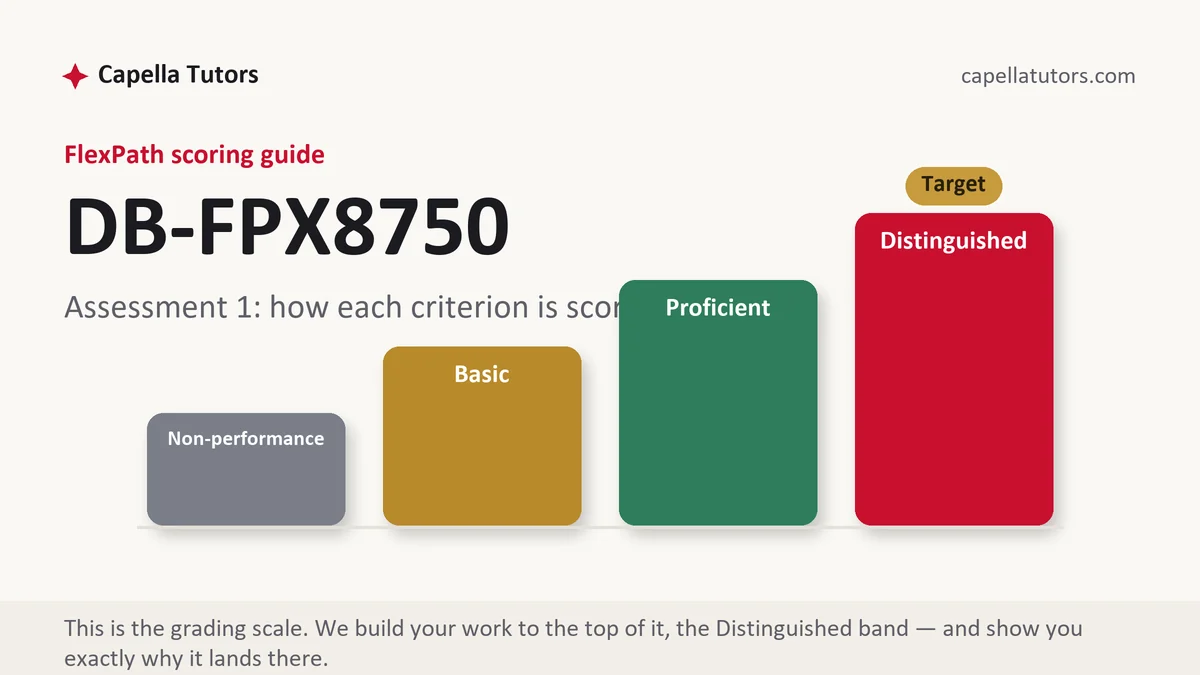
How DB FPX 8750 Assessment 1 is scored
Each criterion is placed at one of four levels on its own, and the top level describes a specific act rather than a level of polish:
| Level | What it means on a review purpose and construct definition |
|---|---|
| Distinguished | The purpose explains why the review is organized the way it is, the question carries a boundary, one definition is adopted and cited to its source, and the competing conceptions are named as excluded rather than ignored. |
| Proficient | A clear purpose and question with the construct defined. Sound work in which the definition is stated but the alternatives are not identified. |
| Basic | A review area announced, the construct defined from a recent textbook or a secondary summary, and the organizing structure left to emerge. |
| Non-performance | A required element is absent, most often the definition itself. Without one, no later screening decision can be assessed as consistent. |
What this hands forward is the sorting rule. Once one conception is adopted, every retained study can be classified by which conception it actually operationalized, and that classification is what turns an apparent empirical disagreement into a definitional one later in the sequence. A note on the review pathway while you are here: analysis of published scholarship does not ordinarily require board review, and the moment your review starts drawing on internal organizational documents or unpublished firm records the position changes, so establish what your programme requires before you begin collecting anything that is not in a library.
The DB FPX 8750 Assessment 1 method, step by step
-
Write the purpose as a job, not as a subject
This review exists to establish what is known about something, for a reason. State the job and the reason, and the organizing structure follows from them. A purpose stated as an area guarantees a review organized chronologically, which is the arrangement that hides the most.
-
Put a boundary in the question
Sector, firm size, level of analysis, time period, or method. Strategy questions without boundaries return literatures rather than corpora, and the boundary you choose deliberately is far better than the one your screening capacity will impose accidentally.
-
Trace the construct back to where it was introduced
Read the original statement rather than a description of it. Terms in this field have widened through use, and the difference between the founding definition and current usage is frequently the most interesting paragraph in the section.
-
Name the competing conceptions and say which you exclude
Two or three rival definitions, each cited, each with a sentence on what it captures and what it lets in. Then state the one you adopt and the reason. This is the paragraph that lets a reader predict your screening decisions before they read them.
-
Write the classification rule you will apply to studies
An instruction: a study counts as operationalizing this conception if it measured these things in this way. The rule is what keeps screening consistent across several hundred abstracts read over several weeks, and it is impossible to reconstruct honestly afterwards.
-
Say what your definition costs the review
A tight definition excludes work a reader might expect to see. Name what falls outside it and why, so the absence reads as a decision rather than as a gap in your reading. Reviewers notice missing literatures and they accept excluded ones.
A structure that maps to the criteria
These word targets are our planning defaults for a doctoral review-method paper, not Capella rules; definition tables and classification rules normally sit in appendices.
| Section | What it must do | Guide |
|---|---|---|
| Purpose of the review | The job the review performs, the reason it is needed now, and how that dictates the structure. | ~250 words |
| Question and boundary | The question stated with its boundary, and the reason the boundary sits where it does. | ~250 words |
| Origin of the construct | Where the term was introduced, what it meant then, and how usage has moved since. | ~300 words |
| Competing conceptions | Two or three rival definitions, cited, with what each admits and excludes. | ~300 words |
| Adopted definition and rule | The definition used, its source, and the classification instruction that will be applied to studies. | ~250 words |
| Cost of the definition and references | What falls outside it and why, plus current APA in both directions. | ~200 words |
Annotated sample excerpt
An original model paragraph from our team, written for a review of ambidexterity in mid-sized machine tool builders. It shows a construct fixed rather than assumed.
This review adopts the structural conception of ambidexterity, in which exploration and exploitation are pursued in separate organizational units with different measures and are reconciled at the level of senior management, cited to the work that introduced the distinction rather than to any of the later summaries that treat the term as a synonym for balance.1 Two rival conceptions are named and excluded: the contextual conception, in which individuals switch between exploring and exploiting inside the same role, which is a real phenomenon measured with entirely different instruments, and the sequential conception, in which a firm alternates between modes over time, which requires longitudinal data that almost none of the retrievable studies in this sector hold.2 The classification rule applied to every retained study is therefore explicit: a study counts as structural if it reports two or more organizational units with distinguishable objectives or measurement regimes, and studies that measure individual-level switching behavior or that infer alternation from performance series are recorded and set aside rather than merged, because pooling the three conceptions is how a review produces an average of unrelated things and calls it a finding.3
- 1Adopts one conception, describes it in operational terms, and cites it to the originating work while naming the specific misuse it is avoiding. The clause about later summaries is doing real work: it explains why the citation choice matters.
- 2Two rivals named, each with what it captures and the practical reason it is excluded. The second reason is empirical rather than theoretical, which is stronger, because it says something about what the sector's literature actually contains.
- 3Converts the definition into an instruction that can be applied to an abstract at speed, and states what happens to the studies that fail it. Recording and setting aside rather than deleting is what keeps the corpus auditable.
The full premium sample for your exact assessment, written fresh to your scoring guide and issue, is free to request. Study it, revise it into your own voice, and submit work you understand.
The five mistakes that cost Distinguished
- A construct defined from a secondary summary. Textbook definitions of strategy terms have usually drifted from the original, and citing the drift as the definition imports the problem you are trying to control.
- A question with no boundary. An unbounded strategy question returns a literature rather than a corpus, and screening capacity then sets the scope by accident.
- Rival conceptions ignored rather than excluded. A reader who knows the field will notice the missing conception, and an unexplained absence reads as unfamiliarity.
- A definition with no classification rule. A definition you cannot apply to an abstract in thirty seconds will not be applied consistently across several hundred of them.
- Purpose stated as a subject area. A review of the literature on innovation gives the reader no reason to expect one arrangement of the sections rather than another.
Pre-submission checklist
- The purpose names the job the review performs and why it is needed now
- The question carries a boundary, with the reason it sits there
- The construct is traced to its originating publication
- Two or three rival conceptions are named, cited, and excluded with reasons
- A classification rule is written as an instruction applicable to an abstract
- What the definition excludes is stated, so absences read as decisions
Review purpose or construct definition due?
Send the criteria and the review question you are working toward. We trace the construct to its origin, name the rival conceptions, adopt one with its source, and write the classification rule your screening will need to stay consistent. Your first premium sample carries no fee.