This manual is for DB FPX 8740 Assessment 3, start to submission. Assessment 3 of Seminar: Strategy and Innovation Topic Development usually asks whether the population exists, whether you can reach it, and whether what you would learn transfers beyond the site. Strategy candidates cross the line from research into consulting without noticing, and this deliverable is where the boundary gets drawn. The working sequence our doctoral tutors apply is below, along with a structure tied to the criteria and an annotated sample excerpt. Prefer to pass it over? A premium original sample for this exact assessment comes back within 24 to 48 hours, revised free while any criterion remains short. Capella's catalog lists the course as DB-FPX8740, and some courserooms print DB8740; both point to this same Assessment 3.
One honesty note before the manual: Capella revises courses and scoring guides over time, so always write to the exact scoring guide attached to your assessment in the courseroom. The course identity above is verified on capella.edu; the method and structure below are our tutors' approach to it, not Capella's official rubric text.
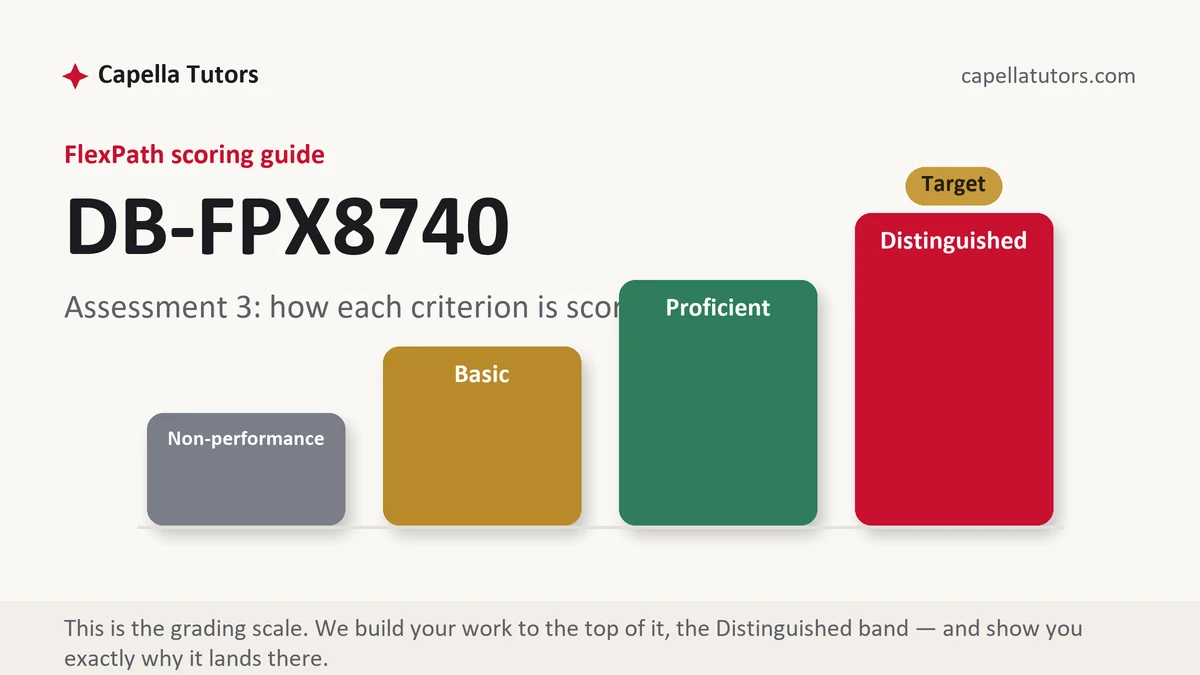
How DB FPX 8740 Assessment 3 is scored
Four levels per criterion, each judged on the evidence present rather than on the paper's confidence:
| Level | What it means on access, sampling, and contribution |
|---|---|
| Distinguished | The frame is counted, the participation rate is defensible, the arithmetic is worked through against the real population, gatekeepers and sensitivity are addressed, and the contribution is distinguished explicitly from a recommendation to one company. |
| Proficient | A feasible sample with access considered and a stated contribution. Credible work whose participation rate is optimistic and unsourced. |
| Basic | Access described as likely, sample size proposed by convention, and contribution claimed as value to the organization and the wider field. |
| Non-performance | A required element is absent, most often the frame count. A design whose population has never been counted has not been shown to be possible. |
Three things move forward from here. The literature review seminar takes your bounded contribution claim and turns it into a documented corpus. The proposal takes the sampling arithmetic more or less intact. And the review submission takes whatever you decide about sensitivity: interviews with managers at firms other than your employer are research with human participants, they frequently touch commercially confidential material, and the determination about review has to be sought before recruitment rather than alongside it. Ask what your programme requires while you are writing this paper and the clock costs you nothing.
The DB FPX 8740 Assessment 3 method, step by step
-
Count the frame before choosing a design
How many organizations, projects, or people of the required type actually exist within your reach. Count them from a list rather than estimating, because the number frequently turns out to be smaller than the design needs and the discovery is free at this stage.
-
Use a participation rate you can source
Take it from a comparable published study or from your own organization's survey history, and cite it. An assumed 60 percent response from busy executives at firms with no relationship to you is the single most common piece of optimism in doctoral feasibility sections.
-
Run the arithmetic and let it change the design
If the requirement exceeds the frame, the design has to change: fewer firms with more informants each, a widened geographic or sector boundary, or a shift from breadth to depth. Say which one you chose and what it costs the study, since that trade-off is itself a finding about the population.
-
Handle commercial sensitivity as a design element
Strategy and innovation questions touch pricing, margins, and unlaunched products. Say what you will not ask, how firms will be de-identified, who could re-identify them from your own description, and what the confidentiality terms will be. Sensitivity handled in advance is what makes recruitment possible.
-
Draw the line between contribution and consulting
A recommendation to one firm produces a decision. A doctoral contribution produces something a practitioner elsewhere could use, which usually means examining how or why a pattern occurs rather than what a particular company should do. Keep the practical value by framing the site as a case that illuminates a broader problem.
-
Say who outside the site would change their behavior
Name the role: an operations director in a comparable firm, a portfolio manager, a board committee. If nobody outside the organization would act differently, the study is a project rather than research, and this is the sentence that exposes it while it is still cheap to fix.
A structure that maps to the criteria
These targets are our planning defaults for a doctoral feasibility paper rather than Capella rules; the frame list and any correspondence normally sit in appendices.
| Section | What it must do | Guide |
|---|---|---|
| Design recap | Purpose, questions, and unit of analysis carried forward, with the design their phrasing implies. | ~150 words |
| Frame and count | The population of the required type, counted from a list, with the boundary that defines it. | ~250 words |
| Participation and arithmetic | The sourced rate, the requirement it produces, and how the design changed to fit the frame. | ~350 words |
| Gatekeepers and sensitivity | Who authorises, what will not be asked, how firms are de-identified, and the confidentiality terms. | ~300 words |
| Contribution | What transfers, to which role outside the site, and how that differs from advice to one firm. | ~300 words |
| Positioning and references | The conversation this joins, bounded by setting and method, with current APA both ways. | ~200 words |
Annotated sample excerpt
An original model paragraph from our team, written for a multi-firm study of engineering consultancies. It shows arithmetic that changes a design rather than decorating it.
The frame is mid-market engineering consultancies of 50 to 300 staff with an in-house bid function, and a list built from the state professional register and two industry association directories contains 22 such firms in the metropolitan area.1 The original design wanted 12 firms with 2 informants each, and at the 35 percent firm-level participation rate reported in a comparable multi-firm study of professional services, reaching 12 firms would require approaching about 34, which is more firms than exist inside the boundary, so the design as drafted cannot be executed no matter how the recruitment is worded.2 Two changes were available and one was chosen: widening to two adjacent metropolitan areas would restore the frame to roughly 50 firms while introducing a market-condition difference the study would then have to control for, or reducing to 6 firms with 4 informants each, which fits a 35 percent rate against 17 approaches and trades breadth for the within-firm triangulation the questions actually need, and the second was selected because the unit of analysis is the bid decision rather than the firm.3
- 1The boundary and the counted frame in one sentence, with the sources of the count named. Twenty-two is a fact; a regional consulting sector is not.
- 2The arithmetic run against the real frame, with the participation rate cited to a comparable study, ending in the flat statement that the design is impossible. Saying so plainly is what earns the criterion.
- 3Two remedies, the cost of each, the choice, and the reason drawn from the unit of analysis. A feasibility section that changes the design in front of the reader is doing the work the seminar exists for.
The full premium sample for your exact assessment, written fresh to your scoring guide and issue, is free to request. Study it, revise it into your own voice, and submit work you understand.
The five mistakes that cost Distinguished
- An estimated frame. About thirty firms in the region is a guess, and the design that rests on it inherits the error at the exact point where it matters most.
- An optimistic unsourced response rate. Busy executives at firms with no relationship to you do not answer at 60 percent, and a cited rate from a comparable study costs one afternoon.
- Arithmetic that does not change anything. A calculation followed by the original plan is decoration, and reviewers read it as a box being ticked.
- Commercial sensitivity left to good intentions. Pricing and unlaunched products need stated boundaries on what you will ask and how firms are de-identified, or recruitment fails quietly.
- Contribution claimed as value to the organization. Helping your employer is a benefit and not a contribution, and the criterion is asking who outside the site would act differently.
Pre-submission checklist
- The frame is counted from an actual list, with the boundary defining it stated
- The participation rate is sourced and cited, not assumed
- The arithmetic is run and the design is changed where it does not fit
- What will not be asked and how firms are de-identified are both stated
- A role outside the site is named who would act differently on the findings
- The contribution is distinguished explicitly from advice to one company
Feasibility or contribution paper due?
Send the criteria, your questions, and the population you have in mind. We count the frame, source the participation rate, rerun the arithmetic until the design fits, write the sensitivity terms, and separate the contribution from a recommendation to one firm. First premium sample at no charge.