This manual is for DB FPX 8740 Assessment 2, start to submission. Assessment 2 of Seminar: Strategy and Innovation Topic Development usually asks what exactly would be counted and who holds the record: the outcome defined, its comparability across cases defended, and questions phrased so that the data you can obtain could answer them. Strategic and innovation performance are slippery constructs and candidates routinely propose to study something nobody records. The build order below is the one our doctoral tutors use, with a criterion-keyed structure and an annotated sample excerpt. Rather delegate it? A premium original sample for this assessment returns in 24 to 48 hours with free passes while a criterion is unmet. Capella's catalog lists the course as DB-FPX8740, and some courserooms print DB8740; both point to this same Assessment 2.
One honesty note before the manual: Capella revises courses and scoring guides over time, so always write to the exact scoring guide attached to your assessment in the courseroom. The course identity above is verified on capella.edu; the method and structure below are our tutors' approach to it, not Capella's official rubric text.
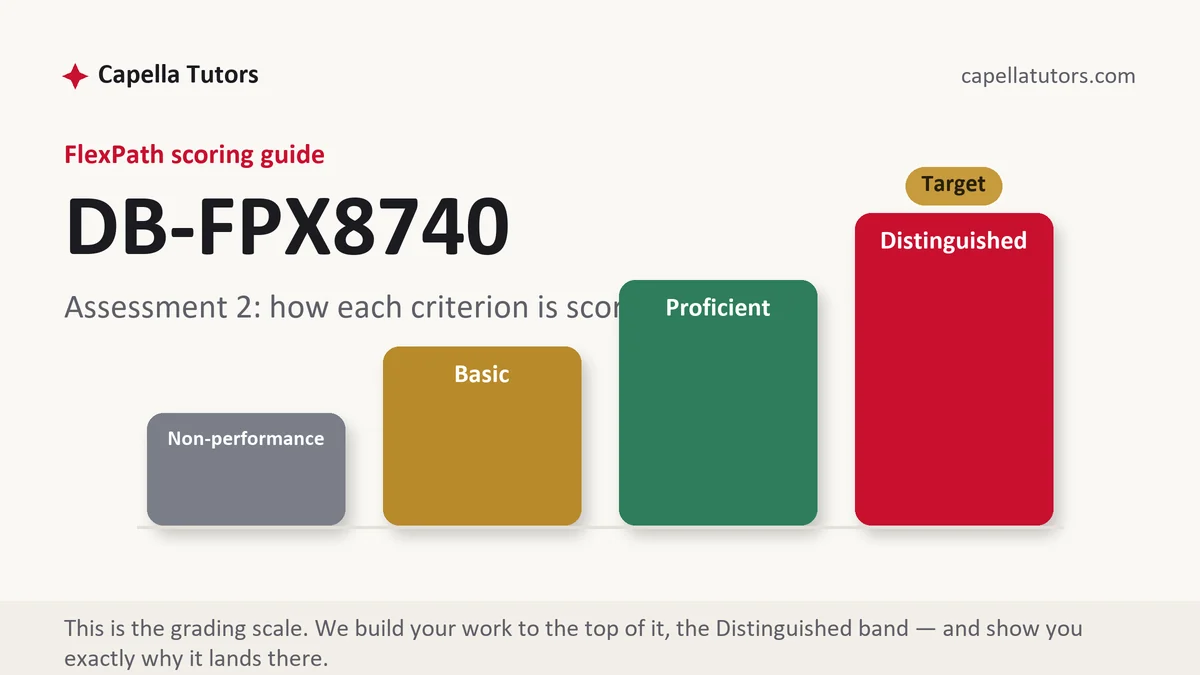
How DB FPX 8740 Assessment 2 is scored
Each criterion is placed independently at one of four levels, and the wording of the top level is the specification you write toward:
| Level | What it means on outcome measurement and questions |
|---|---|
| Distinguished | The outcome is defined operationally, the record holding it is named, its comparability across the intended cases is defended rather than assumed, and each question is answerable from data the candidate has a route to. |
| Proficient | A measurable outcome with matched questions. Careful work in which comparability across cases is asserted rather than argued. |
| Basic | Innovation performance proposed as an outcome, with patent counts or self-reported innovativeness offered as though they measured the same thing. |
| Non-performance | A required element is absent, most often the operational definition. A construct with no counting rule cannot be assessed for feasibility or validity. |
This stage hands the design and the permission conversation forward together. A question answerable from archival records needs a data-sharing agreement and often nothing else; a question answerable only from what managers say needs consent, and if those managers work for competitors of your employer it needs confidentiality terms as well. Decide which route your wording has selected before the feasibility submission assumes it, and find out what your programme requires by way of a determination before collection rather than after.
The DB FPX 8740 Assessment 2 method, step by step
-
Write the counting rule, not the construct name
Revenue from products introduced within 36 months is a rule. Innovation performance is a label. Write the rule as an instruction somebody in finance could follow without asking you a question, then see whether it survives contact with the actual record.
-
Ask who holds the record and what it was built for
A field maintained for pricing decisions behaves differently from one maintained for statutory reporting. Records built for internal convenience are frequently inconsistent across periods, and the person who maintains one can tell you in ten minutes what a week of analysis would eventually reveal.
-
Test comparability across your intended cases
The same field can mean different things in two business units, two years, or two firms. Where the meaning shifts, either narrow the cases, adjust the rule and say how, or measure something else. Averaging across an inconsistent field produces a number nobody can interpret.
-
Check the measure against the phenomenon, not against convenience
Patent counts describe some manufacturers and say nothing about a services business. Self-reported innovativeness measures what executives believe about their organizations, which is a legitimate variable and a different one from output. Name what your measure captures and what it leaves out.
-
Write each question so the obtainable data could answer it
For every question, name the record, the holder, and the route. A question whose answer sits in a competitor's confidential file is not a research question yet, and moving it inside the obtainable boundary is usually a matter of changing the level rather than abandoning the interest.
-
Say what a null result would look like
If you cannot describe the finding that would disappoint you, the question is probably unfalsifiable as posed. Writing that sentence tightens the measurement more reliably than any amount of revision to the construct definition.
A structure that maps to the criteria
Word targets are our planning defaults for a doctoral measurement paper, not Capella rules; the field mapping and any data request usually sit in appendices.
| Section | What it must do | Guide |
|---|---|---|
| Outcome and its rule | The operational definition written as a counting instruction, with the units and the window stated. | ~300 words |
| The record and its custodian | Where the data lives, who maintains it, what it was built for, and how far back it is consistent. | ~250 words |
| Comparability argument | Whether the field means the same thing across the intended cases, and what was done where it does not. | ~300 words |
| What the measure misses | The part of the phenomenon this rule cannot see, and why the trade-off is acceptable. | ~200 words |
| Research questions | Two to four questions, each with the record, the holder, and the access route named beside it. | ~300 words |
| Falsification and references | What a null result would look like, plus current APA matched in both directions. | ~200 words |
Annotated sample excerpt
An original model paragraph from our team, written for a specialty apparel wholesaler measuring how much revenue comes from recent introductions. It shows a measure interrogated rather than adopted.
The firm reports new-product revenue share as sales from styles introduced within the last 36 months, which produced 34 percent last year, and the figure does not mean what the board thinks it means.1 Of the 1,240 active stock-keeping units, 418 carry an introduction date inside the window, but 213 of those share a base pattern and a cost sheet with a style first sold before the window opened and differ only in colourway or trim, because the merchandising system issues a new number and a new date whenever a colour is added; applying the stricter rule that an introduction requires a new base pattern reduces the share from 34 percent to 19 percent, and the two figures have moved in opposite directions over the last three years.2 This study therefore defines the outcome as revenue from styles with a new base pattern, retains the firm's own measure as a secondary variable so the divergence can be reported rather than hidden, and states the limit plainly: the pattern-level rule can be applied consistently from 2021, when the current merchandising system was implemented, so the analysis window begins there rather than at the earlier date the archived spreadsheets would appear to permit.3
- 1States the firm's own measure, the number it produces, and the claim that it is misleading, all before the evidence. The reader now has a reason to care about a paragraph about a data field.
- 2The counting problem shown with counts, then the two rules compared with both results, ending on the detail that matters most: the two measures trend in opposite directions, which means the choice of rule changes the study's conclusion.
- 3Chooses a rule, keeps the firm's version as a secondary variable rather than discarding it, and bounds the window by when the record became consistent. Bounding the analysis by data quality rather than by ambition is what a committee reads as method.
The full premium sample for your exact assessment, written fresh to your scoring guide and issue, is free to request. Study it, revise it into your own voice, and submit work you understand.
The five mistakes that cost Distinguished
- A construct named instead of a rule written. Innovation output and strategic agility cannot be counted, and a criterion asking what would be measured is asking for an instruction.
- A measure imported from a different sector. Patents describe research-intensive manufacturing and nothing about a service operation, and borrowing the measure imports the wrong phenomenon.
- Comparability assumed across periods. A field whose definition changed when a system was replaced cannot be compared across the boundary, and somebody in the business knows exactly when that happened.
- Perception treated as performance. What executives believe about their firm's innovativeness is worth studying and is not a measure of what the firm produced.
- Questions that need data you cannot reach. A question requiring a competitor's internal figures is an interest, and turning it into a question usually means changing the level rather than the topic.
Pre-submission checklist
- The outcome is written as a counting rule somebody else could follow
- The record, its custodian, and its original purpose are all named
- Comparability is tested across cases and periods, with the fix stated
- What the measure cannot see is written down and accepted
- Every question names the record, the holder, and the access route
- A null result is described, so the question is falsifiable as posed
Measurement or research questions due?
Send the criteria, your problem statement, and anything you know about the records available. We write the counting rule, test it against the actual field, argue comparability, and phrase the questions so obtainable data could answer them. The first premium sample is free.