This manual is for DB FPX 8740 Assessment 1, start to submission. Assessment 1 of Seminar: Strategy and Innovation Topic Development usually asks you to reduce a strategic or innovation interest to a researchable problem and to fix the unit of analysis while doing it. Strategy topics fail in a particular way, by posing a firm-level question from a position that can only observe one department, and this deliverable exists to catch that early. Set out below is the order our doctoral tutors work in, then a structure tied to the criteria and an annotated sample excerpt. Prefer to hand it across? A premium original sample keyed to this exact assessment arrives inside 24 to 48 hours and is revised at no charge until the guide is met. Capella's catalog lists the course as DB-FPX8740, and some courserooms print DB8740; both point to this same Assessment 1.
One honesty note before the manual: Capella revises courses and scoring guides over time, so always write to the exact scoring guide attached to your assessment in the courseroom. The course identity above is verified on capella.edu; the method and structure below are our tutors' approach to it, not Capella's official rubric text.
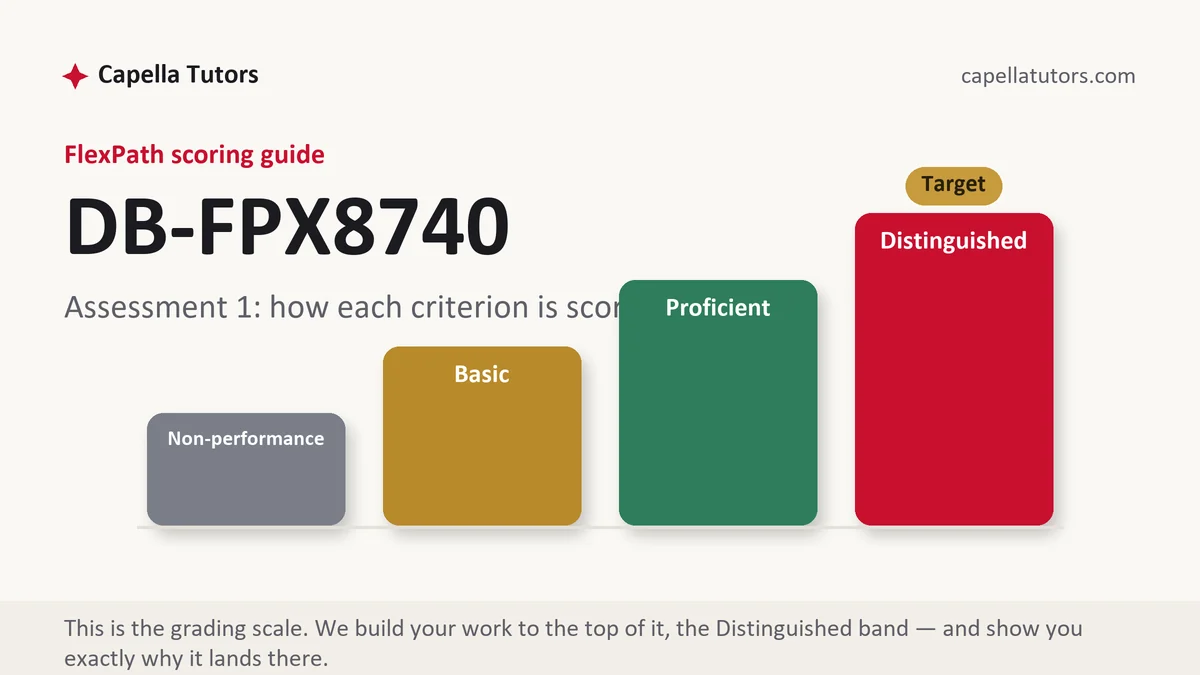
How DB FPX 8740 Assessment 1 is scored
Nothing is averaged here. Each criterion is placed at one of four levels on its own, and the top level is a description of a move:
| Level | What it means on a strategy problem statement |
|---|---|
| Distinguished | The problem is stated at one level with the level named, the underperformance or unexplained pattern is evidenced beyond a single anecdote, the unit of analysis matches the data the candidate could actually observe, and the statement says what it does not yet establish. |
| Proficient | A genuine, evidenced problem with a stated unit of analysis. Sound work in which the unit is named but the evidence sits one level away from it. |
| Basic | A strategic theme with a plausible story attached, posed at the level of the firm because that is where the literature is written. |
| Non-performance | A required element is absent, most often the unit of analysis. Without it a reviewer cannot tell what a single observation in this study would even be. |
Two things travel forward from this sentence. Your purpose and questions can only use constructs that appear here, and your measurement work in the next submission inherits the level: a problem posed about firms requires firm-level records, and a problem posed about projects requires project-level ones, which are held by different people and released under different conditions. Fixing the level now is the cheapest decision in the sequence and the most expensive one to revisit.
The DB FPX 8740 Assessment 1 method, step by step
-
Write the four candidate levels down and choose out loud
Firm, business unit, project, decision. Write one sentence describing what a single case would be at each level, then choose, and give the reason. Choosing in writing is what stops the level from drifting later, because the reason is on the page for you to check against.
-
Match the level to what you can observe
A candidate whose access reaches one product group cannot study competitive performance across firms. That is not a limitation to be apologised for, it is a design constraint that selects the level, and a project-level or decision-level study is frequently the stronger doctoral contribution anyway.
-
Find the unexplained pattern rather than the poor outcome
A firm performing badly is a consulting brief. A pattern that theory does not predict, or that varies where it should not, is a research problem. Look for the variation: two units with the same process and different results, or a practice that works in one setting and not another.
-
Evidence the pattern beyond your own organization
One anecdote is the reason you noticed. Sector data, published cases, trade reporting, and at least one peer-reviewed study establish that the pattern exists elsewhere, which is what makes an answer worth having to anyone but your employer.
-
Write the statement in three sentences and cut every adjective
General condition, the specific evidenced pattern with its level named, and the consequence of not understanding it. Strategy prose attracts words like dynamic and disruptive that carry no information, and removing them usually exposes whichever clause was doing no work.
-
Test the statement against a reviewer's first question
What would one observation be? If you cannot answer in a single phrase, the unit is not fixed. This is the question that opens most seminar feedback, and answering it in the paper is faster than answering it in a resubmission.
A structure that maps to the criteria
These targets are our planning defaults for a doctoral topic paper rather than Capella requirements; your scoring guide decides how much evidence is expected at this stage.
| Section | What it must do | Guide |
|---|---|---|
| Interest and its origin | Where the interest comes from, in one paragraph, without turning the paper into a professional history. | ~200 words |
| The pattern | What varies, where, and how you noticed, described as variation rather than as poor performance. | ~300 words |
| Evidence beyond one site | Sector and published evidence that the pattern exists elsewhere, cited to sources that can carry the claim. | ~300 words |
| Unit of analysis | The four candidates, the choice, the reason, and what a single case would be at the chosen level. | ~300 words |
| Problem statement | Three sentences: condition, evidenced pattern at the named level, consequence of not understanding it. | ~200 words |
| Limits and references | What this statement does not yet establish, plus current APA in both directions. | ~200 words |
Annotated sample excerpt
An original model paragraph from our team, written for a study of new-product introduction decisions inside contract electronics manufacturers. It shows a unit of analysis chosen rather than assumed.
A firm-level study would ask why some contract manufacturers introduce new customer programmes more successfully than others, and it is the wrong question for a candidate who can observe one operations function inside one company.1 The unit of analysis here is the introduction project: a single customer programme moving from award to stable volume production, of which the host organization completed 34 in the last three years and holds a gate record, a cost-variance report, and a first-pass yield history for each, so a single case is a project with a documented decision trail rather than a firm with a reputation.2 Choosing the project level has two consequences the paper accepts openly: it cannot explain why one manufacturer outperforms another, because that comparison requires firm-level data this study will not have, and it can examine why introductions inside the same firm, under the same process and the same leadership, diverge by a factor of three in ramp duration, which is a variation the existing firm-level literature cannot see at all.3
- 1Names the tempting question and refuses it in one sentence, on the grounds of what the candidate can observe. Rejecting the obvious framing at the start is what tells a reviewer the level was a decision.
- 2Defines the unit concretely, then states what records exist per case and how many cases there are. A single case described as a project with a documented decision trail is a unit a committee can evaluate.
- 3Accepts the loss and states the gain in the same sentence, ending on what the chosen level makes visible that the literature's usual level cannot. This is the argument that turns a constraint into a contribution.
The full premium sample for your exact assessment, written fresh to your scoring guide and issue, is free to request. Study it, revise it into your own voice, and submit work you understand.
The five mistakes that cost Distinguished
- A firm-level question from a departmental vantage point. The study then promises to explain competitive performance and can only observe a process, which is the characteristic failure in strategy topics.
- The unit left unstated. If a reviewer cannot say what one observation is, they cannot assess sampling, measurement, or analysis, so every later criterion is affected.
- Poor performance offered as a research problem. Fixing an underperforming business is valuable work and produces a decision rather than transferable knowledge.
- A pattern evidenced only from experience. What you have watched is why you chose the topic, and the criterion is asking whether it happens beyond your building.
- Strategy adjectives doing the work of evidence. Disruptive, agile, and dynamic can be deleted from most sentences without loss, and their presence usually marks a claim nobody measured.
Pre-submission checklist
- Each criterion in the guide has its own labelled section
- All four candidate levels are considered and the choice is justified in writing
- A single case at the chosen level is described concretely
- The pattern is presented as variation, with evidence from beyond one site
- The statement runs three sentences with the level named inside it
- What the statement does not establish is written down
Topic paper or problem statement due?
Send the criteria, the setting you can observe, and the pattern you have noticed. We fix the unit of analysis to what the records can actually support, evidence the pattern beyond your organization, and write the statement so a reviewer's first question is already answered. Your first premium sample carries no fee.