This manual is for DB FPX 8730 Assessment 3, start to submission. Assessment 3 of Managing Innovation, Design, and Creativity usually asks for the evidence and the scoreboard: what was learned from users, from how many, by what method, what it changed, and how the firm will measure innovation without rewarding activity. It is the deliverable where design methods get described as workshop formats rather than as data collection. The order our doctoral tutors work in is below, with a criterion-keyed structure and an annotated sample excerpt. Prefer to pass it over? A premium original sample for this assessment is back with you in 24 to 48 hours, with free passes while a criterion is unmet. Capella's catalog lists the course as DB-FPX8730, and some courserooms print DB8730; both point to this same Assessment 3.
One honesty note before the manual: Capella revises courses and scoring guides over time, so always write to the exact scoring guide attached to your assessment in the courseroom. The course identity above is verified on capella.edu; the method and structure below are our tutors' approach to it, not Capella's official rubric text.
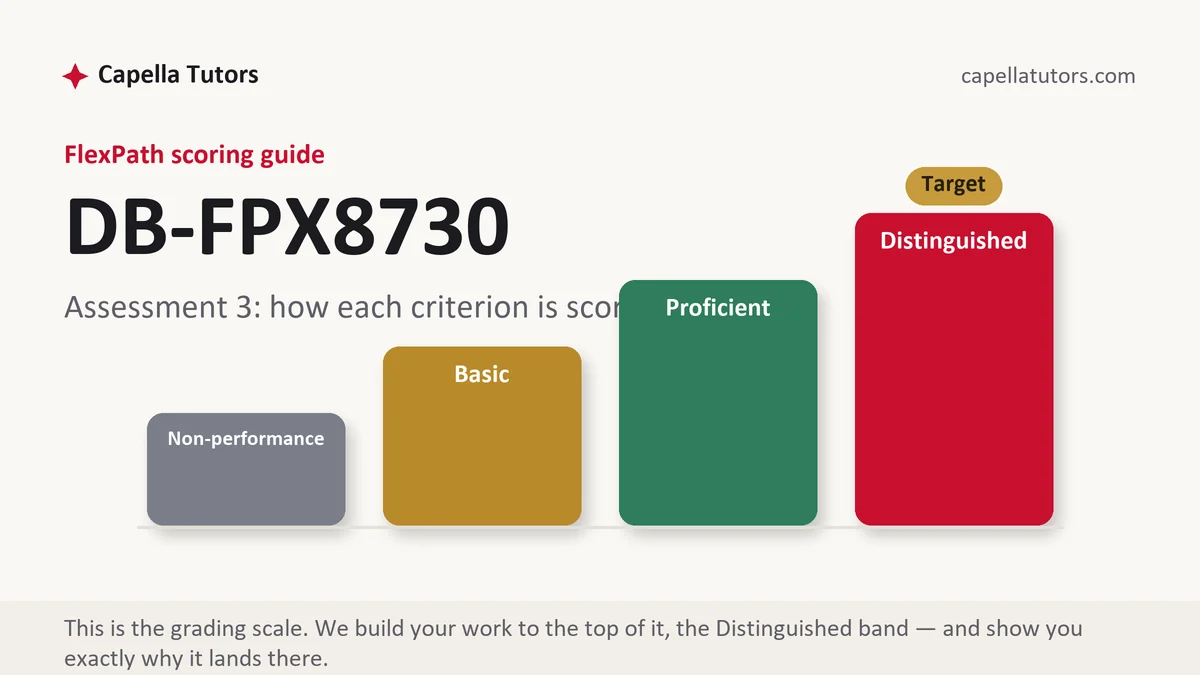
How DB FPX 8730 Assessment 3 is scored
Criterion by criterion, four levels, with the top level naming a specific demonstration:
| Level | What it means on design evidence and measurement |
|---|---|
| Distinguished | A concept change is traced to specific evidence with the method and the number of participants stated, the assumption that remains untested is flagged, metrics cannot be satisfied by activity alone, and the portfolio mix is given as percentages of actual spend. |
| Proficient | Customer research reported and metrics proposed. Careful work in which the link between what was learned and what changed is described rather than traced. |
| Basic | Design thinking presented as a five-stage process, personas included, and innovation measured by number of ideas submitted and projects launched. |
| Non-performance | A required element is absent, most often the untested assumption or the spend mix. A measurement section with only activity counts has not attempted the criterion. |
Exploration and the core business need different measures, different funding rhythms, and often different reporting lines, because judging an exploratory project against the margin standards of the established business kills it at the first review, and exempting it from all discipline produces a permanent science project. Say which measures apply to which part of the portfolio, and state the mix as percentages of money actually spent rather than of money intended, because the gap between those two figures is usually the most informative number in the paper.
The DB FPX 8730 Assessment 3 method, step by step
-
Report the method and the sample before the insight
Fourteen in-home observations is evidence. We spoke to customers is an assurance. State how many, selected how, in what setting, using what protocol, and only then say what was learned, because a reader cannot weight an insight without knowing what produced it.
-
Look for the divergence rather than the confirmation
The useful finding is where behavior differed from what the concept assumed. Count how many participants diverged and in which direction, and treat the count as the finding, since a design study that confirmed everything either asked leading questions or was not needed.
-
Trace one concept change to one piece of evidence
Name the feature, the decision, the evidence behind it, and the participant count. One clean trace demonstrates the whole method better than a page describing an empathy phase, and it is exactly what the criterion asks you to show.
-
Flag what remains untested and say what would test it
Every concept carries an assumption the research did not reach, usually about price, repeat behavior, or scale. Name it, say what evidence would settle it, and put that evidence at the next gate. A design section with no residual uncertainty has not been honest.
-
Build metrics that activity cannot satisfy
Ideas submitted, workshops held, and projects launched can all be produced without any innovation occurring. Revenue from products introduced within a defined window, time from concept to first revenue, and the proportion of gate decisions that were negative are harder to game.
-
State the mix as percentages of actual spend
Core, adjacent, and new, as a share of money actually spent in the last completed year rather than of the plan. Then compare it to the stated intent. The distance between the two is a finding about how the firm really allocates, and it usually surprises the people who set the intent.
A structure that maps to the criteria
Word targets are our planning defaults for a doctoral evidence and measurement paper, not Capella rules; protocols and metric definitions normally sit in appendices.
| Section | What it must do | Guide |
|---|---|---|
| Research design | Method, participant count, selection, setting, protocol, and what the study was trying to learn. | ~300 words |
| Findings and divergences | What was observed, where behavior differed from the concept's assumptions, and how often. | ~300 words |
| Concept changes traced | Each change, the evidence behind it, and the participant count supporting it. | ~300 words |
| Residual uncertainty | What the research did not reach, what would settle it, and at which gate that evidence belongs. | ~200 words |
| Metric set | Measures that activity cannot satisfy, their definitions, owners, and reporting frequency. | ~300 words |
| Portfolio mix and references | Core, adjacent, and new as percentages of actual spend against stated intent, plus current APA. | ~200 words |
Annotated sample excerpt
An original model paragraph from our team, written for a pet-care subscription business testing a measured feeding product. It shows a concept change traced to evidence.
The concept assumed that households portion food at the point of feeding, and 9 of the 14 in-home observations showed something else: the portion is decided once, at the point of purchase or unpacking, and then repeated from memory, with the measuring scoop used in only 4 households and stored out of reach in 6 of the remaining 10.1 That finding removed the pre-measured sachet from the concept and replaced it with a printed fill line on the container the household already keeps on the counter, a change made on the strength of 9 observations rather than on a stated preference, since 11 of the 14 participants said in the same session that they measured every meal.2 What the study did not reach is whether the fill line survives a second bag: every observation was a single visit, and the assumption that a habit formed in week one persists at week six is untested, which is why the next gate purchases a four-week diary study from 20 households before any packaging tooling is ordered.3
- 1States the concept's assumption, then the count that contradicted it, with the supporting detail that makes the observation credible. Nine of fourteen is a finding; most customers told us is not.
- 2Traces one design change to one body of evidence, and then reports that stated preference pointed the other way. The gap between what participants said and what they did is the strongest possible demonstration that observation was the right method.
- 3Names the limit of the study precisely, converts it into the specific evidence that would settle it, and attaches it to a gate before tooling money is committed. This is the sentence that connects design research to the funding machinery.
The full premium sample for your exact assessment, written fresh to your scoring guide and issue, is free to request. Study it, revise it into your own voice, and submit work you understand.
The five mistakes that cost Distinguished
- Insight reported without method or count. Customers told us has no weight, and a reader cannot judge a finding without knowing how it was produced.
- Design thinking described as a process. A five-stage diagram is a syllabus. The criterion is asking what evidence was gathered and what it changed.
- Stated preference treated as behavior. What people say they do and what they do differ predictably, and a concept built on the first will fail on the second.
- Metrics that activity can satisfy. Ideas logged and workshops held can rise without any innovation happening, which makes them measures of effort rather than of output.
- Portfolio mix taken from the plan. Intended allocation and actual spend routinely differ by a wide margin, and only the second describes what the firm does.
Pre-submission checklist
- Method, participant count, selection, and setting all appear before any insight
- Divergences from the concept's assumptions are counted, not summarised
- At least one concept change is traced to specific evidence with its count
- The untested assumption is named, with the evidence that would settle it
- Every metric is one that activity alone cannot satisfy, with an owner
- Core, adjacent, and new stated as percentages of actual spend against intent
Design evidence or measurement plan due?
Send the criteria and whatever research you have, even if it is three conversations and a set of notes. We report the method and the counts properly, trace the concept changes to the evidence, flag what remains untested, and build a metric set activity cannot satisfy. First sample at no charge.