This manual is for DB FPX 8730 Assessment 2, start to submission. Assessment 2 of Managing Innovation, Design, and Creativity usually asks for the selection machinery: a decision rule with value and probabilities in it, a ranking a reader could reproduce, and a stage architecture where each gate buys something specific and somebody is empowered to stop a project. It is the deliverable where the analysis criterion usually lives. The sequence our doctoral tutors use is below, followed by a criterion-keyed structure and an annotated sample excerpt. Rather delegate it? A premium original sample built for this exact assessment comes back in 24 to 48 hours, reworked without charge while a criterion is short. Capella's catalog lists the course as DB-FPX8730, and some courserooms print DB8730; both point to this same Assessment 2.
One honesty note before the manual: Capella revises courses and scoring guides over time, so always write to the exact scoring guide attached to your assessment in the courseroom. The course identity above is verified on capella.edu; the method and structure below are our tutors' approach to it, not Capella's official rubric text.
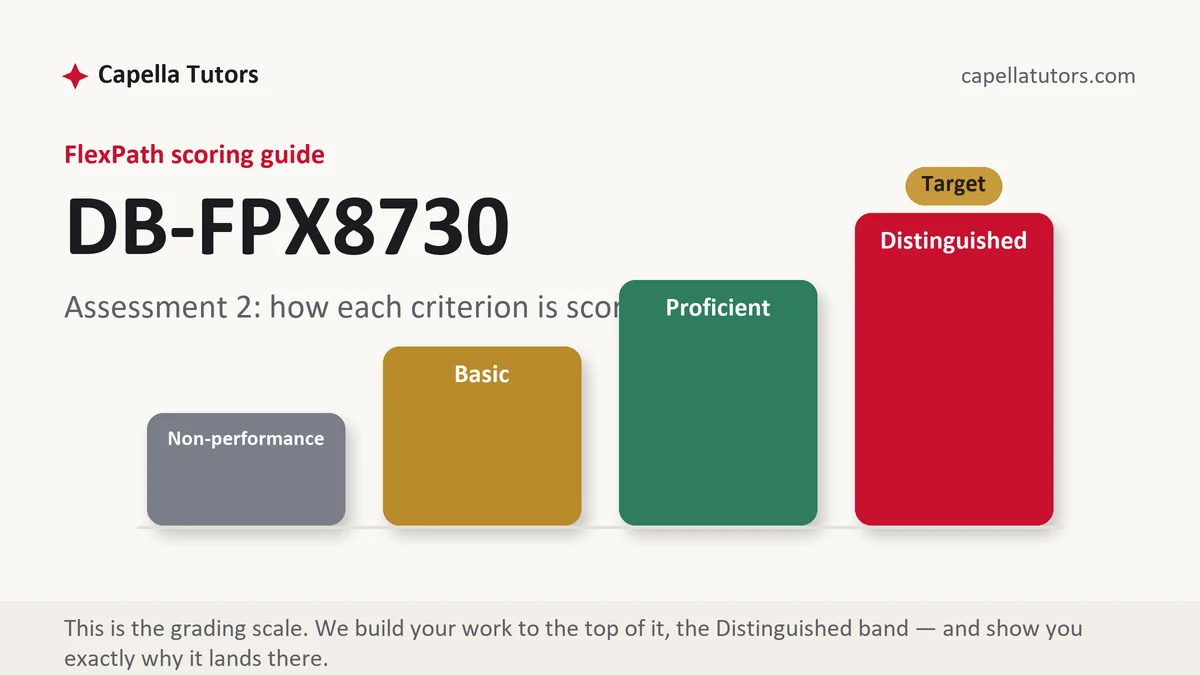
How DB FPX 8730 Assessment 2 is scored
Four levels, applied criterion by criterion, with the top level describing an act rather than a quality:
| Level | What it means on portfolio selection and gate design |
|---|---|
| Distinguished | Expected value is computed with technical and commercial probability separated, the result is divided by the resource that actually constrains the firm, the ranking is shown, and each gate has a purchase and a named person who can stop the project. |
| Proficient | A defensible selection rule with staged funding. Competent work whose ranking is presented as a conclusion rather than reproduced from the inputs. |
| Basic | Projects scored on a weighted matrix with weights nobody can defend, funded in a single decision, and reviewed by a committee that has never cancelled anything. |
| Non-performance | A required element is absent, most often the stopping authority. A gate that cannot stop a project is a status meeting rather than a gate. |
The default in most firms is to fund the project with the largest forecast prize, which systematically favours the proposal whose optimism sits furthest from evidence. Separating the probability of technical success from the probability of commercial success is what breaks that bias, because the two fail for different reasons and are reduced by different kinds of work. Once the arithmetic is done, a cheap project with a modest prize usually outranks an expensive one with a large prize, and saying that plainly is most of the analysis criterion.
The DB FPX 8730 Assessment 2 method, step by step
-
Write the decision rule before you look at the projects
A rule chosen after the candidates are known is a justification. State the rule, its inputs, and where each input comes from, then apply it. If the rule then produces an answer the organization dislikes, that is evidence the rule was worth having.
-
Split the two probabilities
Technical success asks whether it can be built to specification. Commercial success asks whether anyone will buy it at the price assumed. A project can be near-certain on the first and a coin toss on the second, and a single confidence figure hides exactly the distinction that decides what work to fund next.
-
Count only the cost still to be spent
Money already committed is not a reason to continue and it is not part of the ranking. Use remaining development cost and remaining commercialisation cost, and say so explicitly, because sunk cost is the most common contaminant in a real portfolio review.
-
Divide by the constraint that actually binds
If engineering capacity is scarce, rank by expected value per engineer-month rather than per dollar. Most firms are constrained by a specific skill, a test rig, or a regulatory submission slot, and ranking on money when the constraint is people produces a portfolio nobody can staff.
-
Design each gate to buy one thing
An early gate should purchase reduced uncertainty rather than progress: a technical feasibility answer, a willingness-to-pay reading, a regulatory opinion. Say what each gate buys, what it costs, and which probability it is intended to move.
-
Name the person who can stop it and what happens to the team
A stopping authority with no name is no authority. Then say what happens to the people whose project is cancelled, because an organization that punishes a stopped project will never get an honest gate review again, and that consequence belongs in the design.
A structure that maps to the criteria
These targets are our planning defaults for a doctoral portfolio paper rather than Capella requirements; the ranking table and the gate matrix usually sit in appendices.
| Section | What it must do | Guide |
|---|---|---|
| The decision rule | The rule, its inputs, where each input is sourced, and its known weaknesses, stated before any project appears. | ~250 words |
| Project inputs | For each candidate: forecast value, technical probability, commercial probability, remaining costs, resource demand. | ~250 words |
| The ranking, computed | The arithmetic shown for at least two projects, the ranking it produces, and what it reverses. | ~350 words |
| Constraint analysis | The resource that actually binds, and the ranking recomputed against it if it differs from money. | ~250 words |
| Gate architecture | Each gate, what it buys, its cost, the probability it moves, and the role empowered to stop. | ~300 words |
| Consequences and references | What happens to teams whose projects stop, plus current APA in both directions. | ~200 words |
Annotated sample excerpt
An original model paragraph from our team, written for a consumer appliance firm ranking two concepts in its small-kitchen category. It shows a ranking computed rather than asserted.
Concept A, a countertop appliance with a new heating element, forecasts a launched present value of $14.2 million with a 70 percent probability of technical success and a 55 percent probability of commercial success, $2.6 million of remaining development cost and $3.4 million to commercialise, which gives an expected commercial value of $487,000: the commercial-adjusted value of $7.81 million less the $3.4 million launch cost is $4.41 million, multiplied by the technical probability is $3.087 million, less the remaining development cost.1 Concept B, a redesigned carafe and lid assembly for the existing brewer platform, forecasts $5.1 million with a 90 percent technical probability and a 75 percent commercial probability, $600,000 of remaining development and $900,000 to commercialise, which computes to an expected commercial value of $2.03 million, four times Concept A on a prize barely a third the size.2 Dividing by the resource that binds makes the gap wider still: Concept A consumes an estimated 96 engineer-months against Concept B's 22, so the expected value per engineer-month is roughly $5,100 for A and $92,400 for B, and the portfolio review should be discussing whether Concept A survives at all rather than which quarter it launches in.3
- 1The full computation written out in order, so a reader can check it and substitute their own probabilities. Both probabilities appear separately, which is the input most portfolio papers collapse into a single confidence number.
- 2The second project computed the same way, and the comparison stated in the form that makes the point: a smaller prize, a much larger expected value. This is the sentence the whole method exists to produce.
- 3Recomputes on engineering capacity because that is the constraint that actually binds, and the ranking becomes an order of magnitude rather than a preference. It then names the uncomfortable decision instead of leaving it implied.
The full premium sample for your exact assessment, written fresh to your scoring guide and issue, is free to request. Study it, revise it into your own voice, and submit work you understand.
The five mistakes that cost Distinguished
- A weighted scoring matrix with undefendable weights. If nobody can say why strategic fit is worth 30 percent, the matrix launders a preference into a number.
- One confidence figure for the whole project. Technical and commercial risk fail differently and are reduced by different work, and merging them hides what to fund next.
- Sunk cost inside the ranking. Money already spent cannot be recovered by continuing, and a ranking that includes it will protect the project that has wasted the most.
- Ranking on dollars when the constraint is people. A portfolio that clears a financial hurdle and cannot be staffed has selected work the firm will not do.
- Gates that only report progress. A review that has never stopped anything is a status meeting, and the criteria are asking who is empowered to cancel.
Pre-submission checklist
- The decision rule is stated, with its inputs and its weaknesses, before the projects
- Technical and commercial probabilities appear as separate figures
- Only remaining costs enter the calculation, and the paper says so
- The arithmetic is shown for at least two projects and the ranking reproduced
- The binding constraint is identified and the ranking recomputed against it
- Every gate states what it buys and names the role that can stop the project
Portfolio selection or gate design due?
Send the criteria and your project list with whatever value and cost figures exist. We write the decision rule first, split the probabilities, strip the sunk cost, rank on the constraint that binds, and design gates that buy reduced uncertainty. The first premium sample is free.