This manual is for DB FPX 8730 Assessment 1, start to submission. Assessment 1 of Managing Innovation, Design, and Creativity usually asks what innovation is for in a specific firm and where its candidate concepts come from: a definition that excludes something, the channels that supply ideas, and an honest reading of which channel actually yields. It is the deliverable most likely to arrive as an essay about culture. Below is the order our doctoral tutors work in, a structure keyed to the criteria, and an annotated sample excerpt. Prefer to hand it over? A premium original sample keyed to this exact assessment lands within 24 to 48 hours and is revised at no charge until the guide is satisfied. Capella's catalog lists the course as DB-FPX8730, and some courserooms print DB8730; both point to this same Assessment 1.
One honesty note before the manual: Capella revises courses and scoring guides over time, so always write to the exact scoring guide attached to your assessment in the courseroom. The course identity above is verified on capella.edu; the method and structure below are our tutors' approach to it, not Capella's official rubric text.
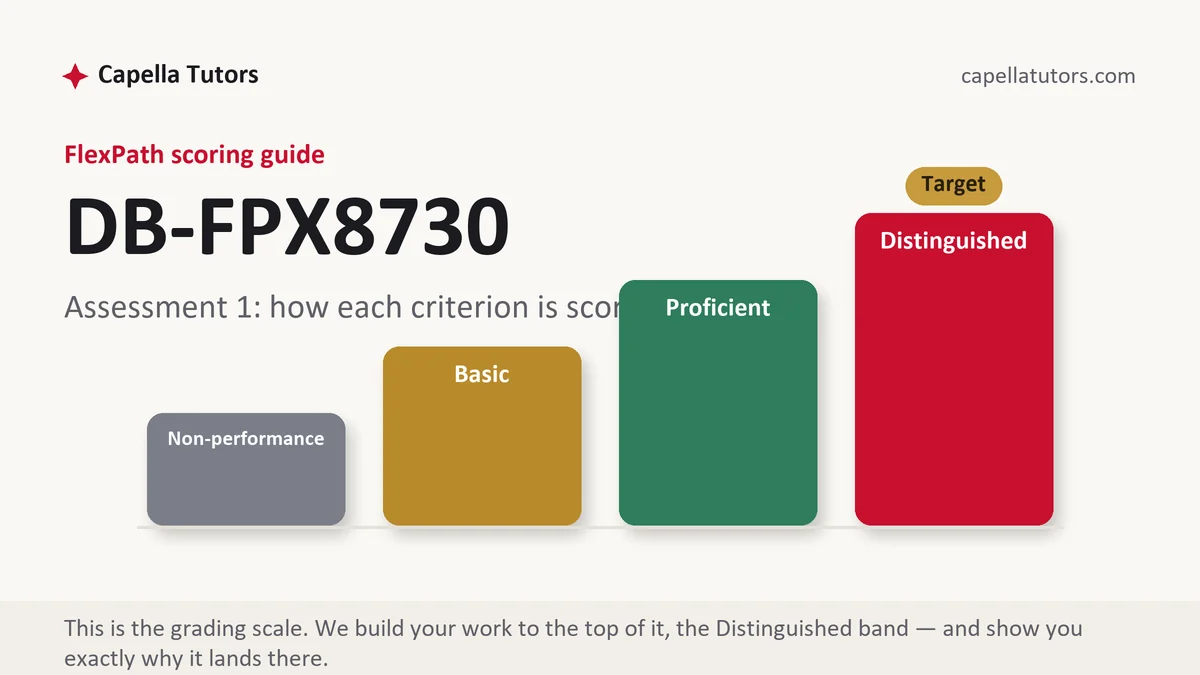
How DB FPX 8730 Assessment 1 is scored
Each criterion is placed at one of four levels on its own merits, and the top level names a specific move:
| Level | What it means on an innovation role and sourcing analysis |
|---|---|
| Distinguished | Innovation is defined so that something is excluded, the definition is tied to the firm's competitive position, sourcing channels are evaluated on yield rather than listed, and the weakest channel is named along with what should be done about it. |
| Proficient | A clear purpose for innovation with sourcing channels described and assessed. Sound work in which every channel is treated as worth keeping. |
| Basic | Innovation praised as a capability, culture discussed at length, and idea sources presented as a list that includes everything an organization could conceivably do. |
| Non-performance | A required component is absent, most often the definition itself. Without a boundary, nothing later in the paper can be assessed as inside or outside scope. |
A definition that excludes nothing is the fastest way to lose the first criterion, because a firm that counts every improvement as innovation cannot allocate to it. Write the sentence that says what would not count here: a price change, a packaging refresh, a cost reduction with no customer-visible difference. The exclusion is what makes the rest of the paper measurable, and it is also what makes it useful to a management team that has to decide where a budget goes.
The DB FPX 8730 Assessment 1 method, step by step
-
Define innovation by what it excludes
One sentence, then a second sentence listing two or three things the firm currently calls innovation that would fall outside the definition. That second sentence is where the criterion is won, and it is also the sentence most candidates cannot bring themselves to write about their own employer.
-
Connect the definition to the competitive position
Innovation is for something. If the firm competes on responsiveness, then process innovation that shortens lead time counts more than a new product line. Say what the firm is trying to defend or build, and the definition stops being generic.
-
Inventory the channels with a count against each
Front-line suggestions, engineering, dealers or distributors, customer complaints, supplier proposals, universities, acquisition, and competitive imitation. For each one, how many concepts entered the process last year and how many survived first review. A channel with no count is a channel nobody manages.
-
Compute yield rather than volume
The channel producing the most ideas is rarely the channel producing the best ones. Divide concepts that reached development by concepts submitted, and the ranking usually rearranges itself. Then say what that rearrangement implies about where attention should go.
-
Name the weakest channel and say what happens to it
Either it is fixed, with the specific change stated, or it is closed, with the consequence acknowledged. A sourcing analysis that recommends encouraging all channels has evaluated none of them, and the criteria are reading for evaluation.
-
Say what happens to a submitted idea and who answers it
Response time to a submitter is the mechanism that keeps a channel alive. If the front-line channel has no reply loop, its yield will fall to zero within two cycles regardless of what the policy says, and that dynamic is worth a paragraph rather than a mention.
A structure that maps to the criteria
Word targets are our planning defaults for a doctoral innovation paper rather than Capella rules; channel tables and yield calculations normally belong in an appendix.
| Section | What it must do | Guide |
|---|---|---|
| Firm and competitive position | What the firm sells, to whom, and what it is currently trying to defend or build. | ~250 words |
| Definition and exclusions | The working definition of innovation here, and the activities it deliberately leaves out. | ~250 words |
| Strategic role | What innovation is expected to produce for this position, and over what horizon. | ~250 words |
| Channel inventory | Every source of candidate concepts, with submissions and survivals counted for each. | ~300 words |
| Yield analysis and judgment | Survival rate per channel, the resulting ranking, the weakest channel, and the decision about it. | ~350 words |
| Feedback loop and references | How submitters are answered and by whom, plus current APA in both directions. | ~200 words |
Annotated sample excerpt
An original model paragraph from our team, written for a manufacturer of agricultural equipment attachments. It shows channels evaluated on yield rather than praised.
Four channels supplied the 187 concepts logged in the last fiscal year, and ranking them by volume produces exactly the wrong answer.1 The employee suggestion scheme contributed 112 concepts of which 3 reached development, a survival rate of 2.7 percent; engineering contributed 41 of which 9 survived, 22 percent; the dealer network contributed 22 of which 11 survived, 50 percent; and two field-service technicians acting outside any formal channel contributed 12 of which 7 survived, 58 percent, which is the highest yield in the firm and the only channel with no owner, no budget, and no name.2 The recommendation follows from the arithmetic rather than from sentiment: the dealer channel is formalised with a quarterly concept review and a named product manager, the service-technician route is given a standing slot in that same review rather than being institutionalised into a scheme that would destroy what makes it work, and the employee suggestion scheme is closed, since at 2.7 percent it is consuming 40 hours a month of screening for three concepts a year and a firm that cannot answer 112 submissions properly is training 112 people not to bother.3
- 1States the total, then says outright that the obvious ranking is wrong. Announcing the counter-intuitive finding before the evidence gives the reader a reason to follow the numbers.
- 2Four channels, submissions and survivals for each, rates computed. The last clause is the finding: the best channel is the informal one, which is an observation that only appears if you count rather than describe.
- 3Three different decisions, each derived from a rate, including a closure with its cost stated and a deliberate refusal to formalise the informal channel. Recommending that a scheme be shut down is what distinguishes evaluation from encouragement.
The full premium sample for your exact assessment, written fresh to your scoring guide and issue, is free to request. Study it, revise it into your own voice, and submit work you understand.
The five mistakes that cost Distinguished
- A definition that excludes nothing. If every improvement counts as innovation, no budget can be allocated to it and no metric can be built for it.
- Culture discussed instead of machinery. Permission and psychological safety matter and they are not a selection rule, a funding mechanism, or a stopping authority.
- Channels listed rather than measured. A catalogue of possible idea sources describes what organizations do in general; submissions and survivals describe what this one does.
- Volume mistaken for productivity. The channel producing the most concepts is usually the one producing the least usable ones, and only the ratio shows it.
- No reply loop for submitters. A channel that does not answer people stops producing within two cycles, whatever the policy document says.
Pre-submission checklist
- The definition names at least two activities that would not count as innovation here
- The definition is tied to what the firm is defending or building competitively
- Every channel carries a submission count and a survival count
- Survival rates are computed and the ranking they produce is stated
- The weakest channel receives an explicit decision, fix or close
- The reply mechanism for submitters is described, with the role that owns it
Innovation role or sourcing analysis due?
Send the criteria and whatever you know about where your firm's ideas come from. We write a definition that excludes something, count the channels, compute the yields, and make the recommendation the arithmetic supports rather than the one the organization expects. First premium sample carries no fee.