This manual is for DB FPX 8720 Assessment 3, start to submission. Assessment 3 of Strategic Digital Transformation usually asks for the part that decides whether any of the benefit arrives: a release sequence justified by what the legacy estate can support, the capability and vendor position, the privacy and security obligations, and a governance design with a stated stopping condition. It is the deliverable where optimism is easiest to detect. What follows is the sequence our doctoral tutors use, a criterion-keyed structure, and an annotated sample excerpt. Prefer to pass it across? A premium original sample built for this exact assessment returns in 24 to 48 hours, revised free until the guide is satisfied. Capella's catalog lists the course as DB-FPX8720, and some courserooms print DB8720; both point to this same Assessment 3.
One honesty note before the manual: Capella revises courses and scoring guides over time, so always write to the exact scoring guide attached to your assessment in the courseroom. The course identity above is verified on capella.edu; the method and structure below are our tutors' approach to it, not Capella's official rubric text.
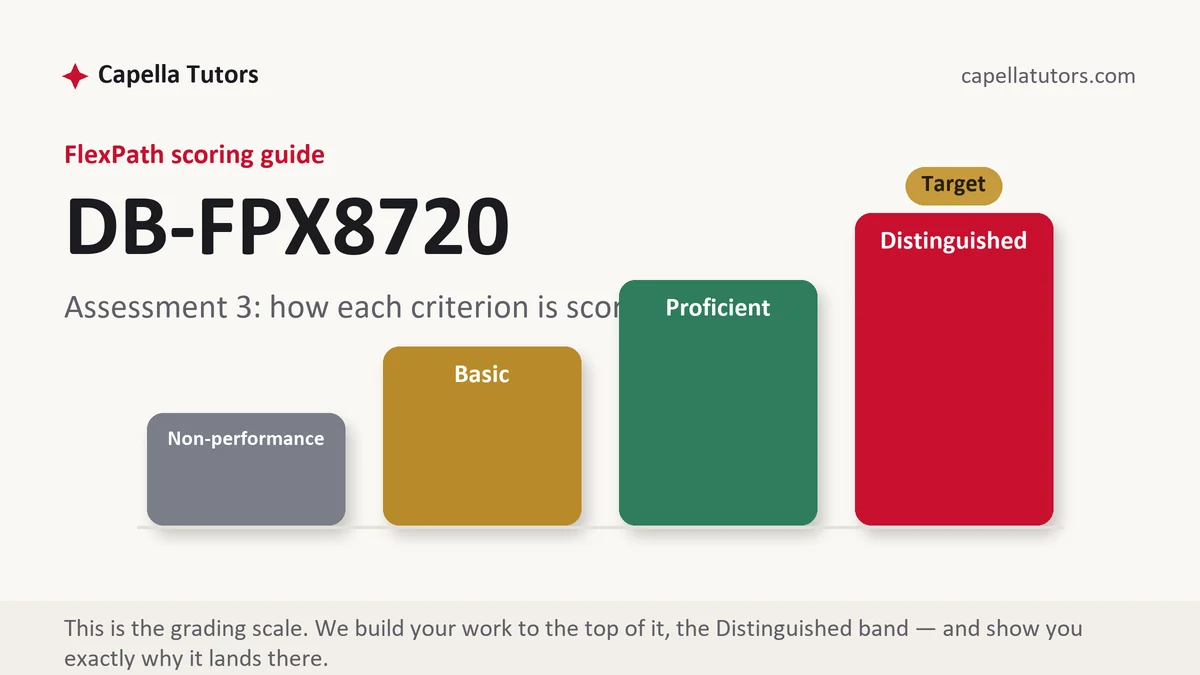
How DB FPX 8720 Assessment 3 is scored
Each criterion is scored on its own at one of four levels, and the level language is the brief:
| Level | What it means on a delivery, risk, and governance plan |
|---|---|
| Distinguished | The sequence is justified by named system constraints, the vendor relationship carries an exit position, privacy and control obligations are cited to documents with versions, benefit tracking sits inside reports the organization already produces, and a stopping condition is written with a threshold and an owner. |
| Proficient | A structured delivery plan with risks, controls, and governance. Credible work whose sequence is presented as a schedule rather than derived from constraints. |
| Basic | A phased roadmap with a risk register, mitigations described as monitoring, and benefits tracked in a new dashboard nobody owns. |
| Non-performance | A required component is absent, most often the governance or the exit position. A plan with no decision rights cannot be evaluated as a plan. |
Two moves distinguish this deliverable. Track benefits in a report that already exists, because a new dashboard built for a programme dies with the programme and the benefit becomes unverifiable within two quarters. And write the stopping condition: the evidence, the checkpoint, the threshold, and the role that calls it. Most authors cannot bring themselves to write one, which is precisely why an executive audience reads it as judgment rather than as pessimism.
The DB FPX 8720 Assessment 3 method, step by step
-
Let the system of record dictate the order
Ask what the underlying system can support today, then sequence releases so that each one can actually run on what exists beneath it. A customer-facing rebuild sitting on an untouched record system inherits every limitation of that system, and the slip will happen at the first integration rather than at the last.
-
Choose the first release for evidence, not for visibility
The opening increment should resolve the assumption the business case depends on. A pilot that proves the shift rate is worth more than a launch that impresses a steering group, and the difference tends to be visible in what the plan measures first.
-
Write the vendor exit before you sign anything
Where does the data live, in what format can it be extracted, what does the contract say about assistance on termination, and what would the organization do for the eighteen months after. A plan with no exit has a cost nobody has priced, and naming it is not disloyalty to the vendor.
-
Say how the capability gets built internally
Name the roles the organization will need to operate this afterwards, whether they exist today, and how they are filled. A design that quietly transfers operational knowledge to a supplier has created a dependency that will reappear as a price increase at renewal.
-
Cite obligations as documents with versions and dates
Privacy law, sector regulation, and control frameworks are documents, not general knowledge. Cite the instrument, the version, and the clause that applies, and say what it requires of the architecture rather than that compliance will be maintained.
-
Put the benefit in an existing report and write the stopping rule
Name the monthly report that will carry the unit-cost measure and the role that already presents it. Then state the checkpoint, the threshold, and who decides to stop. Governance without a stopping condition is a schedule of meetings.
A structure that maps to the criteria
These targets are our planning defaults for a doctoral delivery paper rather than Capella rules; the release plan, control matrix, and indicator schedule normally sit in appendices.
| Section | What it must do | Guide |
|---|---|---|
| Release sequence and constraints | Increments in order, each with the system constraint that fixes its position and the evidence it produces. | ~350 words |
| Capability and vendor position | Roles needed to operate the target state, how they are filled, and the exit position for the critical supplier. | ~300 words |
| Privacy, security, and controls | Obligations cited as instruments with versions, and what each requires of the design. | ~250 words |
| Risk and response | The two or three risks that would stop the benefit, their leading indicators, and the response at each. | ~250 words |
| Governance | Decision rights over scope, funding cadence, checkpoints, and the stopping condition with its owner. | ~300 words |
| Benefit tracking and references | The existing report that carries each measure, the role that presents it, plus current APA. | ~200 words |
Annotated sample excerpt
An original model paragraph from our team, written for a regional bank replatforming small-business loan origination. It shows a sequence derived from constraints and an exit position priced.
The core banking system remains the system of record for limits, exposures, and booked balances, it exposes those balances only through a nightly extract, and it will not be replaced inside this programme, which fixes the order of the first three releases regardless of what the business would prefer to see first.1 Release one therefore replaces document capture and credit-memo assembly, which need no intraday balance and can be reconciled against yesterday's extract; release two introduces decision workflow with limit checks performed against the same extract and an explicit rule that any application within 5 percent of an existing limit is routed to a person, an inelegant control that exists solely because the nightly boundary makes exact real-time exposure unavailable; release three is deferred until the core vendor's intraday interface reaches general availability, and the plan states that if that slips past the second quarter of 2027 the programme delivers two releases and stops rather than building a workaround that becomes permanent.2 The origination platform contract is the concentration risk here: the loan application data can be exported as delimited files with the decision audit trail attached, the agreement provides 90 days of transition assistance at a stated day rate, and replacing the platform would cost an estimated $610,000 and nine months, a figure the bank should hold in mind at renewal rather than discover during it.3
- 1Names the system of record, the specific technical boundary, and the fact that it is out of scope, then states plainly that the constraint outranks business preference. This is what a sequence justified by constraints reads like.
- 2Three releases, each tied to what the constraint permits, including a control the writer openly calls inelegant and a stopping decision with a date. Conceding that a workaround is a compromise is what stops it from being sold as a feature.
- 3Prices the exit: extract format, contractual assistance, cost, and duration. An executive audience reads this paragraph as the difference between a plan and a purchase.
The full premium sample for your exact assessment, written fresh to your scoring guide and issue, is free to request. Study it, revise it into your own voice, and submit work you understand.
The five mistakes that cost Distinguished
- A roadmap ordered by business appetite. Sequence is dictated by what the underlying systems can support, and a plan that ignores that will slip at the first integration.
- A first release chosen for visibility. The opening increment should test the assumption the case depends on, because a demonstration that proves nothing has consumed the cheapest evidence window you had.
- No exit position for the critical vendor. Extraction format, transition assistance, and replacement cost are knowable now and expensive to establish during a renewal negotiation.
- Compliance asserted rather than cited. Obligations are documents with versions and clauses, and a sentence promising that requirements will be met tells a reader nothing about the architecture.
- Benefits tracked in a new dashboard. A reporting artefact created for a programme is retired with the programme, and the measure has to live in something the organization was already producing.
Pre-submission checklist
- Each release position is justified by a named system constraint
- The first increment produces evidence about the case's weakest assumption
- Operating roles for the target state are named and their filling described
- The vendor exit states extraction format, assistance terms, cost, and duration
- Obligations are cited as instruments with versions and the design requirement each imposes
- A stopping condition exists with evidence, checkpoint, threshold, and owning role
Delivery, risk, or governance plan due?
Send the criteria and what you know about the systems and the contracts. We sequence the releases against the constraints that actually bind, price the exit position, cite the obligations as documents, and write the stopping condition with a threshold and an owner. First premium sample at no charge.