This manual is for DB FPX 8720 Assessment 2, start to submission. Assessment 2 of Strategic Digital Transformation usually asks for the design and the money: the target operating model stated as decisions that move and roles that change, and an investment case with build and run separated, benefits expressed per unit of volume, and a discounted return rather than an implied one. It is the deliverable where a feature list is easiest to mistake for a design. The build order our doctoral tutors follow is set out below, then a criterion-keyed structure and an annotated sample excerpt. Rather delegate it? A premium original sample for this exact assessment comes back in 24 to 48 hours, reworked at no cost while a criterion is short. Capella's catalog lists the course as DB-FPX8720, and some courserooms print DB8720; both point to this same Assessment 2.
One honesty note before the manual: Capella revises courses and scoring guides over time, so always write to the exact scoring guide attached to your assessment in the courseroom. The course identity above is verified on capella.edu; the method and structure below are our tutors' approach to it, not Capella's official rubric text.
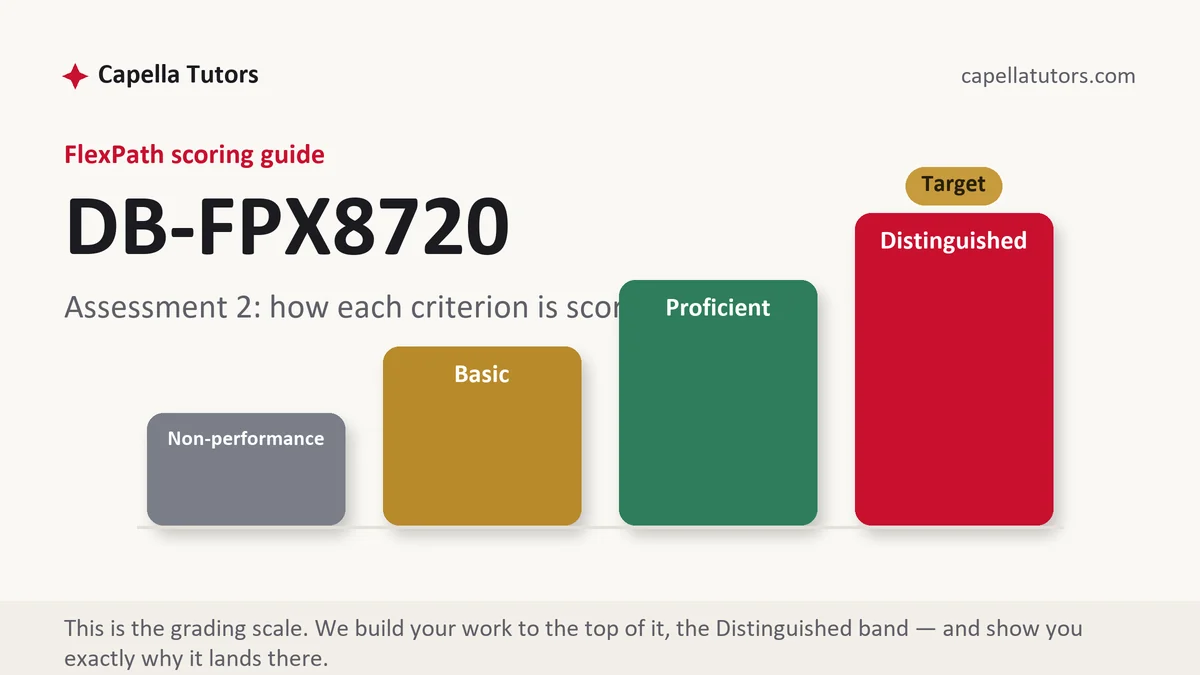
How DB FPX 8720 Assessment 2 is scored
Four levels per criterion, assessed on what is on the page rather than on the paper as a whole:
| Level | What it means on an operating model and investment case |
|---|---|
| Distinguished | The design names which decisions move, which roles change, how work is prioritised afterwards, and who owns the outcome once the delivery team disbands; build and run costs are separated; benefits carry a denominator; and the discounting is shown rather than implied. |
| Proficient | A coherent target model with a costed benefit case. Sound work in which the ongoing run cost is understated and accountability after go-live is implied. |
| Basic | A future-state process diagram, a platform recommendation, and annual savings asserted from a percentage improvement. |
| Non-performance | A required element is absent, most often the run cost or the ownership of the outcome. A case with no ongoing cost is not a case that can be compared. |
The productivity research that survives scrutiny says returns from information technology arrive with a lag and depend on complementary organizational change, which has a direct consequence for how you allocate space: the operating model section should be longer than the technology section. Cite that finding to its authors and let it justify the shape of your paper. It also tells you where to put the risk: the benefit does not fail because the platform does not work, it fails because the decisions never moved.
The DB FPX 8720 Assessment 2 method, step by step
-
Write the decision inventory first
List the decisions made in the current process, who makes each one, and what evidence they use. Then say which of those decisions moves, disappears, or becomes automatic in the target state. A design that changes no decisions has bought a faster version of the same operation.
-
Name who owns the outcome after the programme ends
Delivery teams disband and accountability evaporates with them unless somebody's existing job description absorbs it. Say which standing role owns the benefit, in which report it appears, and what happens to that role's other measures. This is the single most skipped sentence in transformation papers.
-
Separate build from run, and expect run to rise
Consumption-based pricing, licences, integration support, and the internal capability to operate the thing are ongoing costs, and they frequently exceed what the old estate cost to keep alive. A case built only on capital displacement overstates the return and a reader who has bought software will know it.
-
Give every benefit a denominator
Cost per transaction, minutes per cycle, defects per thousand, conversion per session. If a benefit cannot be divided by a volume the organization counts, it cannot be tracked, and a benefit that cannot be tracked will not be delivered whatever the case says.
-
Discount the benefit stream and show the factor
State the horizon, the discount rate, the annuity factor, the present value, and the net present value. Showing the factor lets a reader change the rate without rebuilding your model, and it demonstrates that the discounting happened rather than being asserted in a sentence.
-
Name the assumption that breaks the case
In almost every automation case it is the adoption or automation rate rather than the unit cost. Say which one it is, rerun the number at a materially lower rate, and state the level at which the investment stops clearing its hurdle.
A structure that maps to the criteria
Word targets are our planning defaults for a doctoral design and investment paper, not Capella rules; the cost model and the benefit schedule normally belong in appendices.
| Section | What it must do | Guide |
|---|---|---|
| Design principles | The two or three rules that resolve later trade-offs, stated so a reader can predict your choices. | ~200 words |
| Decision and role changes | Which decisions move, which roles change, and how work is prioritised and funded afterwards. | ~350 words |
| Data ownership and governance | Critical fields, their owners, quality measurement, lineage, and retention in the target state. | ~250 words |
| Cost model | Build cost by component, incremental run cost, and what the current estate stops costing. | ~250 words |
| Benefit case and return | Unit benefits, annual value, payback, discount rate, annuity factor, present value, and net present value. | ~350 words |
| Sensitivity and references | The assumption that breaks the case, rerun at a lower rate, plus current APA both ways. | ~200 words |
Annotated sample excerpt
An original model paragraph from our team, written for a wholesale plumbing distributor replacing counter and phone order entry with a customer portal. It shows a return computed rather than described.
The branches took 486,000 orders through the counter and the phone last year at a fully loaded $6.40 each, which is $3,110,400, and the portal design moves 47 percent of them to self-service at $0.92 each.1 That is 228,420 self-served orders costing $210,146 and 257,580 assisted orders still costing $6.40 each for $1,648,512, a new total of $1,858,658 and a gross saving of $1,251,742 a year; the build is $2.2 million and the portal adds $265,000 a year to run in hosting, licences, and a shared product-data analyst, so the net annual benefit is $986,742 and simple payback is 2.2 years.2 Discounting five years of that benefit at 11 percent gives an annuity factor of 3.696, a present value of $3.65 million against the $2.2 million build and a net present value near $1.45 million; the figure that decides all of it is the 47 percent shift rate, and at 30 percent the annual net benefit falls to about $533,000, present value $1.97 million, which still clears the build but no longer justifies the second phase, so the phase-two gate should be a measured shift rate rather than a date.3
- 1Baseline volume, unit cost, total, and the design parameter in one sentence, with the shift rate stated as a design assumption rather than smuggled in as a result.
- 2The full arithmetic in the open, including the assisted orders that do not go away. Cases fail here by applying the saving to the whole volume, and separating the two populations is what makes this credible.
- 3Discount rate, factor, present value, and net present value, then the sensitivity on the assumption that actually carries the case, ending in a governance consequence. Converting a sensitivity into a gate condition is the move an executive reader is looking for.
The full premium sample for your exact assessment, written fresh to your scoring guide and issue, is free to request. Study it, revise it into your own voice, and submit work you understand.
The five mistakes that cost Distinguished
- A future-state diagram offered as an operating model. Boxes and arrows do not say which decisions move or who owns the outcome, and those are the criteria being scored.
- Savings applied to the whole volume. The transactions that still need a person keep costing what they cost, and a case that forgets them overstates the benefit by a wide margin.
- Run cost omitted or assumed to fall. Consumption pricing and the internal capability to operate the platform are real annual money, and leaving them out is the most common way a case is wrong.
- Percentage improvements as benefits. A 20 percent efficiency gain has no denominator, so nobody can tell afterwards whether it happened.
- Discounting mentioned rather than shown. Without the rate, the horizon, and the factor, a present value is a number the reader has to take on trust.
Pre-submission checklist
- Design principles are stated before any design decision appears
- The decisions that move and the roles that change are both listed explicitly
- A standing role owns the benefit after the programme ends, named with its report
- Build and run costs are separated, with run stated as an annual figure
- Every benefit has a denominator the organization already counts
- Rate, horizon, factor, present value, and net present value all appear, plus one sensitivity
Operating model or investment case due?
Send the criteria and your baseline figures. We write the decision inventory, name the role that owns the benefit afterwards, separate build from run, and compute payback and net present value with the factor shown and the breaking assumption tested. First premium sample free.