This manual is for DB FPX 8720 Assessment 1, start to submission. Assessment 1 of Strategic Digital Transformation usually asks for the case and the baseline: why this change now, stated as an operating problem, and a current state measured in volumes, unit costs, cycle times, error rates, and the systems underneath them. It is the deliverable that decides whether every later number in the sequence has a denominator. The order our doctoral tutors work in appears below, with a criterion-keyed structure and an annotated sample excerpt. Prefer to hand it across? A premium original sample for this exact assessment arrives inside 24 to 48 hours, revised at no charge until the guide is met. Capella's catalog lists the course as DB-FPX8720, and some courserooms print DB8720; both point to this same Assessment 1.
One honesty note before the manual: Capella revises courses and scoring guides over time, so always write to the exact scoring guide attached to your assessment in the courseroom. The course identity above is verified on capella.edu; the method and structure below are our tutors' approach to it, not Capella's official rubric text.
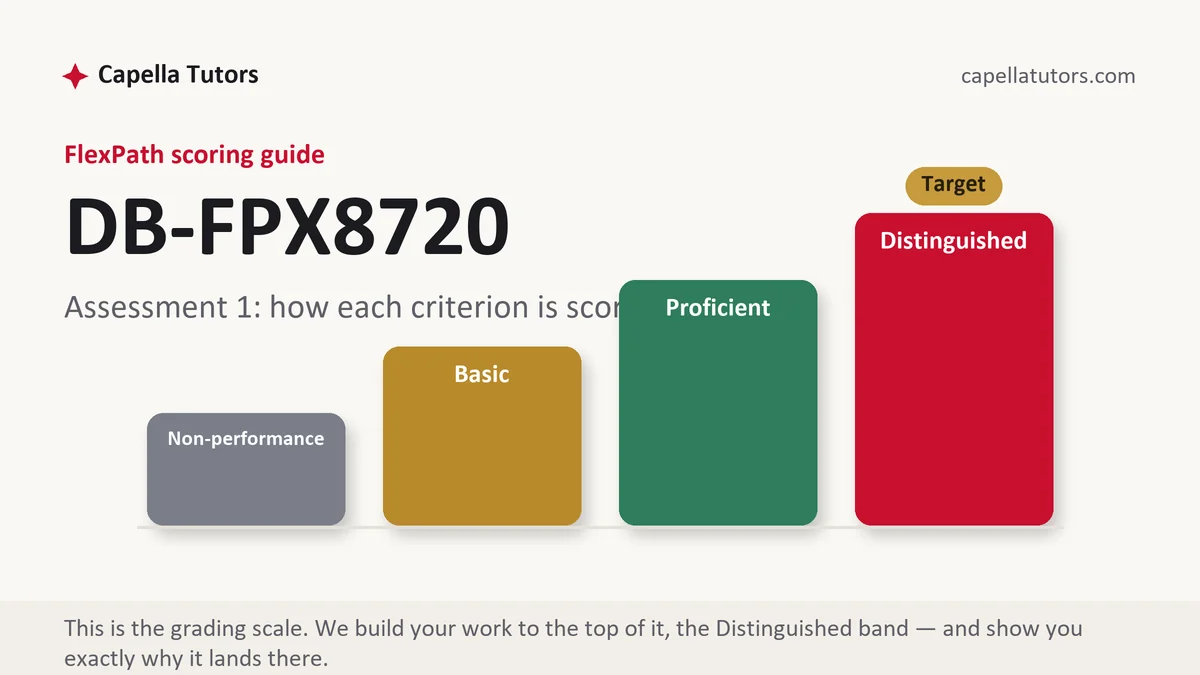
How DB FPX 8720 Assessment 1 is scored
Criteria are placed independently at one of four levels, and the top level tells you the move rather than the standard:
| Level | What it means on a rationale and current-state analysis |
|---|---|
| Distinguished | The rationale rests on a measured performance gap rather than on sector pressure, volumes and unit costs are stated with their sources, technical debt is described in terms of what it prevents, and the analysis names the figure it could not obtain and what was used instead. |
| Proficient | A credible case with the current state quantified and the systems described. Solid work in which at least one unit cost is an estimate where a record existed. |
| Basic | Digital pressure asserted from industry commentary, the process described in prose, and the systems listed by vendor name with no consequence drawn. |
| Non-performance | A required component is absent, most often the baseline measurement. A transformation case with no denominator cannot be assessed for benefit later. |
Everything downstream in this sequence divides by the numbers you establish here, which is why an estimate you did not label will contaminate a net present value two submissions later. Where a figure genuinely cannot be obtained, say so, state the proxy, and say which direction the proxy is likely to be wrong in. A reader who can see the weakness in the baseline will argue about the assumption rather than distrusting the whole case.
The DB FPX 8720 Assessment 1 method, step by step
-
State the problem before any technology exists on the page
The first section should be readable by somebody who does not know what you intend to build. If a vendor name or a product category appears before the operating problem has been measured, the argument has been inverted and the criteria will notice.
-
Find the count the organization already keeps
Transaction volumes, order lines, entries filed, tickets closed, invoices processed. Somebody already reports this monthly for a reason unrelated to your project, and that report is a better source than an estimate you construct, because it is what the business will be measured against afterwards.
-
Build the unit cost from the loaded rate up
Headcount involved, loaded hourly rate, average touch time, and the number of touches per unit. Show the multiplication. A fully loaded cost per transaction assembled in the open is defensible; the same figure asserted as an industry benchmark is not.
-
Count the handoffs and the re-keys
Every point where information is retyped from one system into another is a cost and a defect source, and the count is usually higher than management believes. Walk the process with the people who do it rather than with the process map, because the map describes the intended path.
-
Describe technical debt by what it prevents
Not by age and not by vendor. Say which change is currently impossible or expensive because of a specific constraint: a nightly batch, an unsupported integration method, a field that cannot be extended, a licence tier. Debt described as consequence is analysis; debt described as legacy is a label.
-
Label every estimate and name its direction of error
Mark the figures that came from a system, the ones that came from an interview, and the ones you constructed. For the constructed ones, say whether the assumption flatters the case or penalises it. Doing this is cheap here and impossible to retrofit later.
A structure that maps to the criteria
These targets are our planning defaults for a doctoral baseline paper rather than Capella requirements; the process walkthrough and the volume tables usually sit in appendices.
| Section | What it must do | Guide |
|---|---|---|
| Strategic rationale | The operating or competitive problem, why now, and what the current state costs the organization. | ~300 words |
| Process baseline | Volumes, touch times, handoffs, unit cost built from the loaded rate, and cycle time distribution. | ~350 words |
| Quality and rework | Error rates, where defects are detected, what correction costs, and who absorbs it. | ~250 words |
| Systems and data | The systems of record, the integration method between them, the re-key points, and data ownership today. | ~300 words |
| Technical debt and constraints | What each constraint prevents, and which planned change it would block. | ~250 words |
| Evidence quality and references | Which figures came from systems, which from interviews, which were constructed, plus current APA. | ~150 words |
Annotated sample excerpt
An original model paragraph from our team, written for a freight forwarder's customs documentation operation. It shows a baseline measured rather than characterised.
The documentation team filed 71,400 customs entries in the year to 31 March 2026, a figure taken from the monthly compliance report rather than estimated, and the work was carried by 14 clerks at a loaded rate of $41.60 an hour.1 Timed observation of 46 entries across three trade lanes gave a mean handling time of 24.5 minutes, of which 9.2 minutes is spent retyping data that already exists in another system, since commercial invoice details are entered once into the forwarding platform, once into the broker's filing tool, and once again into the client billing record; at 24.5 minutes the fully loaded cost is $16.99 an entry and $1.21 million a year, and the re-key portion alone is $6.38 an entry, or $455,500.2 Two figures here are not measurements and are labelled as such: the mean is drawn from a 46-entry sample rather than from system timestamps, which the platform does not retain, and the 6.1 percent post-filing amendment rate comes from the broker's own records for two of the three lanes and has been applied to the third, an extrapolation that probably understates the true rate because the third lane carries the most complex classifications.3
- 1Volume, source, headcount, and rate in the first sentence, with the source named before anybody asks. Saying that the number came from an existing report is what makes it usable as a benchmark afterwards.
- 2The unit cost built openly from time and rate, and the re-key cost isolated inside it. Separating the waste from the work gives the later design something specific to remove rather than a general efficiency claim.
- 3Names the two weak figures, explains why each is weak, and states the direction of the likely error. Conceding that a proxy understates the problem is stronger than presenting it silently, because it removes the reader's suspicion that the case was tuned.
The full premium sample for your exact assessment, written fresh to your scoring guide and issue, is free to request. Study it, revise it into your own voice, and submit work you understand.
The five mistakes that cost Distinguished
- A platform named before the problem is measured. Once a product appears on page one, the rest of the paper reads as justification, and the criteria are reading for an operating diagnosis.
- Sector pressure used as a rationale. Competitors are digitising is true of every organization in every industry and explains nothing about this one.
- Unit costs quoted as benchmarks. A cost per transaction taken from an analyst report describes somebody else's operation and cannot be improved by your design.
- Legacy used as an explanation. The age of a system is not a constraint. A nightly batch that makes same-day confirmation impossible is a constraint.
- Estimates presented as measurements. An unlabelled construction becomes a load-bearing figure by the third submission, and by then nobody remembers it was invented.
Pre-submission checklist
- No technology or vendor appears before the operating problem is measured
- Volumes come from a report the organization already produces, with its name given
- Unit cost is shown as headcount, loaded rate, touch time, and touches per unit
- Re-key points are counted from a walkthrough with the people doing the work
- Each constraint is described by the change it prevents
- Every figure is marked as system, interview, or constructed, with error direction
Transformation case or baseline analysis due?
Send the criteria and whatever you can share about volumes, headcount, and systems. We build the unit cost from the loaded rate up, isolate the re-key waste, describe the debt by what it blocks, and label every estimate so the later investment case survives scrutiny. The first premium sample carries no fee.