This manual is for DB FPX 8710 Assessment 3, start to submission. Assessment 3 of Strategy and Innovation: Theorizing, Crafting, Executing usually sits on the third verb: the strategy converted into initiatives with owners, sequence, and money, and the assumptions the whole thing depends on made visible with early warning attached. It is the deliverable most likely to arrive as a timeline with no accountability in it. Below is the sequence our doctoral tutors follow, a structure keyed to the criteria, and an annotated sample excerpt. Prefer to pass it over? A premium original sample written to this exact assessment returns in 24 to 48 hours, revised free until the guide is satisfied. Capella's catalog lists the course as DB-FPX8710, and some courserooms print DB8710; both point to this same Assessment 3.
One honesty note before the manual: Capella revises courses and scoring guides over time, so always write to the exact scoring guide attached to your assessment in the courseroom. The course identity above is verified on capella.edu; the method and structure below are our tutors' approach to it, not Capella's official rubric text.
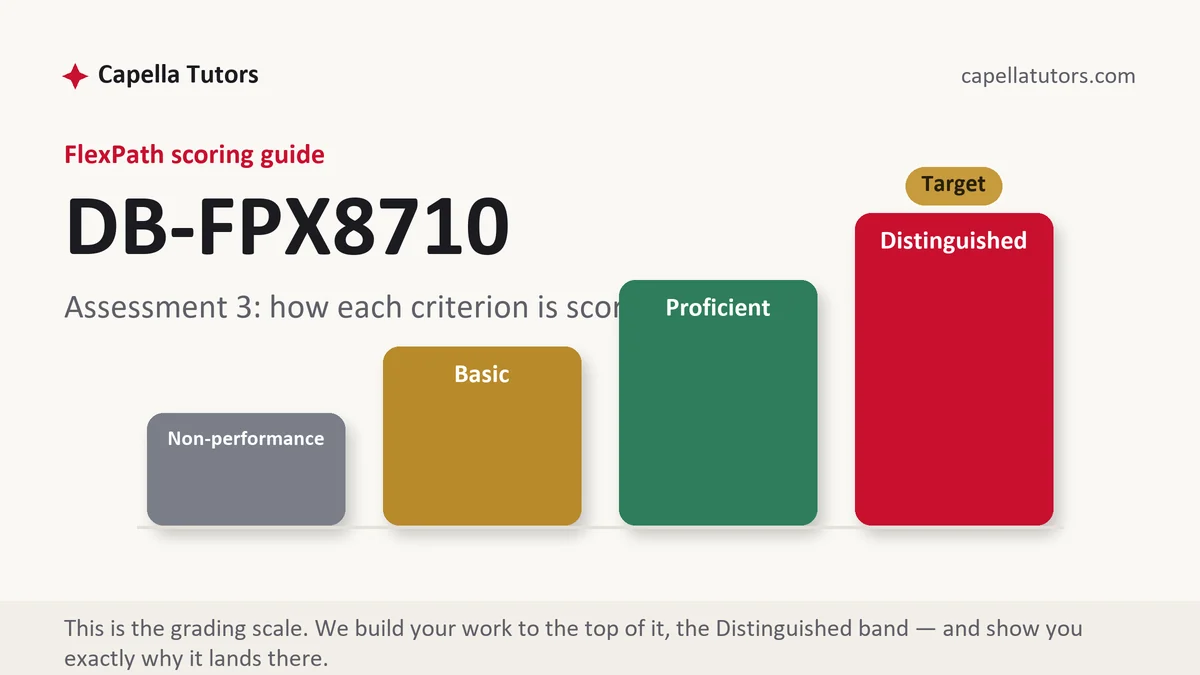
How DB FPX 8710 Assessment 3 is scored
Four levels, one criterion at a time, with the top level describing a move rather than a standard of polish:
| Level | What it means on an execution and monitoring plan |
|---|---|
| Distinguished | Each choice becomes a capability, an initiative, an owner, a funding line, and a measure; the sequence respects prerequisites; and the two or three load-bearing assumptions carry leading indicators with a stated response to each failure. |
| Proficient | A structured plan with owners, timing, and measures. Executable work whose sequence is asserted rather than derived from what has to be true first. |
| Basic | A phase chart with workstreams and a scorecard, initiatives funded in parallel, and risks listed in a register with mitigations described as monitoring. |
| Non-performance | A required component is absent, most often the funding or the accountable owner. Initiatives with no name and no money against them cannot be assessed as a plan. |
Two habits separate this deliverable from a project plan. The first is defunding: name what the firm stops paying for, because a strategy is visible in what it cancels rather than in what it announces. The second is the assumption paragraph. Say which two or three beliefs the strategy rests on, what evidence would show one is wrong, how early that evidence arrives, and what the firm does then. An executive reader treats that paragraph as the mark of somebody who has executed before.
The DB FPX 8710 Assessment 3 method, step by step
-
Convert each choice into a capability, then into an initiative
A choice implies something the firm must become able to do. Name the capability first and the initiative second, because initiatives generated directly from choices tend to be activities, and activities are what fill a plan that never changes anything.
-
Put a person's role, a budget, and a measure on every line
Owner as a role rather than a committee, funding as an amount rather than a note about resourcing, and one measure that would show progress inside a quarter. A line missing any of the three is not yet a commitment.
-
Derive the sequence from prerequisites
Ask what has to be true before each initiative can succeed, and let the answers order the plan. Capabilities are usually prerequisites for one another, and a plan that funds everything in year one funds nothing properly.
-
Name what gets defunded
Every plan is a claim on the same finite management attention and the same budget. Say which existing initiatives stop, who sponsors them today, and what conversation that requires. Candidates skip this because it is uncomfortable, which is exactly why it reads as senior.
-
Write the two or three assumptions the strategy depends on
Not a risk register of twenty entries. The two or three beliefs that, if wrong, make the strategy wrong. Then say what evidence would reveal each one early and where that evidence would appear in reporting the firm already produces.
-
Attach a response to each failing assumption
Monitoring without a decision rule is observation. For each leading indicator, state the threshold and the action: reprice, re-scope, delay, or stop. The plan then contains its own correction mechanism, which is what the risk criterion is usually asking for.
A structure that maps to the criteria
Word targets are our planning defaults for a doctoral execution paper rather than Capella requirements; the initiative table and the indicator schedule usually belong in appendices.
| Section | What it must do | Guide |
|---|---|---|
| From choices to capabilities | Each strategic choice restated as the capability it requires, with the gap against today. | ~250 words |
| Initiative architecture | Initiatives with owner roles, funding, the capability each builds, and the measure that shows movement. | ~350 words |
| Sequence and prerequisites | The order, justified by what must be true first, with the pilot or proof point that de-risks each step. | ~300 words |
| Funding and trade-offs | Where the money comes from, what is being defunded, and who currently sponsors it. | ~250 words |
| Assumptions and early warning | Two or three load-bearing assumptions, their leading indicators, thresholds, and the action at each. | ~300 words |
| Governance and references | Decision rights, review cadence, escalation, and current APA in both directions. | ~200 words |
Annotated sample excerpt
An original model paragraph from our team, written for a regional building-products distributor moving toward a value-added services position. It shows a plan with prerequisites and a defunding decision in it.
The services position depends on quoting installed cost rather than delivered price, which cannot happen until the product master carries labour content for the 1,400 items that make up 82 percent of branch revenue, so the data initiative precedes the commercial one and there is no version of the plan in which they run in parallel.1 Item enrichment is owned by the category management director, funded at $340,000 across seven months for two contract analysts and a rules review, and its measure is the proportion of the 1,400 items with a validated labour standard, reported monthly, with 60 percent as the gate before any branch begins quoting installed work.2 The money comes from stopping the second phase of the loyalty rebate redesign, which the sales vice president sponsors and which has consumed $290,000 with no measured effect on repeat purchase, and naming that trade-off in the plan rather than leaving it to a later budget round is the difference between a strategy the firm can execute and a list it will fund partially and abandon.3
- 1States the prerequisite as a logical dependency and then closes the door on the parallel option. Saying that no version of the plan runs them together is stronger than a Gantt bar and takes one clause.
- 2Owner role, amount, duration, measure, reporting frequency, and the threshold that gates the next step, all in one sentence. Any of those missing and the initiative reverts to an intention.
- 3Names what is being stopped, who sponsors it, what it has already cost, and why the trade-off belongs here rather than in a budget cycle. Volunteering a fight with a named peer role is what an executive reader recognises as a real plan.
The full premium sample for your exact assessment, written fresh to your scoring guide and issue, is free to request. Study it, revise it into your own voice, and submit work you understand.
The five mistakes that cost Distinguished
- Initiatives without an accountable role. Owned by the leadership team means owned by nobody, and the accountability criterion is reading for a single role.
- Everything funded in year one. Parallel funding of prerequisite capabilities guarantees partial delivery of all of them, and a reader with delivery experience will say so.
- A risk register instead of assumptions. Twenty generic risks with monitoring as the mitigation hides the two beliefs the strategy actually depends on.
- Nothing defunded. A plan that adds work to the same management attention without removing any has not been costed in the currency that matters.
- Indicators that only confirm. A measure that moves after the decision window closes is a report, not an early warning, and the monitoring criterion is asking for warning.
Pre-submission checklist
- Every choice is traced to a capability and then to a named initiative
- Each initiative carries an owner role, a funding amount, and a quarterly measure
- The sequence is justified by prerequisites, with gates and thresholds stated
- What gets defunded is named, with its current sponsor and its spend to date
- Two or three load-bearing assumptions have leading indicators and thresholds
- Each threshold has an action attached: reprice, re-scope, delay, or stop
Execution plan or monitoring design due?
Send the criteria and the strategy your earlier submissions established. We convert choices into capabilities, put owners and money against every initiative, sequence the work by prerequisite, and write the assumption and early-warning section an executive reader is looking for. First sample at no charge.