This manual is for DB FPX 8710 Assessment 2, start to submission. Assessment 2 of Strategy and Innovation: Theorizing, Crafting, Executing usually sits on the crafting verb: the strategy written as choices, the options declined, and the unit economics and capital arithmetic that decide whether the chosen position can be held. It is the deliverable where a paper full of ambitions gets marked down for containing no decision. What follows is the build order our doctoral tutors use, a criterion-keyed structure, and an annotated sample excerpt. Rather delegate it? A premium original sample built for this exact assessment comes back in 24 to 48 hours, reworked without charge while any criterion is short. Capella's catalog lists the course as DB-FPX8710, and some courserooms print DB8710; both point to this same Assessment 2.
One honesty note before the manual: Capella revises courses and scoring guides over time, so always write to the exact scoring guide attached to your assessment in the courseroom. The course identity above is verified on capella.edu; the method and structure below are our tutors' approach to it, not Capella's official rubric text.
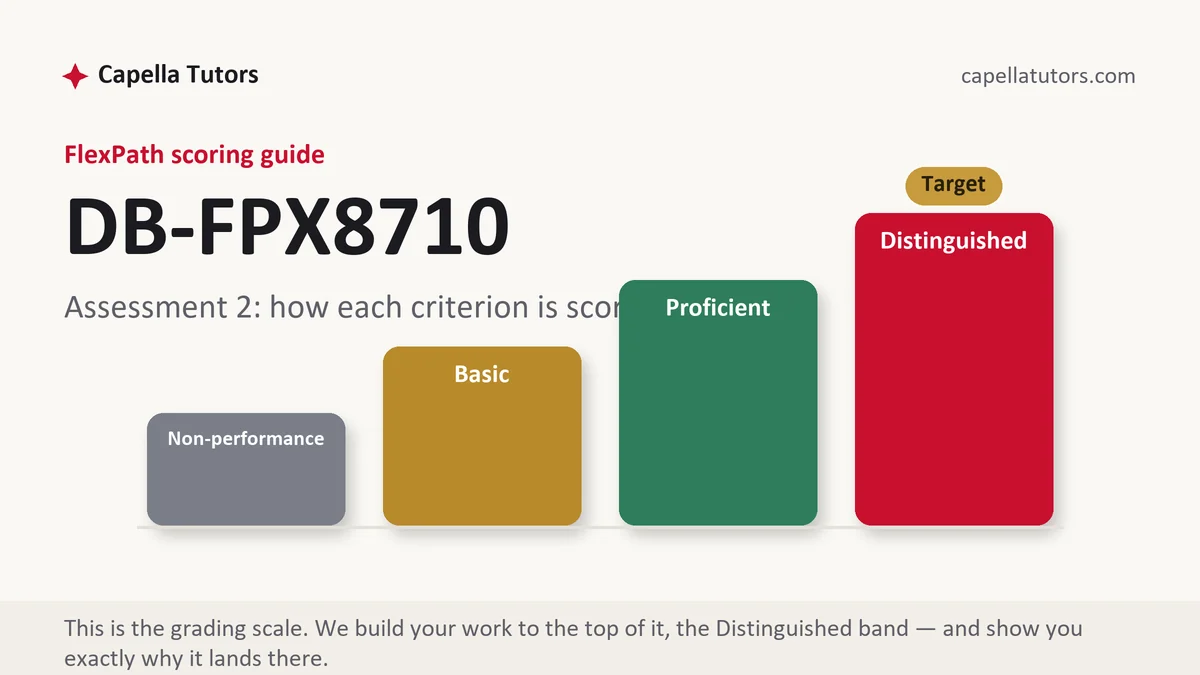
How DB FPX 8710 Assessment 2 is scored
Each criterion is placed at one of four levels independently, and the wording of the top level describes a specific move:
| Level | What it means on strategic choices and value logic |
|---|---|
| Distinguished | The strategy appears as choices with the rejected options named, the cost structure matches the position claimed, and growth options are tested against the cost of capital rather than against the revenue line. The move the top level pays for is the option you turned down and can afford to. |
| Proficient | Clear choices with a business model and margin analysis behind them. Coherent work in which growth is evaluated on profit rather than on the capital it consumes. |
| Basic | A set of intentions labelled as a strategy, supported by market attractiveness and a revenue forecast, with nothing declined. |
| Non-performance | A required component is absent, most often the economics of the chosen position. A strategy with no cost structure attached cannot be assessed for coherence. |
The arithmetic that separates the columns here is return on invested capital against its cost, because a growth option can raise revenue and profit and still make the firm poorer. Doing it openly also protects the recommendation: a reader who can see the hurdle and the shortfall will argue about the margin assumption rather than about your judgment, which is a far better argument to be having in a viva.
The DB FPX 8710 Assessment 2 method, step by step
-
Write the choices as a set, not as a list
Where to compete, what to offer, on what price logic, and what capability that requires. Four answers that fit together are a strategy. Four answers that could each be true of a different company are a set of aspirations wearing a strategy's clothes.
-
Name what the firm is declining and why it can afford to
The declined option is the evidence that a choice was made. Say what it would have cost to pursue, what it would have diluted, and what the firm gives up by walking away. A strategy with nothing rejected has decided nothing.
-
Check the cost structure against the position
A responsiveness position needs slack, and slack costs money that a volume cost structure has already spent. State what the chosen position costs to hold, what margin it can support, and what volume it forfeits, because incoherence between position and cost base is the most common structural fault in strategy papers.
-
Compute return on invested capital before you recommend anything
Operating profit, the tax rate, the invested capital, and the resulting return, then the weighted average cost of capital and the spread. Two lines of arithmetic tell you whether the current business creates value, and no recommendation means anything until that is on the page.
-
Test each growth option against the hurdle, not against the forecast
Incremental revenue, incremental margin, incremental capital, after-tax return on that capital, compared with the cost of capital. When the option fails, say by how much and what would have to change in margin or capital intensity for it to clear, because that is the strategic conversation the number exists to start.
-
Say what the price premium is buying
Any position that charges more has to name what the customer receives for it and how the customer verifies they received it. Unverifiable value cannot be priced for long, and a paper that skips this has assumed the premium rather than earned it.
A structure that maps to the criteria
These targets are our planning defaults for a doctoral strategy paper, not Capella rules; financial exhibits normally sit in appendices your guide may not count toward prose.
| Section | What it must do | Guide |
|---|---|---|
| Position statement | The strategy in four sentences: where, what, on what price logic, and requiring what capability. | ~200 words |
| Options considered and declined | What else was on the table, its cost, and the reason the firm can afford to refuse it. | ~250 words |
| Value logic | How the firm creates and captures value, what the customer verifies, and why they pay what they pay. | ~300 words |
| Unit economics and cost structure | The margin structure the position implies, and the trade-offs it forces on volume and service. | ~300 words |
| Capital test | Return on invested capital, its cost, the spread, and every growth option measured against the hurdle. | ~350 words |
| References | Theory to primary publications, firm figures to documents of record with dates, current APA both ways. | as needed |
Annotated sample excerpt
An original model paragraph from our team, written for a mid-market commercial printer weighing a move into wide-format signage. It shows growth tested against the hurdle rather than the forecast.
The packaging unit turns $58.4 million of revenue on $34.2 million of invested capital and reports $4.9 million of operating profit, which at a 23 percent effective tax rate is $3.77 million after tax, a return on invested capital of 11.0 percent against a weighted average cost of capital of 8.6 percent, so the unit earns a spread of 2.4 points and about $821,000 of economic profit a year.1 The wide-format signage proposal adds $12.6 million of revenue at a 7.5 percent operating margin, which is $945,000 of operating profit and $728,000 after tax, and it requires $9.8 million of new capital for presses, finishing, and the leasehold, giving a return on the incremental capital of 7.4 percent against the 8.6 percent it costs, so the proposal grows revenue by 22 percent and reduces the value of the unit.2 Two changes would clear the hurdle: the operating margin would have to reach about 8.7 percent, which means the mix has to shift toward short-run branded work rather than fleet graphics, or the capital would have to fall to roughly $8.5 million, which is achievable if the finishing line is leased rather than bought, and the board should be arguing about those two levers rather than about whether signage is growing.3
- 1The base case in one sentence, with every input visible: revenue, capital, profit, tax rate, return, cost of capital, spread, and economic profit. A reader can rerun it and a reader who disagrees has to disagree with a number.
- 2The incremental test on the incremental capital, and then the finding stated in the most uncomfortable form available. Growing revenue by 22 percent while destroying value is the sentence that makes the analysis worth reading.
- 3Converts the rejection into two specific levers with the operational change each implies, then redirects the discussion. Telling a board what to argue about is a more senior move than telling it what to decide.
The full premium sample for your exact assessment, written fresh to your scoring guide and issue, is free to request. Study it, revise it into your own voice, and submit work you understand.
The five mistakes that cost Distinguished
- Ambitions presented as choices. Grow the customer base and improve service are outcomes anybody would want, and the criteria are reading for what the firm will not do.
- A position with an incompatible cost base. Responsiveness funded from a volume cost structure is not a strategy, and the incoherence is visible to any reader who checks the margins.
- Growth judged on revenue or profit alone. An option can add profit and still earn less than the capital costs, and a strategy paper that misses this has misused the only number that settles it.
- A premium with no verification mechanism. If the customer cannot tell whether they received the extra value, they will stop paying for it, and the value logic section has to say how they can tell.
- Firm figures taken from secondary summaries. A number lifted from a news report of a filing has lost its provenance, and an executive reader will ask which document it came from.
Pre-submission checklist
- The strategy is stated as four connected choices rather than as objectives
- At least one option is named as declined, with the cost of declining it
- The cost structure is shown to be consistent with the position claimed
- Return on invested capital and its cost both appear as numbers, with the spread
- Every growth option is tested on incremental capital against the hurdle
- Firm-level figures cited to documents of record, with dates
Strategic choice or value logic paper due?
Send the criteria and the numbers you have, even if they are partial. We write the strategy as choices, name what gets declined, build the unit economics, and test every growth option against the cost of capital with the arithmetic shown. The first premium sample is free, and passes continue while a criterion is unmet.