This manual is for DB FPX 8710 Assessment 1, start to submission. Assessment 1 of Strategy and Innovation: Theorizing, Crafting, Executing usually sits on the first of the three verbs: the theory your argument rests on, the external conditions that shape the firm's returns, and the capabilities tested against the four conditions of advantage rather than described. It is the deliverable where a framework can be completed correctly and still earn nothing. Our doctoral tutors work it in the order below, with a structure keyed to the criteria and an annotated sample excerpt. Prefer to hand it across? A premium original sample for this exact assessment returns within 24 to 48 hours, revised at no charge until the guide is met. Capella's catalog lists the course as DB-FPX8710, and some courserooms print DB8710; both point to this same Assessment 1.
One honesty note before the manual: Capella revises courses and scoring guides over time, so always write to the exact scoring guide attached to your assessment in the courseroom. The course identity above is verified on capella.edu; the method and structure below are our tutors' approach to it, not Capella's official rubric text.
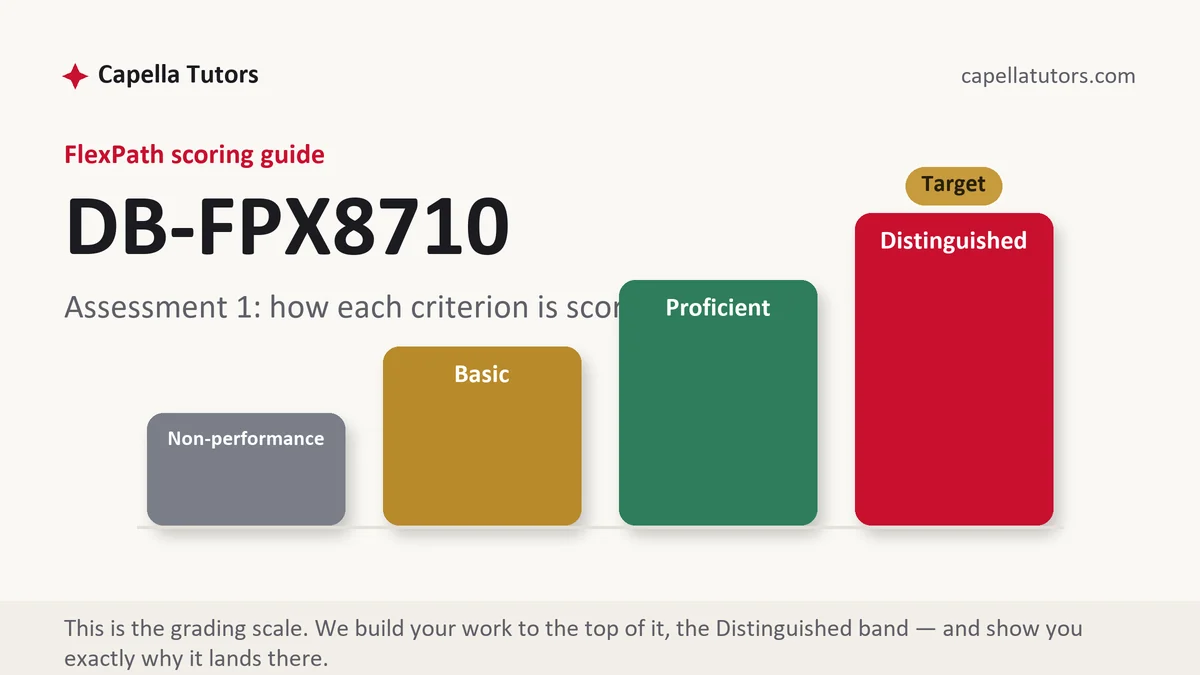
How DB FPX 8710 Assessment 1 is scored
No letter grades and no aggregate. Each criterion lands at one of four levels on its own, and the level wording is what you are writing toward:
| Level | What it means on a theory and capability analysis |
|---|---|
| Distinguished | The theoretical position is chosen and its contestability acknowledged, structural conditions are tied to this firm's own margins, and each claimed capability is tested for value, rarity, imitability, and substitutability with imitability argued in time and money. The top level pays for the test that fails. |
| Proficient | A properly applied framework with conditions and capabilities analysed. Competent, and advantage is concluded rather than tested to the point where it might not hold. |
| Basic | A completed forces table and a list of strengths, with core competence asserted and no consequence drawn for the firm's returns. |
| Non-performance | A required element is missing, most often the imitability analysis. A framework left half applied is an absent criterion rather than a weak one. |
An executive audience reads this deliverable for whether you would tell them something they do not want to hear. That is why the strongest version of the capability section usually concludes that at least one claimed advantage is purchasable, and then says what the firm should do given that it is. The contribution here is to practice: a partner or a board could act differently on Monday because of the imitability paragraph, and that is a higher bar than being theoretically correct.
The DB FPX 8710 Assessment 1 method, step by step
-
Pick the primary lens and say the choice is contestable
An industry-structure account locates returns in a protected market position. A resource-based account locates them in an inimitable bundle of assets and skills. A dynamic-capabilities account answers the objection that both are static and carries its own measurement difficulty. Take one, use a second as a check, and write the sentence admitting the choice could be argued.
-
Tie every structural claim to this firm's margins
Buyer concentration, input volatility, and substitution pressure only matter here through a number in this firm's accounts. If a force cannot be connected to a price, a volume, a term, or a cost line, it belongs in a paragraph about the sector rather than in an analysis of the company.
-
List candidate capabilities, then cut the list in half
Most items on a first list are activities the firm performs competently, which is table stakes rather than advantage. Keep only what a customer would notice or a rival would struggle to copy, and say what you dropped, because the discarded items show the test was actually applied.
-
Run the four tests, and run imitability properly
Value in the market this firm serves, rarity among the competitors it actually meets, imitability expressed as how long and how much a rival would need, and substitutability by an available alternative. Imitability is where most claimed advantages fail, and the failure is the finding.
-
Look for the asset that took time rather than money
Durable advantage usually rests on something that accumulated: a data record, a regulatory approval history, a switching cost embedded in a customer's own process. A rival with capital can buy equipment and hire people, and cannot buy nineteen years of anything.
-
Where the advantage is imitable, write the strategy around speed
Concluding that a position can be copied in eighteen months is not a defeat, it is a constraint that changes the plan. Say what the firm should do with the window it has, and the analysis stops being an audit and becomes advice.
A structure that maps to the criteria
Word targets are our planning defaults for a doctoral strategy analysis rather than Capella requirements; exhibits and financial tables normally sit outside the prose count.
| Section | What it must do | Guide |
|---|---|---|
| Firm and unit of analysis | What the firm or business unit is, its scale, and the level at which the analysis is being conducted. | ~200 words |
| Theoretical position | The lens adopted, the alternatives, why this case suits it, and the acknowledgment that the choice is arguable. | ~300 words |
| External conditions | Structural forces and demand or regulatory shifts, each connected to a figure in the firm's own accounts. | ~350 words |
| Capability inventory and screening | Candidates considered, those discarded, and the reason each was kept or dropped. | ~200 words |
| The four tests applied | Value, rarity, imitability, and substitutability for each surviving capability, imitability in time and money. | ~350 words |
| Conclusion and references | What is defensible, what is purchasable, and current APA with theory cited to originals. | ~200 words |
Annotated sample excerpt
An original model paragraph from our team, written for a specialty chemical blender facing a shift in a key raw material. It shows imitability argued rather than assumed.
The firm treats its formulation laboratory as a core competence, and on the first two tests that holds: customers pay a documented premium of 4 to 7 percent against commodity blenders for guaranteed batch consistency, and only two of the eleven competitors serving this segment operate an in-house rheology capability at all.1 Imitability is where the claim weakens. Two experienced formulators can be recruited at roughly $340,000 a year loaded, a comparable rheometer and mixing pilot line costs about $1.9 million installed, and a determined regional competitor could therefore stand up an equivalent laboratory inside fourteen to eighteen months, which means the laboratory as equipment and staff is purchasable rather than rare.2 What is not purchasable is the stability record: 19 years of accelerated-ageing and field-return data across 340 customer-specific formulations, which is the evidence the firm's own quality guarantee rests on and which a new entrant can only accumulate in real time, so the defensible asset is the archive rather than the laboratory, and the strategy should be written to extend the data advantage rather than to protect the building.3
- 1Concedes the first two tests quickly and with figures, which buys the reader's attention for the test that matters. Note the premium is documented rather than claimed, and the competitor count is specific to the segment served rather than to the industry.
- 2Prices imitation in money and in months. A rival's cost of entry stated this precisely converts a debate about distinctiveness into an arithmetic a board can argue with, and it is the sentence most capability sections never write.
- 3Relocates the advantage from the visible asset to the accumulated one, then draws the strategic consequence. Concluding that the firm has been defending the wrong thing is the kind of finding that earns the top level.
The full premium sample for your exact assessment, written fresh to your scoring guide and issue, is free to request. Study it, revise it into your own voice, and submit work you understand.
The five mistakes that cost Distinguished
- A completed framework with no consequence. A filled-in forces table that never touches the firm's margins has documented a template rather than produced a finding.
- Core competence asserted by label. Calling a capability distinctive is a description. Four tests, each with evidence, is the argument the criterion is scoring.
- Imitability answered with difficulty. Hard to copy is not an analysis. How long, at what cost, by which competitor, is.
- Sector analysis standing in for firm analysis. Conditions that would be true for every company in the industry cannot explain why this one earns what it earns.
- Two theoretical traditions reconciled. Attempting to merge industry-structure and resource-based accounts produces a paper with no position, and the criteria are reading for a position.
Pre-submission checklist
- The unit of analysis is stated as firm or business unit and held throughout
- One primary lens is named, with the choice acknowledged as contestable
- Every structural claim connects to a figure in the firm's own accounts
- Discarded capability candidates are listed with the reason each was dropped
- Imitability is expressed in months and money for a named class of competitor
- Theory cited to primary publications rather than to a textbook chapter
Strategy analysis or capability assessment due?
Send the criteria and whatever you have on the firm, including filings or internal figures if you can share them. We select the lens, tie the structural analysis to the firm's own margins, and price imitation in months and dollars for each claimed advantage. First premium sample carries no fee.