This manual is for DB FPX 8630 Assessment 3, start to submission. Assessment 3 of Catalysts for Change usually asks for the executable half: a sequenced implementation plan, the productivity cost of the transition worked out against the run-rate benefit, and a sustainment design that survives the first pressure the organization puts on it. It is the deliverable most likely to stop at go-live and lose a criterion for it. Below is the method our doctoral tutors follow, a structure that maps to the criteria, and an annotated sample excerpt. Prefer to delegate it? A premium original sample written to this exact assessment arrives in 24 to 48 hours, revised free until the guide is satisfied. Capella's catalog lists the course as DB-FPX8630, and some courserooms print DB8630; both point to this same Assessment 3.
One honesty note before the manual: Capella revises courses and scoring guides over time, so always write to the exact scoring guide attached to your assessment in the courseroom. The course identity above is verified on capella.edu; the method and structure below are our tutors' approach to it, not Capella's official rubric text.
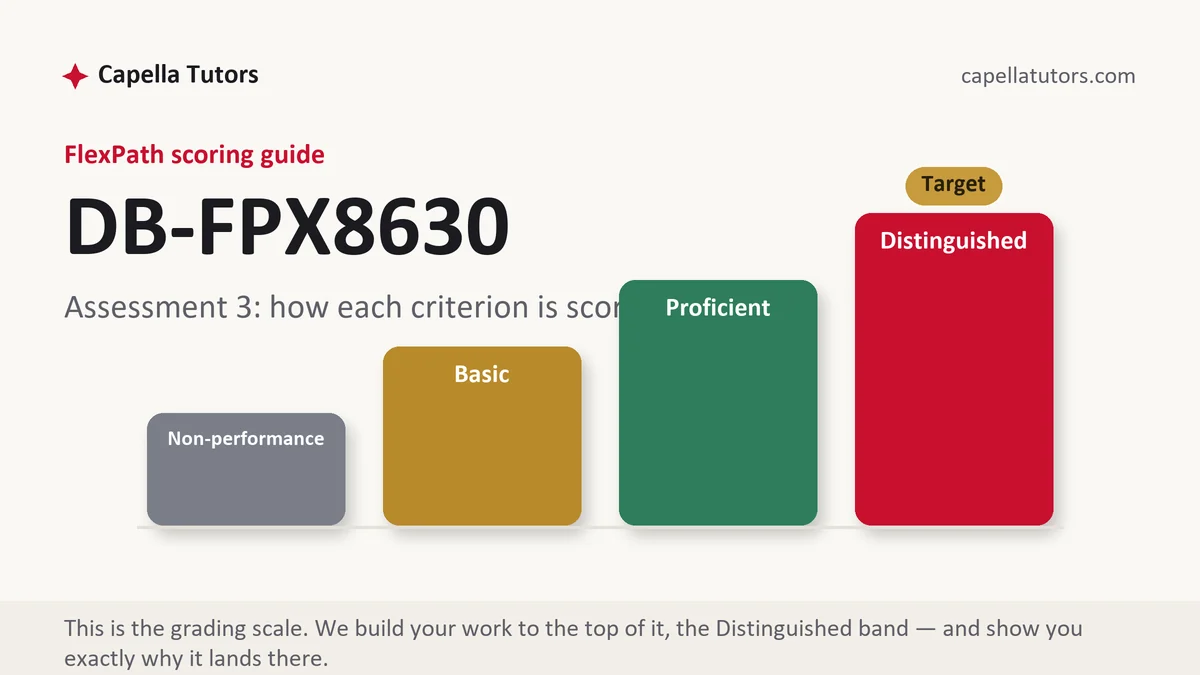
How DB FPX 8630 Assessment 3 is scored
Four levels, applied criterion by criterion, with no aggregate score to hide a weak section inside:
| Level | What it means on an implementation and sustainment plan |
|---|---|
| Distinguished | The sequence respects prerequisites, the transition dip is quantified and set against the run-rate saving with payback stated in weeks, reinforcement is designed into systems rather than into messages, and a stopping rule is written down with a named owner. |
| Proficient | A credible plan with a timeline, owners, and measures. Everything a sponsor asked for, and the economics of the trough are described rather than computed. |
| Basic | A phase chart with dates, benefits asserted from the business case, and sustainment covered by a line about ongoing communication. |
| Non-performance | A required component is absent, most commonly the measurement and reinforcement section. Stopping the paper at implementation leaves the criterion that pays for sustainment unscored. |
Sponsors budget benefits and never the trough, which is why the transition dip is the number that separates the columns in this deliverable. Doing that arithmetic openly also protects you: a plan that concedes eleven weeks of reduced output and still clears its payback is far harder to argue with than one that implies the benefit starts at cutover. Write the sensitivity line as well, because the duration of the dip is the assumption an experienced reader will test first.
The DB FPX 8630 Assessment 3 method, step by step
-
Sequence against prerequisites, not against the calendar
Ask what has to be true before each step can work, and let the answers order the plan. A schedule built backwards from a desired go-live date usually funds everything at once and finishes nothing, and prerequisite logic is visible to any reader who has run a programme.
-
Cost the trough explicitly
State the population, the hours, the loaded rate, the depth of the productivity loss, and how long it lasts. Multiply it through and put the figure in the text. Then state the run-rate benefit the same way, divide, and give payback in weeks rather than in a phrase.
-
Add one sensitivity line and stop
Rerun the arithmetic with the dip lasting half again as long. That single alternative is enough to show the reader which assumption carries the case, and a page of scenarios buries the point that one line makes cleanly.
-
Build reinforcement into systems people cannot avoid
The form, the report, the approval path, and the measure are what hold a change in place. Posters, town halls, and champions are what organizations reach for instead. Say which system changes and what becomes impossible afterwards.
-
Name the first behavior that will revert
Under pressure the step that gets dropped is almost always the one that saved somebody time rather than the one that saved the organization money. Identify it, say when the pressure arrives, and design the specific control that catches it.
-
Write the stopping rule, with an owner and a date
State the indicator, the threshold, the review point, and the role accountable for calling it. Very few candidates will write a condition under which they would abandon their own plan, which is exactly why doing it lands so well with an executive audience.
A structure that maps to the criteria
Word targets are our planning defaults for a doctoral implementation paper rather than Capella requirements; the schedule, the cost model, and the measurement plan usually belong in appendices your scoring guide may or may not count.
| Section | What it must do | Guide |
|---|---|---|
| Plan overview and design principles | What the plan does, the sequencing logic behind it, and the two or three principles that resolve later trade-offs. | ~200 words |
| Implementation sequence | Phases with prerequisites, pilot scope, cutover approach, support model, and owners against each step. | ~350 words |
| Transition economics | Population, hours, loaded rate, depth and duration of the dip, run-rate benefit, payback, and one sensitivity. | ~300 words |
| Reinforcement design | The systems, forms, reports, and measures that change, and what becomes difficult to reverse. | ~250 words |
| Measurement and governance | Leading and lagging indicators, review cadence, accountable roles, and the stopping rule with its threshold. | ~300 words |
| References and appendices | Current APA both ways, with the cost model and the schedule reproduced in full where the guide allows. | as needed |
Annotated sample excerpt
An original model paragraph from our team, built for a regional freight operator converting part of its fleet. It shows a transition costed rather than asserted.
Calderon Freight runs 138 tractors from four depots, and the proposal converts the 46 units assigned to the two metropolitan depots to battery-electric over eleven months, which imposes a cost the benefit case has so far treated as zero.1 Those 46 units cover 312 driver-shifts a week; range planning during the changeover adds an estimated 34 minutes of shift time per affected shift for the first nine weeks after a depot goes live, which is 176.8 shift-hours a week, 1,591 hours across the window, and at a loaded $38.40 an hour the transition costs $61,094 in driver time, with a further $84,000 of overlapping lease on the diesel units held as cover.2 Against that, the steady-state saving is $0.213 a mile on energy and maintenance across 4.1 million annual miles for the converted units, or $873,300 a year, so the transition cost is recovered in about six and a half weeks of run rate, and the case turns instead on the $2.9 million of depot charging capital, which is the number the board should be arguing about.3
- 1Establishes scale and scope, then says plainly that the existing business case omitted the transition cost. Naming the omission is what earns the analysis credit, because it shows the writer read the case rather than repeating it.
- 2The full chain of quantities in one sentence: shifts, added time, duration, hours, loaded rate, and the second cost line for overlapping capacity. A reader can substitute any figure and rerun it, which is what makes this a method rather than a claim.
- 3Computes payback and then redirects the argument to the decision that actually matters. Moving the reader to the real question, having disposed of the smaller one with arithmetic, is how an executive audience recognizes seniority.
The full premium sample for your exact assessment, written fresh to your scoring guide and issue, is free to request. Study it, revise it into your own voice, and submit work you understand.
The five mistakes that cost Distinguished
- A phase chart in place of a sequence. Dates arranged on a page do not show what must be true before each step, and prerequisite logic is the part a reader with delivery experience checks first.
- Benefits starting at cutover. Output falls before it rises, and a plan that implies otherwise has promised something the arithmetic will not deliver.
- Sustainment handled by communication. Reinforcement lives in forms, reports, approvals, and measures. A plan to keep talking about the change is a plan to watch it decay.
- Indicators that only lag. By the time the annual measure moves, the decision window has closed. At least one leading indicator has to be readable inside the first month.
- No condition under which you would stop. A plan with no stopping rule commits the organization to defending it indefinitely, and the criteria for governance usually ask for exactly this.
Pre-submission checklist
- The sequence is justified by prerequisites, with an owner against every phase
- The dip is quantified from stated population, hours, rate, depth, and duration
- Payback appears as a number of weeks, with one sensitivity line beside it
- Reinforcement names the systems that change and what reversal now costs
- One leading and one lagging indicator, each with a review point and a role
- A stopping rule with a threshold, a date, and the person who calls it
Implementation or sustainment plan due?
Send the criteria and whatever you know about the population, the timing, and the money. We sequence the work against its prerequisites, cost the trough, compute payback in weeks, and write the reinforcement and stopping rule an executive reader is looking for. First premium sample at no charge.