This manual is for DB FPX 8630 Assessment 2, start to submission. Assessment 2 of Catalysts for Change usually moves from diagnosis into design: a change model chosen and defended, the affected population mapped, and resistance analysed by source rather than treated as one communication problem. It is the deliverable where model recital is easiest and most expensive. What follows is the build order our doctoral tutors use, a structure keyed to the criteria, and an annotated sample excerpt. Rather pass it over? A premium original sample for this exact assessment comes back inside 24 to 48 hours, reworked without charge while any criterion is short. Capella's catalog lists the course as DB-FPX8630, and some courserooms print DB8630; both point to this same Assessment 2.
One honesty note before the manual: Capella revises courses and scoring guides over time, so always write to the exact scoring guide attached to your assessment in the courseroom. The course identity above is verified on capella.edu; the method and structure below are our tutors' approach to it, not Capella's official rubric text.
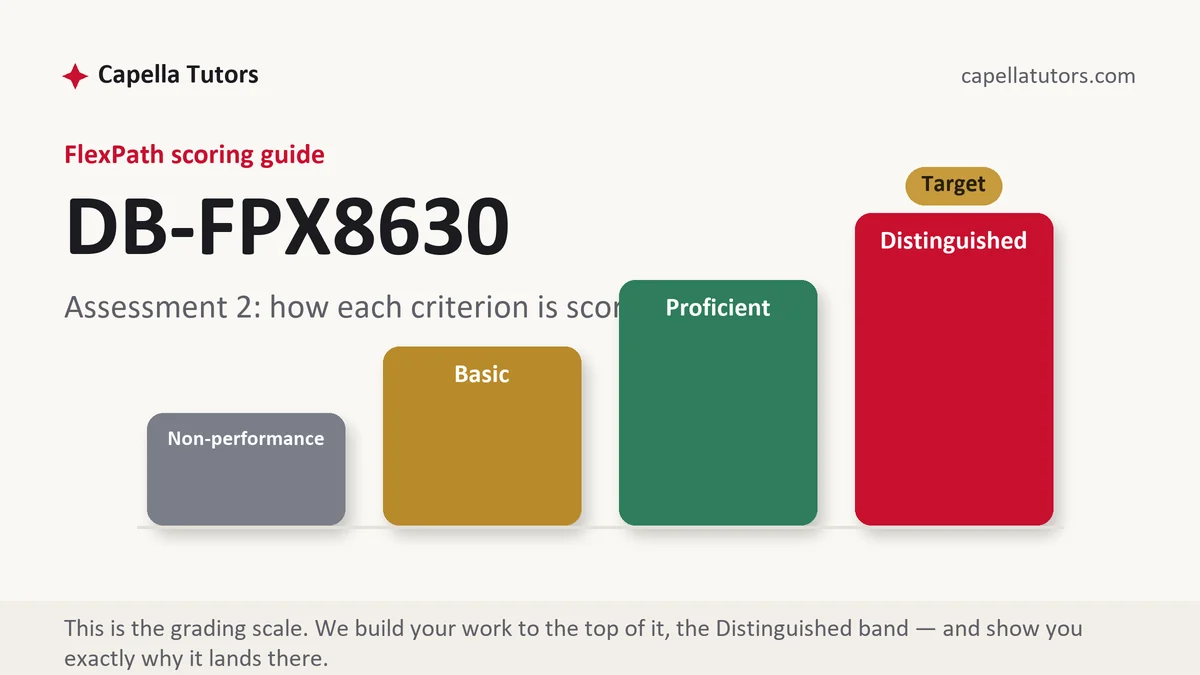
How DB FPX 8630 Assessment 2 is scored
Each criterion is scored on its own at one of four levels, and the level language is your writing brief rather than a summary of it:
| Level | What it means on a framework and stakeholder deliverable |
|---|---|
| Distinguished | One model applied diagnostically, with the aspect of this case it cannot illuminate named and covered another way, and resistance separated into capability, incentive, and credibility with a different remedy against each. The top column pays for the limitation you volunteer. |
| Proficient | A model applied correctly and stakeholders analysed thoroughly. Competent, and the model is being used to organize the paper rather than to interrogate the case. |
| Basic | A march through the stages of a framework, with stakeholders listed in a table and resistance addressed by promising more communication. |
| Non-performance | A required component is missing, most often the justification for choosing this model over the alternatives. A criterion with nothing to read against it cannot be scored generously. |
Two models applied in parallel is the most common way a strong writer loses this criterion, because the paper then says everything twice and commits to nothing. Choose one, use a second only as a check on the first, and say in a sentence that you know the choice is contestable. That sentence reads as seniority to an executive audience and as scholarship to a committee, which is an unusually efficient use of nineteen words.
The DB FPX 8630 Assessment 2 method, step by step
-
Choose the model from the shape of the problem
A migration with a clear end state and identifiable adopters is a diffusion problem. A stalled initiative with an absent sponsor is a coalition problem. A group that keeps reverting is a question about the forces holding the current state in place. Let the case select the lens, then write the paragraph explaining why.
-
Write the model's blind spot in the same section
Every framework was derived from somewhere and does not reach everywhere. Name the aspect of your case the chosen model does not address, then say which additional evidence or which secondary lens covers it. Volunteering the limit is what separates diagnostic use from recital.
-
Map the population by what each group loses
Gains are easy and rarely predictive. For every affected group write the specific thing that gets harder, slower, more visible, or less autonomous, in their terms rather than in the programme's terms. A group with nothing in the loss column has usually not been analysed.
-
Split resistance into three sources
Cannot, will not, and do not believe you. Capability gaps need training or redesign, incentive conflicts need a different design or a different measure, and credibility deficits need a delivered promise rather than a message. One remedy applied to all three fixes none of them.
-
Design the influence path, not the announcement
Say who has to be persuaded by whom, in what order, and with what evidence. Sponsors are not a slot on an organization chart; identify the person whose visible behavior would change what the group believes, and state what you need them to do rather than to say.
-
Test the design against the diagnosis you already wrote
Read the earlier evidence and check that every remedy answers something you actually found. Anything in the design without a matching finding is a habit rather than a decision, and a reviewer reading the two sections together will see it before you do.
A structure that maps to the criteria
Word targets are our planning defaults for a doctoral design paper, not Capella rules; expand any section your scoring guide weights more heavily and let the appendices carry the tables.
| Section | What it must do | Guide |
|---|---|---|
| Recap of the diagnosed problem | Two or three sentences carrying the evidenced gap forward, so the design has something to answer. | ~150 words |
| Framework selection and justification | The model chosen, the alternatives considered, the reason this case suits it, and where it does not reach. | ~350 words |
| Stakeholder analysis | Groups, their interests, their influence, and what each one specifically loses, with the losses located. | ~300 words |
| Resistance by source | Capability, incentive, and credibility separated, each with the evidence for it and its own remedy. | ~350 words |
| Influence and sponsorship plan | Who persuades whom, in what order, with what evidence, and what sponsors must be seen doing. | ~250 words |
| References | Founding works cited to the original publications, commercial methodologies labelled as such, current APA. | as needed |
Annotated sample excerpt
An original model paragraph from our team, set in a regional grocery chain redesigning its loyalty scheme. It shows resistance handled as information rather than as an obstacle.
At Merrifield Markets the objection from store teams to the tiered loyalty redesign is usually reported upward as reluctance to learn the new terminal, and the store-level evidence says it is three different objections wearing one coat.1 Of the 62 checkout supervisors surveyed across 14 stores, 41 could not describe how a tier threshold would be explained to a customer mid-transaction, which is a capability gap answerable by a scripted decision rule and eleven minutes of practice; 23 are measured on transactions per hour and correctly observe that any enrolment conversation costs them against that measure, which is an incentive conflict no amount of explanation will resolve; and 19 referred unprompted to the 2023 basket-coupon pilot that was announced at a district meeting and withdrawn without comment eight weeks later.2 The third group is not resisting the redesign, it is pricing the probability that head office finishes what it starts, and the only instrument that moves that estimate is a delivered commitment, which is why the plan opens with the smallest visible promise the programme can certainly keep.3
- 1Opens by naming how the organization currently describes the resistance, then contradicts it with evidence. Correcting the received account is a strong doctoral move because it demonstrates the diagnosis was actually performed.
- 2Three sources, three counts, three different remedies, all in one sentence with the numbers attached. The incentive clause is the one that matters: it concedes the objectors are right, which a paper defending the programme would not do.
- 3Names credibility as a forecast rather than a feeling and derives the sequencing decision from it. The design choice now follows from the evidence instead of arriving as a preference.
The full premium sample for your exact assessment, written fresh to your scoring guide and issue, is free to request. Study it, revise it into your own voice, and submit work you understand.
The five mistakes that cost Distinguished
- Two frameworks running side by side. A paper that applies a staged model and a field-theory reading in parallel duplicates its own argument and commits to neither.
- Stakeholders listed without losses. A table of interested parties with a column of benefits has recorded who exists, not who has a reason to slow you down.
- Resistance answered with a communication plan. Messaging cannot close a capability gap or resolve an incentive conflict, and pretending otherwise is the classic Basic move in this course.
- A vendor methodology presented as scholarship. Proprietary change frameworks are legitimate to use and must be labelled commercial, with their owner named, or the sourcing criterion suffers.
- A sponsor named but given nothing to do. Executive support as a line item is decorative; the design has to state the visible behavior the sponsor is committing to and when.
Pre-submission checklist
- One framework selected, with the alternatives named and the choice defended
- The model's limit for this case stated, and the gap covered by something else
- Every stakeholder group has a specific loss written in their own terms
- Resistance split into capability, incentive, and credibility with separate remedies
- Founding change works cited to their original publications, not to a summary
- Every design element traceable back to a finding in the diagnosis
Framework or stakeholder analysis due?
Send the criteria, the change, and whatever your earlier submission established. We select the model, argue the choice, split the resistance by source, and build the influence sequence around what the evidence actually supports. First premium sample free, revisions until the guide is met.