This manual is for DB FPX 8630 Assessment 1, start to submission. Assessment 1 of Catalysts for Change usually asks for the diagnostic half of change work: a case for change assembled from evidence rather than from urgency, and a readiness judgment that counts what the affected group is already carrying. It is the deliverable where a committee decides whether you can tell an organizational problem from a personal preference. Below is the method our doctoral tutors use for it, a structure that follows the criteria, and an annotated sample excerpt. Would rather hand it across? A premium original sample built for this exact assessment returns within 24 to 48 hours, revised at no charge until the guide is met. Capella's catalog lists the course as DB-FPX8630, and some courserooms print DB8630; both point to this same Assessment 1.
One honesty note before the manual: Capella revises courses and scoring guides over time, so always write to the exact scoring guide attached to your assessment in the courseroom. The course identity above is verified on capella.edu; the method and structure below are our tutors' approach to it, not Capella's official rubric text.
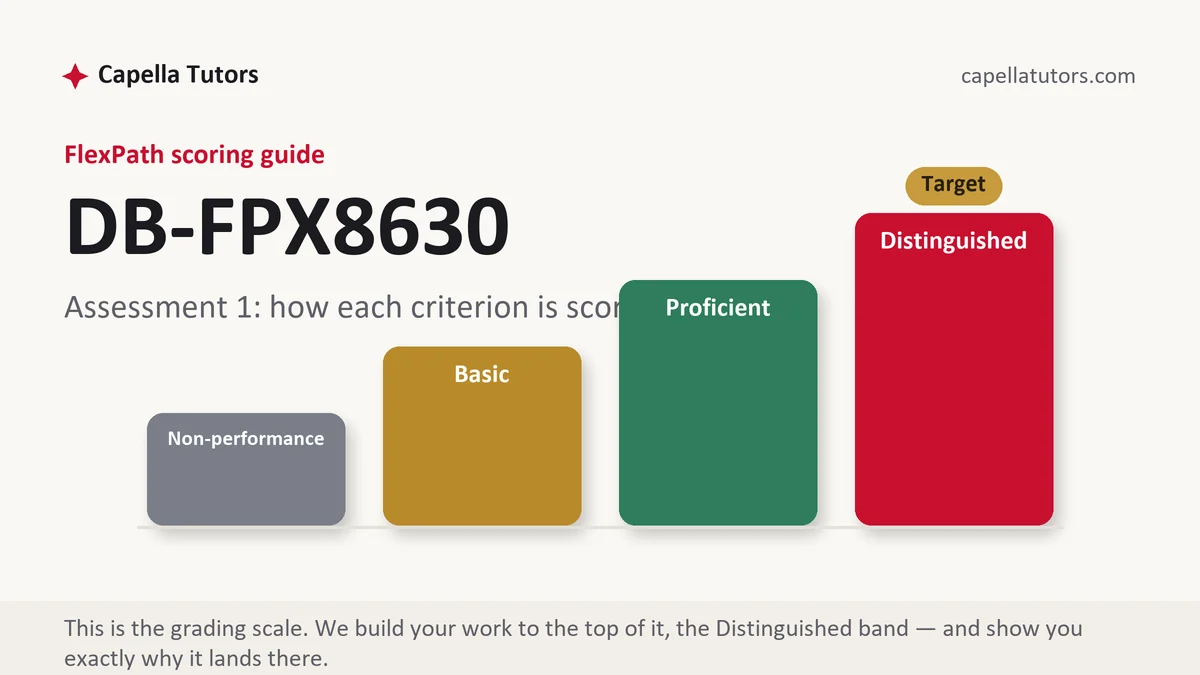
How DB FPX 8630 Assessment 1 is scored
FlexPath awards no letter grades. Every criterion on your scoring guide is placed independently at one of four levels, and the wording of the level you are aiming at is the only specification that matters:
| Level | What it means on a change diagnosis |
|---|---|
| Distinguished | The problem is evidenced with figures a finance function would recognize, readiness is assessed against the work the group is already carrying, and the analysis states which part of the diagnosis the available evidence cannot settle. The additional move is written into the criterion itself; find the verb and perform it. |
| Proficient | The case for change is complete and supported and readiness is addressed. Defensible work that a committee will accept, and still one move below the top column. |
| Basic | Urgency asserted from sector pressure, readiness reported as broadly positive, and the diagnosis carried by adjectives where numbers belong. |
| Non-performance | A required element is absent rather than thin, most often the readiness component. An omitted section cannot be marked as a weak one, which is why leaving it out costs more than doing it badly. |
A doctoral diagnosis is judged by whether a sponsor could act on it, which is a harder test than whether it is interesting. That standard has one practical consequence for how you draft: every claim about the current state needs a source, a date, and a unit, because an executive audience reads an unsourced figure as an estimate and an undated one as history. The contribution you are making here is to practice rather than to theory, so the diagnosis should end somewhere a named role could pick it up on Monday.
The DB FPX 8630 Assessment 1 method, step by step
-
State the change as a difference in behavior
Not a project name, not a system, not a value. Write one sentence naming who will do something differently, what the difference is, and when it starts. If the sentence needs the word transformation to survive, it is not yet specific enough to diagnose, and everything downstream inherits the vagueness.
-
Size the problem in money before you argue it in prose
Take the current state and convert it into a run rate: hours, units, error volumes, rework, overtime, lost orders, whatever the organization already counts. A problem with a number attached becomes a decision. A problem without one stays a discussion, and the analysis criterion is reading for the decision.
-
Count what the affected group is already carrying
List the initiatives already running in that population, name the sponsor of each, and estimate the hours per person per week they consume. Change capacity is finite and mostly invisible, so the count is the single most useful piece of primary evidence you can gather, and nobody else in the cohort will have gathered it.
-
Interview for history rather than for opinion
Ask what was attempted here before, what was promised, and what actually happened. Institutional memory is a variable with predictive power: a group that watched a previous programme get announced and quietly abandoned has a rational reason to wait you out. Record roles rather than names and keep the account de-identified.
-
Separate what you know from what you are assuming
Put the evidence in one column and the assumptions in another, then label each assumption with how you would test it and what it would cost to be wrong. Committees do not object to assumptions; they object to assumptions dressed as findings, and the labelling is what tells them apart.
-
Self-score the diagnosis criterion by criterion
Read the draft once per criterion, mark it D, P, B, or N yourself, and be ungenerous. Anything short of the top level gets another pass. Submit early in the week, because FlexPath evaluation can take two business days and a Friday submission usually sits over the weekend.
A structure that maps to the criteria
These word targets are our planning defaults for a doctoral diagnostic paper rather than Capella requirements; tables and appendices sit outside the prose count, and your scoring guide can move any of them.
| Section | What it must do | Guide |
|---|---|---|
| Situation and change statement | The organization in three or four sentences, then the behavioral change stated with population, difference, and start date. | ~200 words |
| Evidence for the problem | The performance or risk gap with its measures, sources, and dates, plus the run-rate cost of leaving it alone. | ~350 words |
| Readiness assessment | Change history in this group, initiatives in flight with their sponsors, available slack, and capability gaps. | ~350 words |
| Stakeholder and impact map | Who is affected, what each group gains and loses, and where the losses concentrate. | ~250 words |
| Diagnostic conclusion | What the evidence supports, what it does not, and the decision the sponsor now faces. | ~250 words |
| References and appendices | Current APA matched both ways, with the initiative count and any instrument reproduced in an appendix. | as needed |
Annotated sample excerpt
An original model paragraph from our team, written for a family-owned manufacturer moving to a governed board. It shows the register that scores at the top of a diagnostic criterion.
Hartwell Fastening, a third-generation family manufacturer of precision cold-formed fasteners with 214 employees and $61 million of revenue, has no written delegation of authority, and the consequence is measurable rather than philosophical.1 In the twelve months to March 2026 the finance system recorded 1,340 purchase commitments above $10,000, of which 1,187 carried the signature of one of two family principals, and the average interval between requisition and approval on those commitments was 6.8 working days against 1.9 days for the 153 approved by operations managers.2 Applied to the 940 commitments that sat on the critical path of a customer order, the additional 4.9 days of queue time is roughly 4,606 order-days a year, and at the $1,180 average daily carrying and expediting cost the plant already books against late orders, the governance gap is consuming something close to $5.4 million a year before any argument about succession is made.3
- 1Identifies the organization, its size, and the specific structural absence in the first sentence, then refuses the abstraction. A reader who wanted a lecture on family business governance has been told immediately that this is a measured problem.
- 2Two comparable populations from the same system, with the interval stated for each. The comparison is what converts a complaint about bottlenecks into evidence, and it comes from a record the firm already keeps rather than from a survey nobody ran.
- 3The run-rate cost, built openly from stated quantities so a reader can substitute their own figures. Notice the last clause: it concedes that succession is a separate argument, which protects the diagnosis from being read as advocacy.
The full premium sample for your exact assessment, written fresh to your scoring guide and issue, is free to request. Study it, revise it into your own voice, and submit work you understand.
The five mistakes that cost Distinguished
- Urgency borrowed from the sector. Competitive pressure in general is not evidence about this organization, and a case for change that would fit any firm in the industry has diagnosed nothing.
- Readiness reported as a mood. Staff are supportive is an impression; three initiatives running in the same 40 people with two sponsors and no stop date is a finding.
- A change written as a system or a project name. Installing a platform is an activity. The diagnosis has to say what specific people will do differently, or there is nothing to assess readiness for.
- Named individuals carrying the blame. Attributing motive to identifiable people converts analysis into grievance and raises consent problems the paper does not need.
- Recommendations smuggled into the diagnosis. If the intervention appears before the readiness evidence, the paper has decided the answer and the diagnosis reads as decoration.
Pre-submission checklist
- Each scoring-guide criterion has its own labelled section, in the guide's order
- The change is one sentence naming population, behavioral difference, and start date
- Every current-state figure carries a source, a date, and a unit
- Initiatives in flight are counted, with a sponsor named against each
- Assumptions are labelled as assumptions, each with a stated test
- Self-scored at the top level on every criterion, submitted early in the week
Change diagnosis or readiness paper due?
Send the prompt, the criteria, and whatever you can tell us about the organization and what has been tried there before. A team of eight, including a research analyst and two scoring-guide reviewers, returns a premium original doctoral sample with the problem sized, the readiness counted, and the assumptions labelled. The first one carries no fee.