This manual is for DB FPX 8620 Assessment 3, start to submission. A closing deliverable in this course usually asks you to design an intervention and say how you would know whether it worked. The assessment usually wants an operating rhythm you could actually run, meaning a cadence, an owner, a review forum and a stated response to the perverse incentive your own measure creates. You can also delegate it, and a premium original doctoral sample fixing the evaluation before the look returns inside 24 to 48 hours, revised at no charge until it clears. Capella's catalog lists the course as DB-FPX8620, and some courserooms print DB8620; both point to this same Assessment 3.
One honesty note before the manual: Capella revises courses and scoring guides over time, so always write to the exact scoring guide attached to your assessment in the courseroom. The course identity above is verified on capella.edu; the method and structure below are our tutors' approach to it, not Capella's official rubric text.
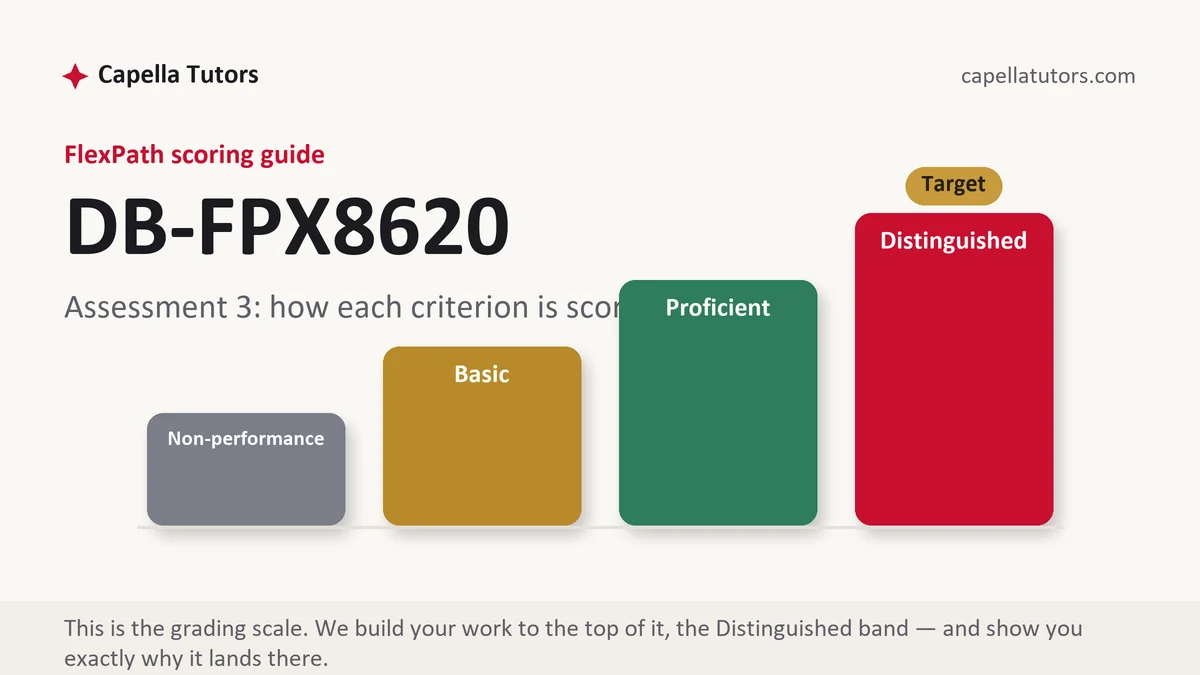
How DB FPX 8620 Assessment 3 is scored
Every criterion is scored on its own at one of four levels, and the doctoral top wording asks for a design that survives its own scrutiny:
| Level | What it means on an intervention and evaluation deliverable |
|---|---|
| Distinguished | A baseline, a comparison and a review interval fixed before the look, plus the way the measure could be satisfied without real improvement and the counter-check that detects it. |
| Proficient | A workable intervention with a credible evaluation attached. |
| Basic | An intervention proposed with success defined as the target moving. The reading a doctoral guide penalizes. |
| Non-performance | A required element absent, most often the evaluation design. |
Goal-setting evidence is strong and its documented side effects are equally well recorded: narrow goals crowd out unmeasured work, aggressive targets raise the rate of corner-cutting, and a scoreboard nobody can influence produces cynicism. Any performance design blind to those effects has not been worked through.
The DB FPX 8620 Assessment 3 method, step by step
-
Map the criteria and write the intervention as a change to work
Say what people will do differently, in what sequence, and who runs it. A training event is not an intervention unless the document says what changes in the work afterward and who is accountable for it continuing.
-
Pair every narrow target with the work it could crowd out
For each measure you propose, name the unmeasured activity that competes with it. That pairing is the single most efficient way to show a doctoral reader that the design anticipated its own consequences rather than discovering them.
-
Build a composite that cannot be satisfied cheaply
Where a single measure is gameable, construct the ratio that captures the real objective, then show the arithmetic. A measure that improves while the composite worsens is the clearest possible evidence for the point you are making.
-
Fix the baseline, the comparison and the interval before you look
A rate read three weeks after a workshop measures enthusiasm rather than practice. Name the baseline period, the comparison unit and the interval in advance, and say which existing report the number comes from so nobody builds a new spreadsheet to track your idea.
-
State what would falsify the design
Say what result would tell you the mechanism was wrong rather than the execution weak, and what you would do next in that case. A design with no falsifying result is not an evaluation, it is an announcement.
-
Cost the change fully, then self-score
Participant hours at a loaded rate plus cash, with a break-even in the unit's own performance measure. Then grade each row yourself and sequence your deliverables so the heavier analytical one is not due in the same week as your other course.
A structure that maps to the criteria
Take the lengths here as our tutors' working plan rather than Capella rules, and rebalance wherever your own guide asks.
| Section | What it must do | Guide |
|---|---|---|
| The intervention | What changes in the work, in what sequence, run by whom, over what schedule. | ~230 words |
| The target and what it crowds out | The measure proposed and the unmeasured activity that competes with it. | ~250 words |
| The composite | The ratio that captures the real objective, with the arithmetic shown across the change. | ~290 words |
| Evaluation design | Baseline period, comparison unit, review interval and the existing report used. | ~260 words |
| Falsification and risk | The result that would show the mechanism wrong, and the counter-check on gaming. | ~250 words |
| Cost, owner and references | Hours and cash, the break-even in the unit's measure, the owner, and current APA. | as needed |
Annotated sample excerpt
An original excerpt from our team showing a target that improved while performance did not. Read the arithmetic, then build the same composite for the measure you are proposing.
Average handle time was the target and it moved as intended, falling from 6 minutes 20 seconds to 5 minutes 48 seconds across the two quarters after the goal was set.1 First-contact resolution fell in the same window from 71 percent to 64 percent, and repeat contacts within seven days rose from 18 to 26 percent, which matters because the objective was never handle time; it was minutes consumed per issue actually resolved.2 Computed as a composite the picture reverses: at 71 percent resolution the unit spent 1.41 contacts per resolved issue at 6.33 minutes each, or 8.92 minutes, and at 64 percent it spends 1.56 contacts at 5.80 minutes, or 9.06 minutes, so the target improved by 8 percent while the thing the target was meant to proxy got slightly worse, and the design that follows sets the composite as the reported measure, reads it monthly from the existing contact report against the two queues that did not receive the target, and treats a divergence between the two numbers as the signal rather than as noise.3
- 1Concedes that the target moved, without qualification, which is what makes the reversal that follows credible rather than defensive.
- 2Reports the two measures that were not targeted, then names the actual objective in the same sentence. Identifying what the proxy was standing in for is the analytical move.
- 3Computes the composite from both periods and shows the reversal, then converts it into a reported measure with a comparison and a cadence. Arithmetic that defeats your own target is the strongest available evidence.
The full premium sample for your exact assessment, written fresh to your scoring guide and issue, is free to request. Study it, revise it into your own voice, and submit work you understand.
The five mistakes that cost Distinguished
- Success defined as the target moving. A proxy that improves while the objective worsens is the documented failure mode, and the design has to be able to see it.
- An intervention that is only a training event. Unless the document says what changes in the work afterward and who owns it, nothing has been designed.
- The review interval chosen after the look. A number read at a convenient moment is not an evaluation, and the interval has to be fixed in advance.
- A new spreadsheet proposed to track the idea. If the measure does not come from a report the organization already produces, it will stop being produced.
- Carrying an expected effect across from an unlike setting. A result from a manufacturing sample does not transfer to a service queue without an argument about task interdependence.
Pre-submission checklist
- The intervention states what changes in the work, in sequence, with an owner
- Every target is paired with the unmeasured work it could crowd out
- A composite measure is computed with its arithmetic shown
- Baseline, comparison unit, interval and source report are fixed in advance
- A falsifying result and a gaming counter-check are both named
- Cost includes participant hours, with a break-even in the unit's measure
Intervention and evaluation section due?
Send the criteria, your unit's size and hours, and the measure your organization already reports. We design the change, build the composite that cannot be satisfied cheaply, fix the evaluation in advance and name the falsifying result. Back within 24 to 48 hours, with free rework for as long as any criterion remains unmet.