This manual is for DB FPX 8620 Assessment 2, start to submission. A middle deliverable in this course usually asks you to build a team-level claim from individual responses, which is the step doctoral readers watch most closely. The assessment usually wants the aggregation rule stated and defended rather than performed, because shared properties require evidence that members agree with each other. Handing it across is an option, and a premium original doctoral sample defending the aggregation rule comes back inside 24 to 48 hours, with free revision until the criteria clear. Capella's catalog lists the course as DB-FPX8620, and some courserooms print DB8620; both point to this same Assessment 2.
One honesty note before the manual: Capella revises courses and scoring guides over time, so always write to the exact scoring guide attached to your assessment in the courseroom. The course identity above is verified on capella.edu; the method and structure below are our tutors' approach to it, not Capella's official rubric text.
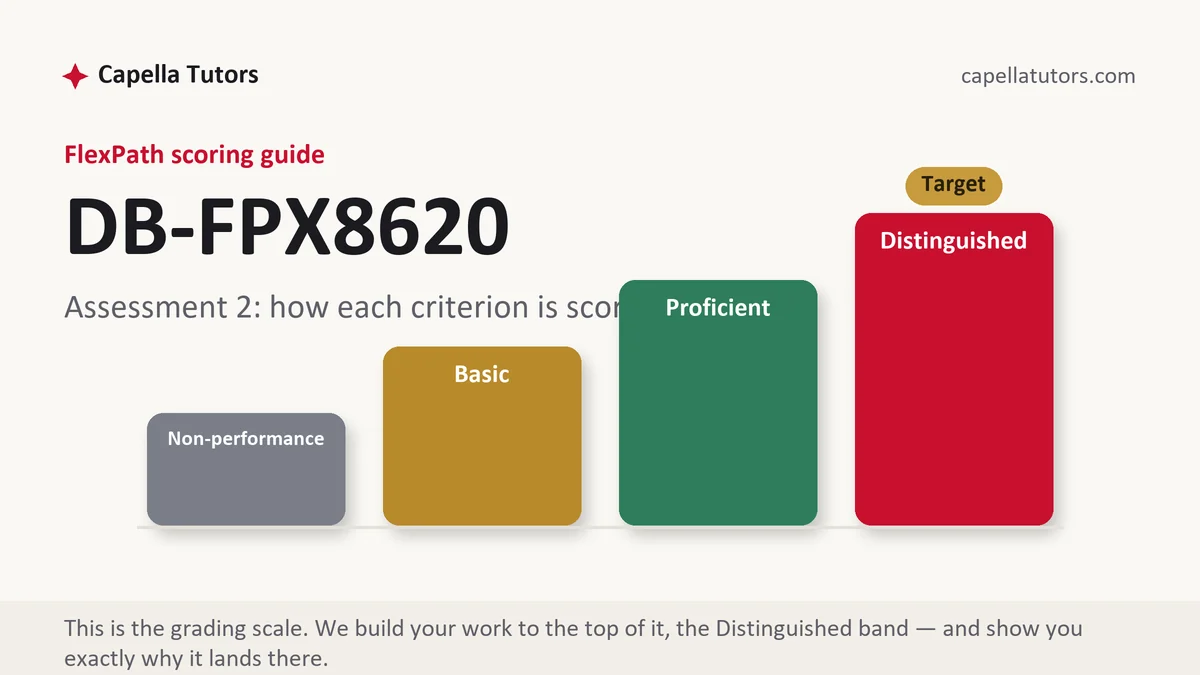
How DB FPX 8620 Assessment 2 is scored
Criteria are graded one at a time at one of four levels, and the doctoral top wording asks for measurement discipline:
| Level | What it means on a team-level construct deliverable |
|---|---|
| Distinguished | Agreement and reliability evidence cited, the referent of the survey items stated, and the consequence of weak agreement followed through rather than ignored. |
| Proficient | The construct correctly identified and aggregated with a stated rule. |
| Basic | Individual responses averaged into a team score by assertion. The move a doctoral criterion treats as a measurement error. |
| Non-performance | A required element absent, most often the justification for aggregating. |
Writing one level down averages the answers and carries on. Doctoral writing states the aggregation rule, defends it with an agreement index and a reliability estimate, and says what would follow if agreement were weak. That last clause is where most of the difference sits.
The DB FPX 8620 Assessment 2 method, step by step
-
Turn the criteria into headings and identify the shared property
Psychological safety, cohesion and collective efficacy are properties of a group rather than averages of individuals, and the distinction decides what evidence the paper owes. Name which shared property is in play before any data appears.
-
Check the referent of the items
Asking whether I feel safe raising a problem and asking whether we can raise problems on this crew produce different data. A shift in referent changes what the aggregate means, and stating which wording was used is the cheapest credibility in the section.
-
Report agreement and reliability, not just the mean
A within-group agreement index shows whether members converge, and an intraclass correlation shows whether the team means are distinguishable from each other. A doctoral reader expects a citation behind any threshold you apply rather than a bare number.
-
Say what happens where aggregation fails
Some teams will not meet the threshold, and reporting them is stronger than dropping them quietly. Say whether they are excluded, analyzed separately, or treated as evidence that the construct is not shared there, and defend the choice.
-
Link the construct to an outcome the organization counts
A shared state is a link in a mechanism rather than the end of it. Carry the chain through to something operational, and name the weakest link rather than glossing it, because that is what the mechanism criterion is grading.
-
Handle the counterintuitive pattern, then self-score
Safer teams often record more errors because they report more of them, so an evaluation reading raw incident counts can conclude the intervention made things worse. Say how you would avoid that reading. Then grade each row yourself and plan for the review window.
A structure that maps to the criteria
Working figures our tutors use on a deliverable shaped like this, not a Capella requirement, and the guide in your courseroom decides.
| Section | What it must do | Guide |
|---|---|---|
| The shared property | The construct in play, its originating author, and why it is a group property rather than an average. | ~230 words |
| Measurement and referent | The instrument, the item referent, the response scale and who was surveyed. | ~250 words |
| Aggregation evidence | The agreement index and reliability estimate, with the threshold cited to a methodological source. | ~290 words |
| Where aggregation fails | The teams below threshold, what was done with them, and why that choice is defensible. | ~250 words |
| Mechanism to outcome | The chain from the shared state to an operational measure, with the weakest link named. | ~250 words |
| Sources and apparatus | Foundational statements cited to origin, methodological sources for thresholds, current APA. | as needed |
Annotated sample excerpt
An original excerpt from our team showing aggregation defended rather than assumed. Read it for the discipline, then rebuild it around the teams and the construct your criteria name.
The construct is psychological safety as a crew-level property, and the items were written with a team referent, asking whether problems can be raised on this crew rather than whether the individual feels able to raise them, because the two wordings do not produce the same variable.1 Across 74 technicians in 11 crews the median within-group agreement index is 0.78, above the conventional 0.70 threshold that this paper cites to a methodological source rather than asserting, and the intraclass correlation supports treating crew means as distinguishable.2 Two crews fall below, at 0.52 and 0.58, and they are not dropped: the defensible reading is that safety is not a shared property in those two, which is itself a finding, since both are the crews that absorbed the recent merger of a smaller contractor and the disagreement is between the incoming and incumbent technicians rather than random, so they are analyzed separately and the mechanism section treats them as a boundary condition on the recommendation rather than as missing data.3
- 1Names the construct as a group property and states the item referent with the alternative wording, in one sentence. Referent shift handled explicitly is a doctoral marker.
- 2Reports the agreement index, the threshold, the source of the threshold and the reliability evidence. Citing the threshold rather than asserting it is what the measurement criterion pays for.
- 3Reports the failures, explains the pattern inside them, and converts them into a boundary condition. Following weak agreement through instead of dropping it is the top-column move.
The full premium sample for your exact assessment, written fresh to your scoring guide and issue, is free to request. Study it, revise it into your own voice, and submit work you understand.
The five mistakes that cost Distinguished
- Rolling individual answers up into a team figure because it seemed reasonable. A shared property needs evidence that members converge, and at this level the missing justification is read as a measurement fault.
- The item referent unstated. Individual and team referents produce different variables, and the aggregate means something different in each case.
- A threshold used with no citation. A bare number for an agreement cutoff is exactly the claim a methodological reader will ask about.
- Teams below threshold quietly dropped. Reporting them and explaining the pattern is stronger evidence than a clean dataset.
- Raw incident counts read as an outcome. Safer teams report more, so an evaluation on raw counts can reach the opposite of the truth.
Pre-submission checklist
- The construct is identified as a group property with its originating author
- The item referent and response scale are stated
- Agreement and reliability evidence appear with a cited threshold
- Teams below threshold are reported and their treatment defended
- The chain to an operational outcome names its weakest link
- The reporting artifact in incident counts is addressed, APA matched both ways
Team-level construct section due?
Send the criteria, your team structure and any survey data you can describe. The second reader on this course has one job beyond the scoring guide, which is confirming that no individual-level finding has been quietly promoted to a team-level conclusion. It comes back within 24 to 48 hours and is reworked at no cost until each row is satisfied.