This manual is for DB FPX 8620 Assessment 1, start to submission. An opening deliverable in a high performance leadership course usually asks what performance means in the setting you chose. The assessment usually wants an indicator, a denominator and a period named before anything is called high, because throughput per shift, first-pass yield, revenue per employee and voluntary turnover all describe performance and none of them describe the same thing. Or let us build it: a premium original doctoral sample defining the measure with a denominator and a counter-check arrives inside 24 to 48 hours, revised free throughout. Capella's catalog lists the course as DB-FPX8620, and some courserooms print DB8620; both point to this same Assessment 1.
One honesty note before the manual: Capella revises courses and scoring guides over time, so always write to the exact scoring guide attached to your assessment in the courseroom. The course identity above is verified on capella.edu; the method and structure below are our tutors' approach to it, not Capella's official rubric text.
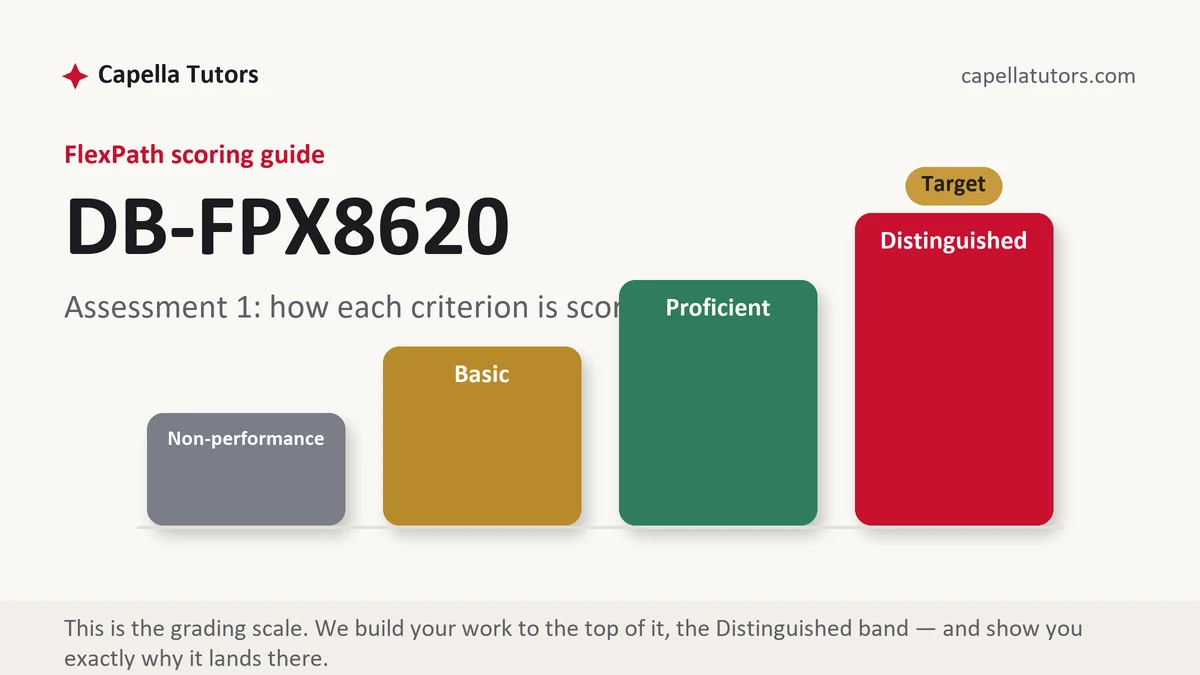
How DB FPX 8620 Assessment 1 is scored
FlexPath grades each criterion by itself at one of four levels, and the doctoral top wording is exacting:
| Level | What it means on a performance definition deliverable |
|---|---|
| Distinguished | A measure the unit can influence, defined tightly enough that two readers would compute it the same way, with variation reported beside the mean. |
| Proficient | An appropriate indicator selected and baselined accurately. |
| Basic | Performance praised with no denominator and no period attached. The register a doctoral guide penalizes hardest. |
| Non-performance | A required element absent, most often the baseline or the definition itself. |
Strong performance is an assertion about a unit rather than a compliment paid to whoever runs it. A paper that praises a team without saying which measure moved has not begun, and one that names a measure the unit cannot influence has begun in the wrong place.
The DB FPX 8620 Assessment 1 method, step by step
-
Write the performance question at the top of the page in one sentence
Criteria become headings, the top-column language goes underneath each, and every paragraph names the criterion it serves. In a course built around unit performance the clusters usually run: what performance means here, the current state with evidence, the mechanism, the intervention, and how you would know whether it worked.
-
Choose an indicator the unit can actually move
A scoreboard nobody can influence produces cynicism rather than effort, which is a documented effect rather than a morale opinion. Test each candidate measure by asking what the unit would do differently tomorrow if it wanted the number to improve.
-
Define it so two readers compute it identically
State the numerator, the denominator, the window, the exclusions and the source report. Most definitions fail on exclusions, and an undefined exclusion is the gap through which the measure will later be satisfied cheaply.
-
Baseline with variation, not just an average
Report the mean and the spread, because the reader needs to see whether the problem is level or consistency. A unit at 88 percent with a stable distribution and a unit at 88 percent with two catastrophic weeks need different interventions.
-
Price the current gap
Convert the shortfall into hours and cash at a loaded rate, so the size of the problem is established before any intervention is proposed. A doctoral proposal that reaches its recommendation before the problem has a price has skipped the step the committee cares about.
-
Name the gaming route and its counter-check, then self-score
Every target creates an incentive to satisfy it cheaply. Say how your own measure could be defeated, whether by reclassification, by pushing work downstream or by changing what enters the denominator, and state the counter-check that would catch it. Then grade each row and plan for the two-business-day review.
A structure that maps to the criteria
Word counts are our tutors' planning targets for a deliverable of this kind, not Capella rules; your scoring guide decides where the length sits.
| Section | What it must do | Guide |
|---|---|---|
| Performance definition | The outcome, its measure, its numerator and denominator, the window and the exclusions. | ~230 words |
| Why this measure | What the unit would do differently to move it, and what the alternatives would have missed. | ~250 words |
| Baseline evidence | Current values from named internal reports, with variation as well as averages. | ~280 words |
| The price of the gap | The shortfall converted into hours and cash at a stated loaded rate. | ~250 words |
| Gaming and counter-check | How the measure could be satisfied without real improvement, and what would detect it. | ~250 words |
| Sources and apparatus | Foundational statements cited to origin, empirical work for effect sizes, current APA. | as needed |
Annotated sample excerpt
An original model excerpt from our team showing a measure defined to survive contact with an incentive. Study the definition, then write your own for the unit you are analyzing.
Performance here is first-pass yield, defined as claims closed without being reopened within 60 days divided by all claims closed in the period, excluding claims reopened solely because of a court order, and read monthly from the existing claims operations report rather than from a new spreadsheet.1 Across 61,000 claims closed last year by 34 adjusters the unit ran at 88.2 percent, which is roughly 7,200 reopens, and the variation matters as much as the level, since two adjuster teams sat above 93 percent while one sat at 79 and accounted for a disproportionate share of the total; at 1.4 hours of rework per reopen and a loaded $52 an hour, the gap is worth about $524,000 a year.2 The measure has an obvious defeat: an adjuster can close and then open a fresh claim number rather than reopening the original, so the counter-check is to match on policy number and date of loss instead of claim number, reported quarterly by the operations analyst who already produces the file.3
- 1Numerator, denominator, window, exclusion and source report in one sentence. Two readers would compute this identically, which is what the definition criterion is testing.
- 2Baselines the level, then the variation, then prices the gap in hours and cash. The distribution detail is what tells the reader whether the problem is level or consistency.
- 3Names the specific route by which the measure could be satisfied cheaply and gives the counter-check with an owner and a cadence. Anticipating the gaming of your own metric reads as doctoral rather than enthusiastic.
The full premium sample for your exact assessment, written fresh to your scoring guide and issue, is free to request. Study it, revise it into your own voice, and submit work you understand.
The five mistakes that cost Distinguished
- Performance praised before it is defined. A result carrying neither a base nor a window cannot be moved on the page or on the floor.
- A measure the unit cannot influence. A scoreboard beyond the unit's reach produces cynicism, and the effect is documented rather than anecdotal.
- Exclusions left unstated. The exclusion is where the measure will later be defeated, and leaving it undefined invites exactly that.
- A mean with no variation beside it. Two units with the same average can need entirely different interventions, and the spread is what tells them apart.
- Nothing written about the cheap ways the number could be satisfied. Any target invites the least costly route to hitting it, and a design blind to that reads as never having met practice.
Pre-submission checklist
- Numerator, denominator, window, exclusions and source report are all stated
- The measure is one the unit can influence, with the reasoning shown
- Baseline reports variation alongside the mean
- The gap is priced in hours and cash at a stated loaded rate
- A gaming route and a counter-check with an owner are named
- Foundational claims cited to origin, APA matched both ways, self-scored
Performance definition deliverable due?
Send the criteria, your unit size and whatever volume, quality or turnover figures you can share. We define the measure with a denominator and a window, baseline it with variation, price the gap and name the counter-check. Returned within 24 to 48 hours, with rework included until nothing on the guide is outstanding.