This manual is for DB FPX 8610 Assessment 3, start to submission. A closing deliverable in this course usually asks you to appraise evidence rather than to generate it, which means handling somebody else's data and your own organization's numbers with the same discipline. The assessment usually asks what a reported association is allowed to mean, and what design would have settled the question. If you would rather hand it over, a premium original doctoral sample stating design before finding lands inside 24 to 48 hours, revised free until the guide is satisfied. Capella's catalog lists the course as DB-FPX8610, and some courserooms print DB8610; both point to this same Assessment 3.
One honesty note before the manual: Capella revises courses and scoring guides over time, so always write to the exact scoring guide attached to your assessment in the courseroom. The course identity above is verified on capella.edu; the method and structure below are our tutors' approach to it, not Capella's official rubric text.
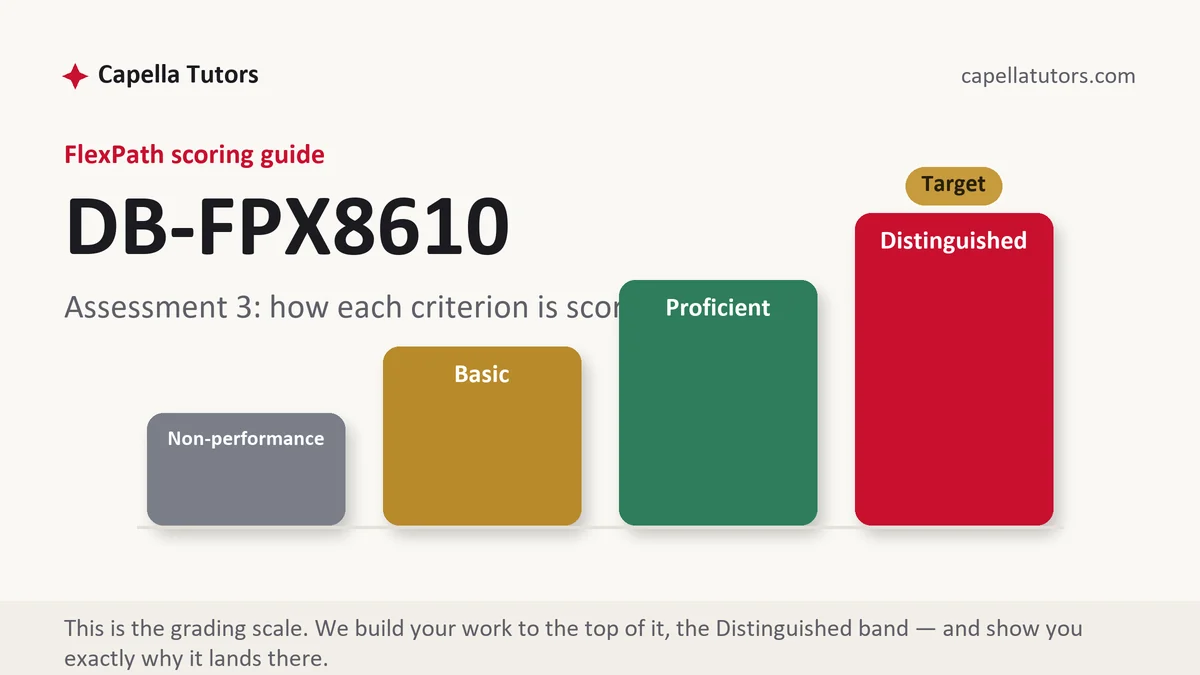
How DB FPX 8610 Assessment 3 is scored
Every criterion is scored independently at one of four levels, and the doctoral top wording asks for calibrated confidence:
| Level | What it means on a doctoral inference appraisal |
|---|---|
| Distinguished | Study quality characterized in the writer's own words, the alternative causal story stated, and the design that would separate the two named along with why it was unavailable. |
| Proficient | Evidence reported with its design and correctly qualified. |
| Basic | Published findings treated as quotable conclusions and organizational figures treated as results. The register a doctoral reader discounts. |
| Non-performance | A required element absent, most often the appraisal of design. |
Endogeneity runs through this field, because a unit that performs well produces subordinates who describe their leader in glowing terms, and cross-sectional survey work cannot separate that story from the one where the leader caused the performance. Students who treat published studies as conclusions land mid-guide; students who treat them as evidence with a design attached land at the top, and it is the same amount of reading either way.
The DB FPX 8610 Assessment 3 method, step by step
-
Turn the criteria into headings and state the claim you are appraising
Write the causal claim in one sentence, with the direction stated, before touching any evidence. An appraisal of a vaguely worded claim will itself be vague, and the row measuring analysis will have nothing to grade.
-
Open the method section before the discussion
Who rated whom, how far apart in time, and with what instrument decides what a reported correlation is allowed to mean. Where the same respondent rated both the leader and the outcome, the association is inflated and the paper should say so rather than hedge in the conclusion.
-
State the alternative causal story explicitly
Write out the reverse-direction account and the common-cause account in their strongest forms. Implicit leadership theories complicate ratings again, since respondents score a real leader partly against the prototype they brought into the room.
-
Name the design that would separate them
A before and after set against a defensible comparison unit outranks any confident claim, and explaining where that comparison unit falls short outranks it again. Say what design would settle the question and why it was not available to you.
-
Convert coefficients into something a payroll can feel
A correlation squared tells the reader how much of the outcome is left to everything else in the organization, and saying so plainly is stronger than reporting the coefficient alone. A modest effect applied across a large payroll can still be worth acting on, and naming the ceiling before proceeding is the doctoral move.
-
Commit to a reading, then self-score
Pick one of the field's live disputes, state both positions with citations to the people holding them, say which body of evidence you find more persuasive and why, then commit. A reader at this level pays for the position taken, not for the balance held. Then grade every row and plan for the review window.
A structure that maps to the criteria
The lengths here are our tutors' working targets rather than Capella rules, so follow your own guide wherever it distributes the weight differently.
| Section | What it must do | Guide |
|---|---|---|
| The claim | The causal claim in one sentence, with its direction and the unit it operates on. | ~180 words |
| What the evidence is | Design, sample, instrument, rating source and interval, stated before any result. | ~300 words |
| The alternative accounts | Reverse direction and common cause in their strongest forms, plus rating-prototype effects. | ~280 words |
| The separating design | What would settle it, why it was unavailable, and the best available substitute. | ~270 words |
| What follows anyway | The strongest claim the evidence supports, with the ceiling named and the action defended. | ~250 words |
| Scholarly apparatus | Primary theoretical sources, empirical and meta-analytic work, current APA both ways. | as needed |
Annotated sample excerpt
An original excerpt from our team showing an inference held at the strength the evidence carries. Read it for the discipline, then apply it to the claim your own criteria name.
The claim under appraisal is that the incoming director raised engagement in this service line, and the evidence for it is a seven-point rise in the annual survey index between the year before and the year after the appointment.1 Two rival accounts fit that evidence equally well. The reverse-direction story is that a service line whose vacancy rate fell for reasons unconnected to the director, in this case a regional wage adjustment in the same quarter, produces staff who describe their leadership more favorably; the common-cause story is that both the appointment and the improvement followed a capital decision that reopened two closed rooms, and respondents rated the visible change rather than the person.2 The design that would separate them is not available here, since no comparison line changed leadership in the same window, so the best available substitute is a difference in differences against the two lines that received the wage adjustment without a leadership change, which would leave the capital story unresolved and should be reported as leaving it unresolved rather than as a limitation paragraph at the end.3
- 1States the causal claim and the evidence for it in one sentence each, with the direction explicit. An appraisal cannot be precise about a claim that was never stated precisely.
- 2Writes both rival accounts in their strongest forms, each anchored to a specific event in the same period. Naming a concrete confound is worth more than a general caution about causality.
- 3Identifies the unavailable design, proposes the best substitute, and says exactly what the substitute leaves open. Placing the limitation inside the argument rather than at the end is the top-column move.
The full premium sample for your exact assessment, written fresh to your scoring guide and issue, is free to request. Study it, revise it into your own voice, and submit work you understand.
The five mistakes that cost Distinguished
- A correlation carrying a causal verb. Survey data gathered at one moment carries association only, and the fix is a sentence about the design rather than a softened conclusion.
- A limitations paragraph doing the work of an appraisal. Confounds named at the end change nothing; named inside the argument they change what the paper is allowed to claim.
- Common-source variance unmentioned. Where one respondent rated the leader and the outcome, the association is inflated and the reader expects that stated.
- A coefficient reported without its share of variance. Squaring the correlation tells the reader how much is left to everything else, and the sentence costs nothing.
- Refusing to commit. Doctoral evaluators reward a defended position over a balanced survey of everybody's view.
Pre-submission checklist
- The causal claim is one sentence with its direction and unit stated
- Design, sample, instrument, rating source and interval precede every result
- Reverse-direction and common-cause accounts are both written out
- The separating design is named, with why it was unavailable
- The strongest supportable claim is stated with its ceiling
- Founding claims cited to originals, APA matched both ways, self-scored
Evidence appraisal due and the causality will not hold still?
Send the criteria, the claim you are appraising and whatever organizational figures you can lawfully describe. The draft reports design before finding, writes out the rival accounts, names the design that would separate them, and commits to a reading. Back inside 24 to 48 hours, and reworked free for as long as a criterion sits short.