This manual is for DB FPX 8610 Assessment 2, start to submission. A middle deliverable in this course usually asks you to turn theory into a recommendation an executive committee would act on. The assessment usually wants the theoretical justification and the arithmetic in the same document, because a development proposal with no cost and no break-even reads as an opinion however well it is grounded. Delegating is available, and a premium original doctoral sample with the break-even in your own reported measure returns inside 24 to 48 hours, with revision until it scores. Capella's catalog lists the course as DB-FPX8610, and some courserooms print DB8610; both point to this same Assessment 2.
One honesty note before the manual: Capella revises courses and scoring guides over time, so always write to the exact scoring guide attached to your assessment in the courseroom. The course identity above is verified on capella.edu; the method and structure below are our tutors' approach to it, not Capella's official rubric text.
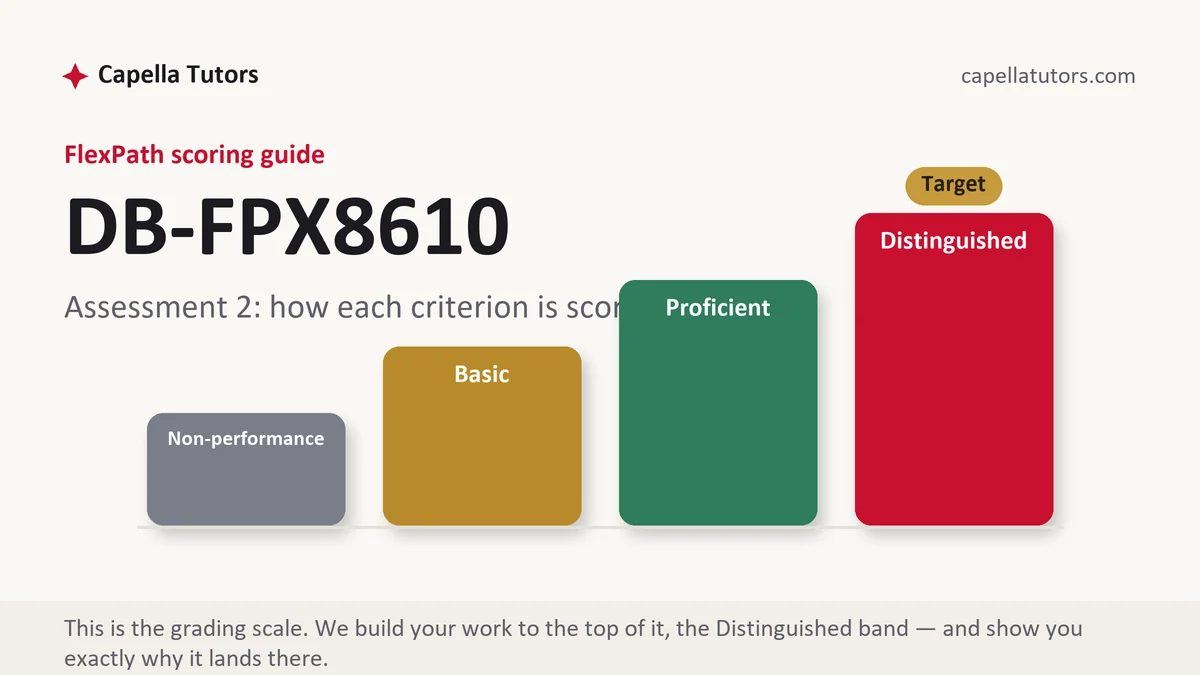
How DB FPX 8610 Assessment 2 is scored
Each criterion is graded on its own at one of four levels, and the doctoral top wording asks for more than accuracy:
| Level | What it means on a costed doctoral recommendation |
|---|---|
| Distinguished | A full cost including participant time, a break-even expressed in the organization's own measure, and a test of the assumption most likely to move. |
| Proficient | A theoretically grounded recommendation with a credible cost attached. |
| Basic | A development proposal justified by literature with no arithmetic behind it. The register a doctoral reader reads as underpowered. |
| Non-performance | A required element absent, most often the cost or the owner. |
Writing at this level starts paying for itself the moment a proposal carries a figure. A committee trusts a writer whose break-even is expressed in a measure the organization already tracks, and discounts one whose benefits arrive as adjectives.
The DB FPX 8610 Assessment 2 method, step by step
-
Map the criteria and decide what the recommendation is for
Name the decision the document informs and the sponsor who would take it, before any theory appears. A proposal written without a decision behind it has no basis for choosing between a cheap intervention and an expensive one.
-
Ground the intervention in a mechanism, not a category
Say which theory predicts that this intervention changes this behavior, through what intervening state. Leadership development is not a mechanism, and a proposal that names one only in the literature review has left the theory outside the argument.
-
Cost participant time as well as cash
Participant hours are the larger line in almost every leadership intervention, and leaving them out understates the ask by a wide margin. Use a loaded rate, state it, and show the hours.
-
Express the break-even in the organization's own measure
Divide the total cost by the unit value of the thing you claim to improve, then convert the result into the measure the organization reports: departures avoided, points off a rate, hours recovered. That conversion is what makes the proposal arguable at committee rather than admirable.
-
Take the effect size from evidence, not from ambition
Match the expected effect to what the literature supports for a comparable context, and say plainly where the borrowing is imperfect. A result from a different industry does not transfer without an argument about the work itself.
-
Test the fragile assumption, then self-score
Identify the assumption most likely to move, usually the effect size or the replacement cost, and show the break-even at both ends of a plausible range. Then grade the document against every row and plan the dates so a rework cycle fits inside the billing session.
A structure that maps to the criteria
Planning targets our tutors use for a costed doctoral deliverable, not Capella requirements; the guide attached to your assessment governs.
| Section | What it must do | Guide |
|---|---|---|
| Decision and sponsor | What is being decided, by whom, and what the document is meant to settle. | ~190 words |
| Theoretical mechanism | The theory, its author, and the path by which the intervention is claimed to change behavior. | ~290 words |
| Evidence for the effect | What the literature supports for a comparable context, with design and sample stated. | ~280 words |
| Full cost | Cash and participant hours at a stated loaded rate, itemised and totalled. | ~250 words |
| Break-even and sensitivity | The total converted into the organization's own measure, at both ends of a plausible range. | ~260 words |
| Owner, sequence and references | Who owns each part, in what order, and current APA in both directions. | as needed |
Annotated sample excerpt
An original model excerpt from our team showing a break-even a committee could argue with. Read it for the arithmetic, then rebuild it around the organization you are writing about.
The proposal covers all 22 branch managers at $2,950 a seat, which is $64,900, and consumes 24 hours of each manager's time at a loaded $54 an hour, adding 528 hours and $28,512, for a first-year commitment of $93,412.1 The claimed benefit is teller retention, and the organization already reports the numbers that make it testable: 340 tellers with voluntary separations running at 27 percent, which is 92 departures a year at a replacement cost of about $9,400 each, or roughly $864,800.2 Dividing $93,412 by $9,400 says the program has to prevent about ten departures to wash its face in year one, which is 2.9 percentage points off a 27 percent rate, and the honest framing for the committee is that the effect sizes reported for supervisor-focused interventions in comparable service settings straddle that figure rather than clearing it, so the decision turns on whether a movement to roughly 24 percent is credible here, which is the argument worth having.3
- 1Costs the cash and the hours separately, at a stated loaded rate, and totals them. Participant time is the line most proposals omit and the one a committee notices.
- 2Takes the benefit measure from what the organization already reports, with a headcount, a rate and a unit cost, so nothing in the calculation has to be invented.
- 3Converts the total into departures and then into percentage points, and states that the literature straddles rather than clears the threshold. Naming the fragility is what makes the recommendation doctoral.
The full premium sample for your exact assessment, written fresh to your scoring guide and issue, is free to request. Study it, revise it into your own voice, and submit work you understand.
The five mistakes that cost Distinguished
- An intervention costed in cash alone. Participant hours are usually the larger line, and leaving them out understates the ask.
- A break-even in dollars only. Committees act on the measure they already report, so the total has to be converted into departures, points or hours.
- An effect size borrowed without an argument. A result from a different industry does not transfer, and a doctoral reader will ask about the work itself.
- Benefits stated as adjectives. Improved engagement and stronger culture cannot be divided into a cost, and the row asking for justification finds nothing.
- No owner and no sequence. A proposal nobody owns and nothing precedes cannot be implemented, and it is read as an opinion.
Pre-submission checklist
- The decision and its sponsor are named before any theory appears
- The intervention is grounded in a mechanism with an intervening state
- Cost includes participant hours at a stated loaded rate
- The break-even is expressed in a measure the organization already reports
- The fragile assumption is tested at both ends of a range
- Owner and sequence stated, founding claims cited to originals, APA matched both ways
Costed leadership recommendation due?
Send the criteria, the theories your course named and whatever headcount, wage and turnover figures you can share. We attribute every framework to its source, cost the participant hours as well as the cash, and express the break-even in your own reported measure. It returns within 24 to 48 hours and is reworked without charge until the guide is satisfied.