This manual is for DB FPX 8610 Assessment 1, start to submission. An opening deliverable in a doctoral leadership course usually asks you to hold two or three named theories against a situation you can describe in detail. The assessment usually asks for mechanism rather than preference, which means stating what each theory claims, who advanced the claim, and what observation would tell the competing mechanisms apart. Your scoring guide decides the form the comparison takes. Or hand it to us: a premium original doctoral sample deriving an observable prediction from each mechanism comes back inside 24 to 48 hours, revised free until the rows clear. Capella's catalog lists the course as DB-FPX8610, and some courserooms print DB8610; both point to this same Assessment 1.
One honesty note before the manual: Capella revises courses and scoring guides over time, so always write to the exact scoring guide attached to your assessment in the courseroom. The course identity above is verified on capella.edu; the method and structure below are our tutors' approach to it, not Capella's official rubric text.
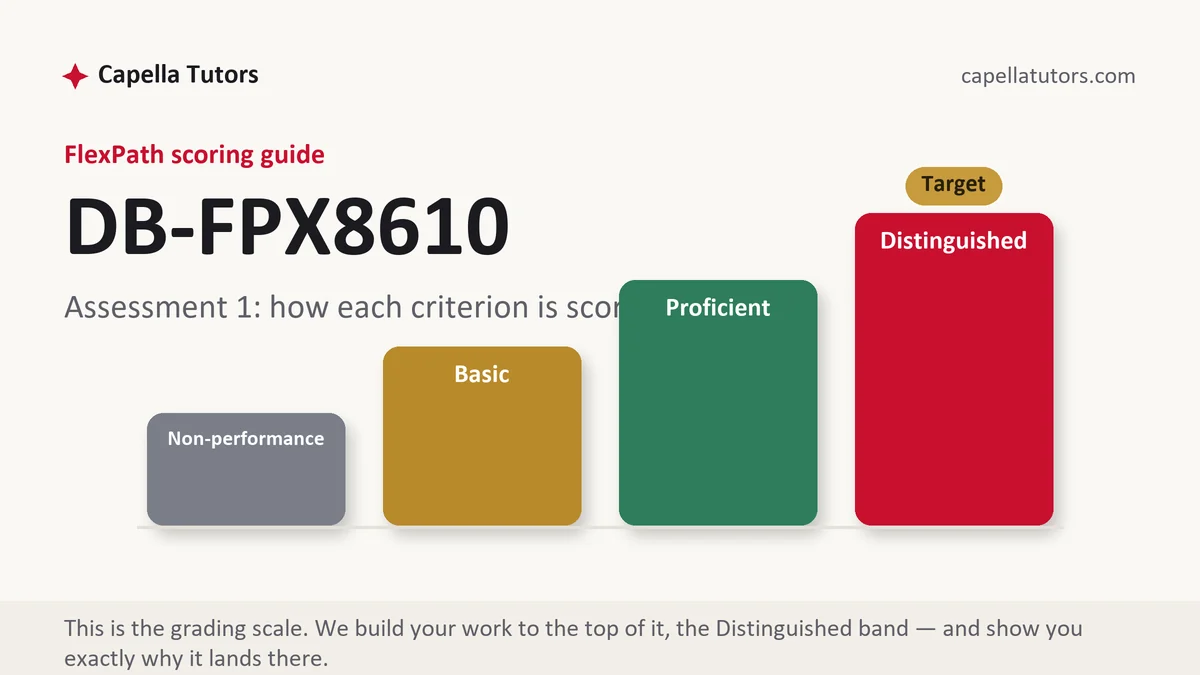
How DB FPX 8610 Assessment 1 is scored
FlexPath scores each criterion separately at one of four levels, and at doctoral level the top wording is unusually demanding:
| Level | What it means on a doctoral theory appraisal |
|---|---|
| Distinguished | Mechanisms set against each other rather than summarized in sequence, with the observation that separates them identified and the level of analysis named. |
| Proficient | Each theory stated accurately, attributed, and applied to the case. Competent, and short of the top wording. |
| Basic | Two or three theories summarized in a paragraph each, followed by a declared favorite. The register a doctoral guide is written to punish. |
| Non-performance | A required element absent, most often the evidence appraisal. An unfilled row cannot be partially credited. |
The work here is what divides a theory of leadership from a taste in leaders. No row on the guide asks which approach you find appealing. They ask what the theory asserts, who first asserted it, what has accumulated for and against it since, and the point past which the support runs out.
The DB FPX 8610 Assessment 1 method, step by step
-
Build the document out from the scoring guide, not the reading list
Every criterion becomes a heading, the Distinguished sentence sits beneath it in brackets while you draft, and nothing enters the file that does not belong under one of those headings. Anything remaining outside those headings was written for your own benefit.
-
Choose theories that disagree about your case
Two or three handled properly beat six handled at speed, because a comparison only generates analysis when the theories predict different outcomes. Where your course materials name a set, work with that set and say briefly why the ones you set aside apply less well here.
-
State the causal mechanism each theory proposes
A definition is not a mechanism. Say what the theory claims produces what, through what intervening state, and over what interval. Once two mechanisms are on the page in that form, the observation that would distinguish them usually becomes obvious, and identifying it is what the top column is describing.
-
Handle the instruments explicitly
Leadership theories arrive attached to measures, and the measures carry their own problems. Say what the instrument captures, who did the rating, against which outcome, and what the measure misses. Writing that an executive is transformational, with none of that stated, produces a practitioner essay.
-
Name the level of analysis and hold it
A dyadic construct averaged into a team score becomes a different variable and needs an argument before it can stand in for the original. Full-range models operate on individuals, work-practice bundles on units, institutional accounts on whole organizations, and sliding between them changes the subject mid-argument.
-
Translate into executive terms, then self-score
A doctoral reader wants to know what a named leader would do differently on Monday, who would notice, and what the change would cost. Then grade the document against every row yourself and plan the dates so a rework cycle still fits inside the billing session, since faculty have two business days on an attempt.
A structure that maps to the criteria
The counts below are our tutors' working plan for a deliverable of this kind and not a Capella rule, and your guide decides where the length belongs.
| Section | What it must do | Guide |
|---|---|---|
| The problem and its executive context | The organization, the decision in front of it, and the behavior at issue, with the unit of analysis named. | ~200 words |
| Theoretical frame | Each theory by name, the scholar who introduced it, and the causal path it proposes. | ~300 words |
| Evidence appraisal | The empirical tests behind each theory, their designs, samples and instruments. | ~300 words |
| The distinguishing observation | What would be seen if one mechanism operated here rather than the other, and what is seen. | ~260 words |
| Implications for practice | The behavior that changes, the person accountable for it, the price, and the point at which it pays back. | ~250 words |
| Scholarly apparatus | Founding statements at first hand, recent empirical testing, and APA reconciled in both directions. | as needed |
Annotated sample excerpt
An original model excerpt from our team, written at the register a doctoral evaluator reads for. Study the moves, then run them on the theories your own course materials name.
The two accounts propose different causal paths and therefore different observables. A dyadic exchange account claims that differentiated relationships between the supervisor and individual associates produce discretionary effort through obligation, so its prediction is within-shift variance: two associates on the same shift under the same supervisor should report different treatment and should differ correspondingly in effort.1 A transformational account claims that articulated purpose and individualized attention raise effort through identification with a collective, so its prediction is between-shift variance with within-shift convergence, because the mechanism operates on the group.2 Those predictions can be separated with data this operation already holds: overtime acceptance and voluntary shift coverage recorded by associate rather than by shift, over eight periods, with the supervisor constant. The night shift shows a within-shift standard deviation roughly twice that of the other two, which is the pattern the exchange mechanism predicts and the transformational one does not, and the appropriate doctoral claim is that the exchange account fits this unit better rather than that it is the superior theory.3
- 1States the first mechanism as a causal path with an intervening state, then derives an observable prediction from it. A prediction is what makes a theory testable in a case study.
- 2Does the same for the rival and locates the difference precisely, at the level each mechanism operates on. This is the sentence a doctoral reader is looking for.
- 3Identifies data the organization already holds, reports the pattern, and then bounds the claim to this unit rather than to the field. Calibrated confidence is what the top column pays for.
The full premium sample for your exact assessment, written fresh to your scoring guide and issue, is free to request. Study it, revise it into your own voice, and submit work you understand.
The five mistakes that cost Distinguished
- Theories summarized where they should have been contrasted. Three accounts placed end to end with nothing colliding is a walk through the reading, and the row wanted a case made.
- A founding claim cited to a textbook. The founding publication sits in the library, and passing a foundational idea through somebody's restatement signals that you have not read it.
- Levels of analysis crossed with no argument for it. A two-person construct averaged up to a team figure is no longer the same variable, and a doctoral reader sees the substitution at once.
- A construct asserted without its measure. Calling a leader transformational, with no instrument, no rating source and no outcome, is a practitioner claim.
- A recommendation carrying no price. Executives read proposals for cost, sequence and owner, and one missing all three is an opinion.
Pre-submission checklist
- Every criterion is a heading and nothing sits outside one
- Each theory carries its originating author and its causal mechanism
- An observation that would separate the mechanisms is identified
- Instrument, rating source and outcome measure are stated for each empirical claim
- The level of analysis is named and held throughout
- The recommendation carries a cost, an owner and a sequence, APA matched both ways
Doctoral leadership analysis due?
Send the prompt, the criteria and the theories your course named, plus whatever you can describe about the organization. Every framework is attributed to its source, every empirical claim carries the design that produced it, and every recommendation carries a cost. Returned inside 24 to 48 hours, with rework at no charge until every row is met.